

EC’s Automotive Simplification Package Must Not Overlook Tyres, Says Tyres Europe
- By TT News
- December 22, 2025
Tyres Europe has responded to the European Commission’s recently presented Automotive Simplification Package. While acknowledging the proposal as an initial positive step towards reducing regulatory complexity, the association identifies a significant omission: the failure to address the regulatory regime governing tyres. According to the association, tyres are a fundamental component influencing vehicle safety, energy efficiency, noise and emissions, making their inclusion in any regulatory simplification effort essential.
The association welcomes the Package’s move away from redundant laboratory testing, noting this sensible approach recognises that proliferating tests increases cost without necessarily improving environmental or safety outcomes. However, it argues this logic must be applied consistently across all vehicle components, including tyres. A specific and immediate opportunity for simplification is highlighted concerning the Implementing Act on In-Service Verification for heavy-duty vehicle emissions. The association points out that new original-equipment tyres used in this testing are already rigorously certified under separate, existing tyre legislation. The new act imposes stricter tolerances, creating a scenario where tyres fully compliant with their specific regulations could fail the in-service test. This constitutes a disproportionate double regulation that undermines legal certainty for manufacturers. The association contends that the objectives of in-service verification could be met more effectively through reinforced market surveillance instead of creating a parallel regulatory regime.
Looking forward, Tyres Europe calls for a coherent regulatory framework that properly acknowledges the tyre’s essential role. This framework should formally recognise tyres as core safety components, introduce new requirements with clarity and predictability, base decisions on reliable data and support innovation, circularity and European manufacturing. The association concludes that significant industry investment in safer and more sustainable products depends on regulatory confidence. For Europe to maintain a resilient and competitive automotive industry, tyre policy must be fully integrated into regulatory design, ensuring tyres are visible in policy discussions and recognised for their critical contribution to sustainable mobility.
Toyo Tire Shareholder Change Follows Mitsubishi Exit
- By TT News
- August 13, 2026
Toyo Tire Corporation said Mitsubishi Corporation has ceased to be a major shareholder after tendering its entire holding through a treasury share buyback, ending its status as the company’s largest shareholder.
The change took effect on 10th August , 2026, following Toyo Tire’s acquisition of its own shares through off-auction trading (ToSTNeT-3). Mitsubishi tendered all its shares, excluding less than one unit, as part of the transaction.
As a result, Mitsubishi is no longer classified as a major shareholder or associated company of Toyo Tire, the company said.
Before the transaction, Mitsubishi held 30,822,206 shares, equivalent to 20.07 percent of total voting rights, and ranked as the largest shareholder. Following the change, its holding has effectively been reduced to zero.
The move follows Toyo Tire’s earlier announcement on August 7, 2026 regarding the termination of its capital and business alliance with Mitsubishi, alongside plans to repurchase its own shares.
Toyo Tire said the change would have no impact on its consolidated financial results.
Linglong Becomes First Chinese Tyre Maker To Join GDSO As Full Member
- By TT News
- August 13, 2026
Linglong Tire has become the first Chinese tyre manufacturer to join the Global Data Service Organization (GDSO) as a full member, marking a step in the industry’s efforts to standardise and exchange tyre-related data globally.
The company joins the non-profit body as its fourteenth member. GDSO was established in January 2022 by Bridgestone, Continental, Goodyear, Michelin and Pirelli to facilitate the digital exchange of tyre data and develop common standards across the sector.
Moh Wahi, Head Of Truck And Bus Tyre Development at Linglong Europe, said: "By joining the GDSO as a Full Member and providing reliable data, we want to be the first Chinese tyre manufacturer to make a positive contribution to the further development of the tire industry and set new standards for the efficient processing of tire data in the digital age."
Riccardo Giovannotti, Secretary General of GDSO, said: "With Linglong Tire as a Full Member, GDSO is gaining one of the leading Chinese tire companies which is committed to digitalization and sustainability in the industry. Together, we will further make progress in developing standards for data processing and future-oriented solutions."
Shandong Linglong Tire Co., Ltd., founded in 1975, operates seven research and development centres globally and employs almost 20,000 people. The company runs nearly 200,000 sales outlets and exports products to 175 countries.
It supplies tyres to more than 200 production bases for over 60 automakers and has manufacturing facilities across China, Thailand and Serbia, with plans to expand further overseas.
TyreSafe And Sussex Police Launch Digital Tyre Safety Tool For Frontline Officers
- By TT News
- August 12, 2026
TyreSafe, UK’s charity dedicated to raising tyre safety awareness, has joined forces with Sussex Police’s Road Safety Team to introduce a pioneering digital reference tool for frontline officers. The initiative equips police with immediate, device-accessible tyre safety data during roadside stops.
Developed as a local pilot, the application enables consistent vehicle examinations and improves driver communication regarding tyre dangers. It offers specific checklists for diverse vehicle categories, including motorcycles, cars, heavy goods vehicles, light commercial vans and towed trailers. The system further incorporates guidance on part-worn tyres, common queries and educational talking points.
Following its Sussex trial, the programme holds potential for nationwide adoption across UK police forces. This deployment underscores Sussex Police’s dedication to roadway innovation and reinforces the essential contribution of proper tyre maintenance to overall public safety.
Stuart Lovatt, TyreSafe Chair, said, “This partnership with Sussex Police is a landmark moment for tyre safety enforcement and education. By putting reliable, accessible tyre safety guidance directly into the hands of frontline officers, we can ensure safer vehicles on our roads and help prevent avoidable collisions and breakdowns. Sussex is leading the way, and we hope this model will soon be adopted nationally.”
Superintendent Jo Grantham, Head of Roads Policing, Sussex Police, said, “Our officers are committed to keeping road users safe, and having instant access to this tyre safety resource makes a real difference on the ground. It supports enforcement while also giving us the tools to educate drivers more effectively. We’re proud to be working with TyreSafe on this project and to be the first police force in the country to pilot it.”
Towing Breakdowns Reach Record High As Vehicle Fleet Ages, Says UKTSA
- By TT News
- August 12, 2026
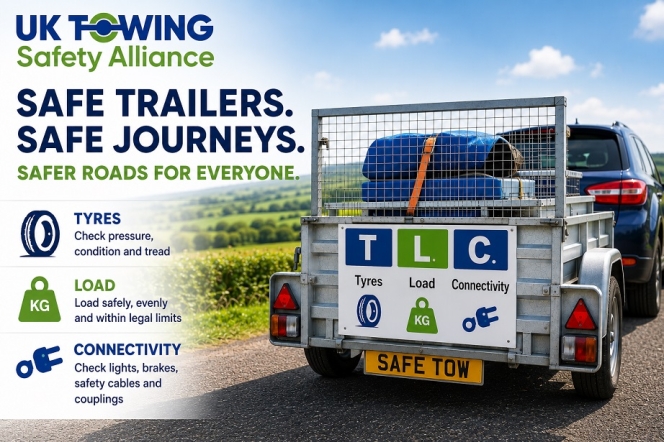
The UK Towing Safety Alliance (UKTSA) has published a comprehensive four-year analysis of incident data from National Highways’ Strategic Road Network, covering 2022 to 2025. The findings reveal a 23 percent rise in total towing-related incidents, driven primarily by a maintenance crisis affecting utility and commercial trailers. While traffic collisions involving towed vehicles decreased by 17 percent, mechanical breakdowns now constitute 77 percent of all towing-related incidents, highlighting vehicle and trailer condition as the sector's foremost challenge.
The data coincides with SMMT Motorparc 2025 figures showing Britain's vehicle fleet at its oldest recorded level, with average car age reaching 9.7 years. The summer harvest season has also arrived, bringing agricultural trailers back to roads after months of disuse. NFU Mutual research indicates collisions involving agricultural vehicles are 56 percent more likely between May and September, reinforcing the need for pre-journey roadworthiness checks.
Utility and agricultural trailers now account for nearly half of all towing-related callouts, surpassing 3,000 incidents in 2025. Regionally, the North West has overtaken the South East as the most incident-prone area, with trailer failures surging 60 percent since 2022, while the North East recorded a 55 percent increase. A growing divide exists between leisure and commercial towing sectors.
Leisure sector improvements, including fewer horsebox incidents and regional caravan reductions, suggest awareness campaigns are yielding positive results. However, utility trailer failures continue climbing, indicating maintenance standards across commercial and domestic sectors require greater attention. Regular servicing, correct loading and proper coupling remain essential to prevent avoidable incidents.
For working trailers, summer represents peak operational period, with agricultural and utility trailers seeing intensive use while rural roads become busier with tourists and cyclists. The Alliance emphasises that trailers stored for extended periods require thorough inspections before returning to service.
The UKTSA urges all towers to perform three essential checks covering tyres, load and connection before every journey. Tyres must be inspected for pressure, tread and deterioration; loads correctly distributed and couplings and electrical connections verified. The Alliance will place ‘The Working Trailer’ at the centre of safety campaigns, collaborating with industry partners to boost maintenance awareness and reduce preventable breakdowns across the Strategic Road Network.
A spokesperson for the UK Towing Safety Alliance said, “It’s encouraging to see fewer collisions involving towing vehicles, which suggests that drivers are becoming more aware of safe towing practices. However, that progress is being undermined by a growing number of preventable mechanical failures. The challenge is no longer simply about how people tow – it’s increasingly about what they’re towing and the condition it’s in. As both tow vehicles and trailers get older, regular maintenance has never been more important.”
Stuart Lovatt, Chair of TyreSafe, said, “Harvest season places extra demands on both vehicles and trailers, particularly those that may only be used for a few months each year. One of the most common issues we see is tyres that appear to have plenty of tread but have deteriorated through age, weathering or prolonged storage. Whether you’re towing a livestock trailer, plant trailer, horsebox or caravan, tyres should always be inspected for correct pressure, damage, cracking and signs of ageing before every journey. A few minutes spent carrying out these checks can prevent breakdowns and significantly improve safety for everyone using our roads.”
Sarah Smithurst MBE, COO, National Trailer & Towing Association (NTTA), said, “Across the NTTA network, we’re seeing a noticeable increase in enquiries from people looking to refurbish older trailers or source second-hand trailers, including imported models, as a more affordable alternative to buying new. While extending the life of a trailer is often entirely appropriate, it’s essential that owners understand that trailers are not maintenance-free. Many have been in service for years, sometimes decades, and components naturally deteriorate over time, even if the trailer has seen relatively little use. Every trailer should be thoroughly inspected before it returns to the road, with particular attention paid to tyres, brakes, bearings, couplings and lighting. Investing in regular servicing and maintenance is far less costly than experiencing a breakdown – or worse, being involved in an incident. The NTTA continues to help and advice new and old trailer users about safety and many are asking for help when towing, especially the reversing aspect of a trailer, now the B&E test was withdrawn. We are also seeing more trailers being repatriated from North America and Europe rather than purchasing new in the UK.”

Comments (0)
ADD COMMENT