

NATRAX: WORLD-CLASS TESTING, EVALUATION SERVICES
- By Dr N Karuppaiah
- May 05, 2021


The facility will have all types of surface to test vehicles on varying terrains and stringency. The mandate of NATRAX proving ground is to offer world-class testing and evaluation services catering for all categories of vehicles from 2 and 3 wheelers to heavy commercial vehicles. NATRAX will also emerge as a Centre of Excellence for Vehicle Dynamics catering to the design and development activities of OEMs and tyre manufacturers in the country and abroad with the capability to undertake testing and R&D projects in the area for optimization of ride and handling, chassis and suspension tuning, full vehicle characterization, modelling and simulation etc. The test tracks at NATRAX, which are meant primarily for R&D tests for automotive and auto component sector, can also be used for homologation tests. These test tracks are open air laboratories with stringent specifications and quality control to meet International standards.
 NATRiP has planned an expenditure of about INR1,300 Crores to create this world class facility. Facilities at the center include R&D Tracks (Proving Ground) for NVH, fatigue and other performance testing, vehicle dynamics lab (Center of Excellence) and powertrain lab for development tests. NATRAX will be the largest automotive proving ground in Asia and one of the largest in the world.
The facility is a boon to the tyre industry for benchmarking of performance of their tyres. It has also come in the right time when the concept of ‘Tyre Labeling’ has come into force with introduction of new standards for tyres viz., rolling resistance, wet grip and rolling noise emission parameters.
Facilities
NATRAX proving ground consists of 14 different types of test tracks viz., high speed track, dynamic platform, multi friction braking track, fatigue track, gradient track, gravel and off road track, handling track, comfort track, handling track for 2&3 wheelers, sustainability track, wet skid pad, noise track, general road along with dust tunnel, water wading trough, salted water wading trough, shower test rig etc. for comprehensive testing and evaluation, research & development and certification of vehicles.
 NATRAX also contains state-of-the-art vehicle dynamics lab and power train lab complimented by CAE Lab, instrumentation lab, client workshops and general storage building as support facilities. The vehicle dynamics lab houses one of its kind facility in the country i.e. Kinematics and Compliance (K&C) Test rig for measurement of suspension parameters and damper test rig, elastomer test rig & steering test rig for measurement of performance of components, which can be used for mathematical modelling and prediction of performance using CAE tools and improve ride and handling characteristics in automobiles. The power train Lab contains a Chassis Dynamometer coupled with Emission measurement system capable of benchmarking and testing compliance to emission norms of India, US, CARB, EPA, EURO and Japanese regulations.
Test capabilities
Tracks: Dynamic Platform : This is of 300 m diameter platform connected by 1.5 km long track of width varying from 20 m to 100 m with zero percent longitudinal slope designed with stringent evenness specifications. This is the unique facility where High speed manoeuvrability and roll over stability of vehicles can be tested to the limits on this track.
Multi Friction Braking Track: This track has four different test surfaces like basalt tiles, ceramic tiles, polished concrete and high friction asphalt to offer varying friction values from low to high values. Braking tests at 160 kmph, ABS tests with one side wheels on low friction and other side wheels on high friction surface, tyre development tests are undertaken on this track. The track has facility to wet the surfaces uniformly through water sprinklers to undertake wet braking tests. The track has also a special track on the side to test aqua planning.
Fatigue Track: This track has various torture track surfaces like pave track, pot holes, ditches, wash boards, herringbones, cobblestones, rough roads, splash road, twist road etc for accelerated endurance testing of vehicles. The track has two circuits one of low severity for testing upto cars and LCV’s and the other of high severity for testing buses and trucks.
Handling Track: This track is of 3.6 km length and 8 m width and has got serpentine curves of different radius varying from 20 m to 300 m and also with up and down gradients, reverse camber etc for testing high speed manoeuvrability / stability and road grip of vehicles on curves.
Handling Track for 2 and 3 Wheelers: There is a dedicated handling track for 2 and 3 wheelers of 1.5 km length and 5 m width with radii varying from 8 m to 20 m.

Gradient Track: The track has seven different gradients with percentage varying from 6 % to 30 % (6,8,12,18,20,24 & 30) for testing gradeability and parking brake capability of different vehicles. All the tracks except 24 and 30 % have low friction surfaces also on the sides of gradients for testing vehicles with traction control systems.
Gravel and Off-Road Track: The track is of two loops of 3.5 km length and 5 m width each, the first loop with various gravels and the other with different forest / off – road patches like cross country, village roads, mud bowls, sand patches, mounds, steps, cants, twist ditches etc to assess the mobility and durability of off-road vehicles.
Comfort Track: The comfort track contains different surfaces like smooth/rough asphalt, smooth/rough concrete, smooth/rough pave, wash boards, steps, cleats, bridge joints, village roads etc to assess the ride comfort in different road surfaces on different loads and speeds.
Sustainability Track: The sustainability track is built over a hill with uniform slope of 8 % over a length of 800 m and of 7 m width to assess the cooling performance of vehicles and also to test the effectiveness of retarders, transmission etc.
Wet Skid Pad: This track has been specially designed with combination of low and high friction surfaces of basalt tiles / asphalt combination on the circular pads with radius varying from 20 to 35 m to test wet cornering capabilities of tyres and vehicles.
Noise Track: The noise track has a unique feature with two different test patches complying with ISO 1994 and 2014 standards with acceleration and deceleration length of 350 m on both sides to be able to test the pass by noise levels of vehicles as per National/Inter-national standards.
High Speed Track: This is of oval shape and will be one of the largest in the world with total circuit length of 11.3 km and 16 m width. The straight portion of the track is of 2.1 km length and the curved section of the track is of parabolic shape designed for testing at 250 kmph on curves as though travelling on straight roads. A wide range of tests viz., high speed endurance tests, fuel consumption tests, coast down tests, noise & vibration measurements etc are undertaken on this track. The construction of this track has been completed recently.
Labs
Vehicle Dynamics Lab: There is a modern Test rig named Kinematics & Compliance (K&C) Test Rig in the Vehicle Dynamics Laboratory for testing suspension parameters of Cars and LCV’s which can be used for mathematical modelling and prediction of performance using CAE tools and improve ride and handling characteristics in automobiles. This is a unique facility in the country which the Indian automobile manufacturers have started using now before which these measurements were done abroad on their vehicles. The lab also contains component test facilities such as damper test rig, elastomer test rig and steering test rigs for performance characterization and durability assessment.
Emission Test Lab: The Power Train Lab contains a Chassis Dynamometer to simulate road loads coupled with Emission measurement system capable of benchmarking and testing of cars and LCV ‘s for compliance to emission norms of India, US, CARB, EPA, EURO and Japanese regulations.
Current status
The Vehicle Dynamics Lab and Power Train Lab along with Client Workshops for support have already been commissioned and are being used by the Industry. All 13 test tracks except the High-speed track have also been completed already and are in use by the Industry. As regards the high-speed track, the works have been completed recently and its formal inauguration is awaited. (TT)
NATRAX discusses Budget impact on auto industry
The National Automotive Test Tracks (NATRAX), one of the state-of-the-art testing and certification centres under NATRiP, and a flagship project of the Ministry of Heavy Industries, Govt of India, recently discussed the impact of India’s Union Budget 2021-22 in the country’s automotive industry. The webinar was attended by customers of NATRAX/auto industry professionals. The purpose was to make the auto industry professionals aware of the new avenues proposed in this budget for the growth of the auto industry.
The expectation from the Union Budget speech was very high, especially as Finance Minister Nirmala Sitharaman had promised to deliver a "first of its kind" and historic budget, the delegates observed.
NATRAX welcomed and appreciated the budget. There were seven presentations presented in the webinar wherein the speakers shared their knowledge on the budget pertaining to the auto industry and emphasised how NATRAX can support the requirements of testing and certification.
Dr N. Karuppaiah, Additional Director & Head, NATRAX delivered the welcome address and presented an overview of the budget focusing on six pillars- Health and Wellbeing, Physical & Financial Capital, and Infrastructure, Inclusive Development for Aspirational India, Reinvigorating Human Capital, and Minimum Government and Maximum Governance, of this budget. He also highlighted the subjects relevant to Auto Industry and outlined the plans of NATRAX orienting to the Budget as under.
Sagar Bendre, Asst. The manager (T&D) at NATRAX, presented his paper on Budget Allocation for Highway Infrastructure.The proposed investment, he said, will boost construction equipment sales and the heavy truck and tipper industry and eventually also result in better demand from the rural and wage-earning community in the country. "Highways are coming up at a rapid pace, and accordingly, the crash barriers are also being installed along the highways. To maintain quality and standard requirements, specification in the crash barrier testing will be an important contribution from NATRAX. NATRAX is now known for the crash barrier testing facility. This is a unique test facility which NATRAX has performed independently and indigenously," said Bendre.
This year’s budget has allocated INR 18,000 crore to support augmentation of bus transport services for public. Srihari SJ, Asst Manager (T&D), NATRAX, said this scheme will facilitate deployment of innovative PPP models to enable private sector players to finance, acquire, operate and maintain over 20,000 buses. “The scheme will boost automotive sector, provide fillip to economic growth, create employment opportunities for youth and enhance ease of mobility for urban residents,” said Srihari.
The emerging electric vehicles mobility paradigm is an important opportunity to foster Make–in-India for the advanced chemistry cells or EV batteries and their components, said Umesh Raghuwanshi, Asst. Manager (T&D) of NATRAX. Speaking on EV infrastructure, Raghuwanshi said, "GOI is providing modified special incentive package scheme and tax incentives that will help develop the indigenous testing and development ecosystem. Towards this NATRAX is working on the EV battery testing and development facility to work for the prospective EV makers to become self-reliant in the field of battery technology reducing the dependence on the import from China, Thailand and Japan."
"The budget outlay for the MSME sector has been doubled compared to last year. MSME dominates the auto component industry, and this will provide them with the necessary succour as the industry recovers," said Tulika Mazumdar, Sr. Engineer (P&TC) at NATRAX. He said start-ups in the automobile and allied industries can get immensely benefitted from NATRAX as the centre is equipped with state-of-the-art test tracks supplemented by the test laboratories for the components and system-level tests.
The government has also allocated INR 50,000 crore for National Research Foundation in this budget. JK Chakrabarty, Technical Advisor, said, "NATRAX, in association with prospective OEMs, will be working out projects in the areas of vehicle dynamics, Electric vehicle battery technology and vehicle testing. Suitable projects will be taken up in association with the National Research Foundation for funding. (TT)
Tegeta Green Planet Explains Producer Responsibility To Future Automotive Professionals
- By TT News
- October 08, 2026
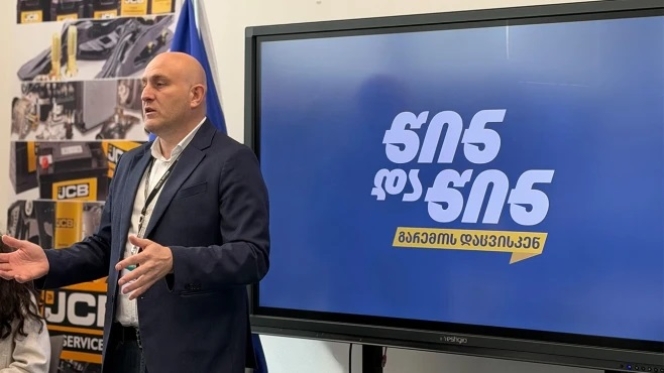
Tegeta Green Planet opened the Light Vehicle Diagnostics course at Tegeta Academy with a presentation for attendees aged 17 to 33. Beyond their chosen vocational field, participants learned about automotive waste management and environmental responsibility.
Shalva Akhvlediani, the organisation’s director, outlined its activities and goals while emphasising Extended Producer Responsibility. The session examined how the automotive sector connects to environmental duty and why used tyres, waste oils and automotive batteries must be collected and managed properly.
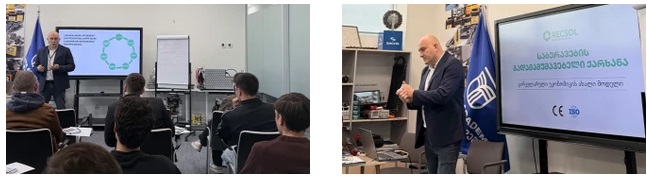
Tyre management and RECSOL featured prominently. Attendees traced a used tyre’s path from collection to recycling and learned how waste becomes a source of new resources. RECSOL, Tegeta’s tyre recycling plant, is a significant infrastructure project in used tyre recycling, processing tyres into materials for various uses and supporting circular economy principles.
A core aim is a system where waste is not an endpoint but the starting point for new resources, which requires infrastructure alongside greater public awareness and information on proper disposal. For participants, the meeting linked professional education with environmental awareness, stressing that future automotive professionals should understand this responsibility early.
Tyres Europe Joins Industry Call To Rethink CBAM Scope Extension
- By TT News
- October 08, 2026
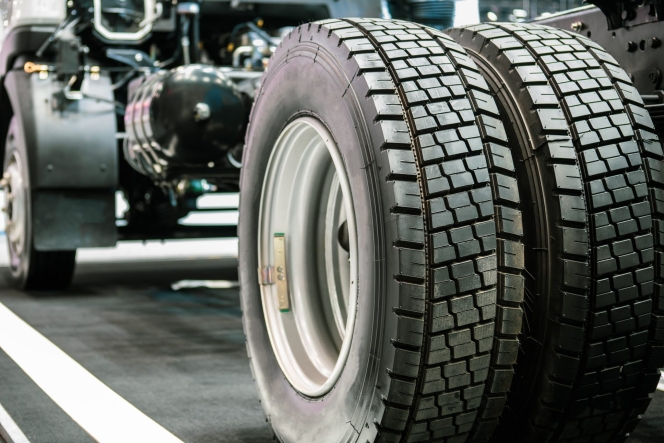
Tyres Europe, alongside ACEA (the European Automobile Manufacturers’ Association) and CLEPA (the European Association of Automotive Suppliers), has dispatched a joint communication to EU decision-makers concerning the possible broadening of the Carbon Border Adjustment Mechanism (CBAM) to cover downstream goods. The move comes as trilogue discussions approach.
Tyre producers form part of an automotive value chain already bearing carbon-related expenses for steel and aluminium manufactured within Europe. The proposed expansion would draw additional products into the mechanism’s remit before the existing framework has demonstrated its effectiveness. Resulting costs and administrative requirements would land on downstream manufacturers, tyre makers included, with signatories cautioning that a conceptually sound regulatory effort could become an operational and financial strain.
Endorsing the mechanism’s aims, the signatories nonetheless urge a proportionate scope that shields the entire value chain from carbon leakage while preventing that risk from being pushed further downstream. They advocate extending the mechanism only where a material carbon-leakage danger is evidenced, and request that policymakers ease compliance demands, including via more fitting default values mirroring real production routes.
NEXEN TIRE Renews Zalgiris Deal, Expanding Brand Visibility Across Europe
- By TT News
- October 08, 2026

NEXEN TIRE has extended its partnership with Zalgiris, reinforcing its commitment to basketball in Europe, particularly across the Baltic region. The renewal builds on a relationship that began in 2024 and reflects the company’s broader strategy of linking its brand to performance, innovation and mobility.
The tyre maker has pursued sports partnerships as a way to connect with fans, sharing in the passion and excitement of supporting favourite teams during major matches and memorable moments. It also values the teamwork, dedication and collective achievement that define team sports, using such ties to build authentic connections and deepen engagement in key European markets. Its collaboration with clubs including Zalgiris and FC Bayern München forms part of this approach.
Under the extended agreement, NEXEN TIRE will gain greater visibility among sports fans in the region. The partnership offers branding opportunities at Zalgirio Arena, such as synchronised on-screen advertising and promotion on LED stands near the court, in a position visible on television during EuroLeague and LKL home games.
The arrangement also includes a hospitality programme allowing NEXEN TIRE to welcome guests and business partners at Zalgiris home fixtures. Through the strengthened alliance, the company aims to share its passion with more fans while raising brand awareness across the region.
Ricky Lee, Managing Director, NEXEN TIRE Poland, said, “Our cooperation with Zalgiris has developed positively since 2024, and we are pleased to extend and strengthen this partnership. Basketball has a particularly strong following in the Baltic region, making Zalgiris an important partner as we continue to grow our presence and engage with fans. We look forward to supporting the team throughout the season and doing our best to create positive experiences for both the players and their passionate fans.”
Paulius Jankunas, President, Zalgiris, said, “We are delighted to continue our cooperation with NEXEN TIRE and build on the partnership we started two years ago. NEXEN TIRE brings extensive experience in sports marketing, and we are proud to work together on creating meaningful projects and experiences for our fans. We look forward to another successful period of cooperation and to welcoming NEXEN TIRE’s guests and partners to our games and events.”
TBC Corporation Expands Multi-Mile Tyres Portfolio With Four New Lines
- By TT News
- October 08, 2026

TBC Corporation, one of North America’s largest marketers of automotive replacement tyres through wholesale and franchise operations, has widened its tyre portfolio through the addition of four new lines under the Multi-Mile Tyres banner. Serving as a value step-up brand, Multi-Mile gives dealers a strong mix of broader product coverage and improved consumer advantages crafted to drive better retail margins, helping retailers offer greater value while lifting profitability. With this expansion, the portfolio now reaches over 85 percent of the vehicle market, offering dealers more ways to satisfy customer demand.
Among the additions are tyres built for rugged and mud terrain use, boasting self-cleaning treads that push out mud and stones alongside dependable traction both on and off the road. Also joining the range are commercial and C-metric speciality tyres tailored to heavy-duty regional and long-haul trucks, together with all-weather tyres that hold the 3-Peak Mountain Snowflake severe snow rating and are made for high mileage and consistent year-round use.
A prominent name in the replacement tyre segment, Multi-Mile carries cutting-edge touring, high-performance and broad-line tyres suited to passenger cars, light trucks and SUVs. Meanwhile, the upgraded Mile After Mile Protection Plan warranty now delivers broader coverage, adding three-year roadside assistance, a three-year road hazard protection plan and a 60-day ride guarantee on top of its extensive treadwear warranties.
Rachel Tibor, Chief Marketing Officer, TBC Wholesale, said, “For more than 70 years, Multi-Mile products have offered cost-efficient, reliable and durable tyre options that enhance safety and performance. With this expanded portfolio, Multi-Mile strengthens its position as a value step-up brand, giving dealers more opportunities to meet evolving consumer needs while offering a product mix designed to support stronger retail margins. We’re continuing our longstanding tradition of supplying the right products at the right time for every type of vehicle and application.”

Comments (0)
ADD COMMENT