

Yokohama Rubber H1 Profit Soars More than Double And Raises Full-Year Outlook
- By Sharad Matade
- August 11, 2026
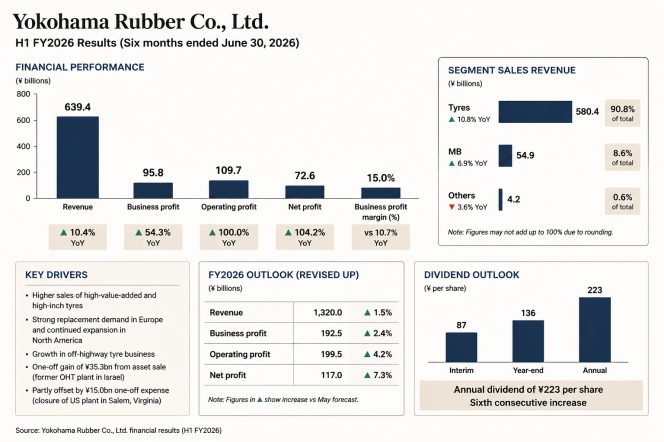
Yokohama Rubber reported record earnings for the first half of fiscal 2026, with profits more than doubling and margins reaching a historic high.
The Japanese tyre maker said sales revenue rose 10.4 percent year on year to ¥639.4 billion in the six months to June, while business profit increased 54.3 percent to ¥95.8 billion. Operating profit doubled to ¥109.7 billion, and profit attributable to owners of the parent rose 104.2 percent to ¥72.6 billion.
Business profit margin improved to 15.0 percent, compared with 10.7 percent a year earlier, marking a record level for the company.
Yokohama Rubber said the results reflected strong performance across its businesses, delivering record first-half highs in all key earnings categories.
Segment data showed that tyre sales revenue rose 10.8 percent year on year to ¥580.4 billion, accounting for 90.8 percent of total revenue, while the MB (Multiple Businesses) segment recorded revenue of ¥54.9, up 6.9 percent and contributing 8.6 percent of the total. Other businesses declined 3.6 percent to ¥4.2 billion.
Business profit growth was led by the tyre segment, where profit increased 57.3 percent to ¥89 billion. The MB segment posted profit of ¥6.3 billion, up 22.5 percent, while other businesses reported profit of ¥0.5 billion.
The company said tyre segment growth was supported by higher sales of high-value-added and high-inch tyres, as well as increased volumes in the off-highway tyre business. Replacement tyre demand strengthened across regions, with strong sales in Europe and continued expansion in North America.
Operating profit was also supported by a ¥35.3 billion gain on the sale of assets at a former off-highway tyre plant in Israel, partly offset by a one-off expense of ¥15.0 billion related to the closure of a US tyre plant in Salem, Virginia.
The company also revised upwards its full-year forecast for fiscal 2026. It now expects sales revenue of ¥1,320 billion, business profit of ¥192.5 billion, operating profit of ¥199.5 billion and profit attributable to owners of the parent of ¥117 billion.
- The Tire Industry Project
- TIP
- Dr Willie Peijnenburg
- Leiden University
- Dutch National Institute for Public Health and the Environment
- RIVM
- Dr John Spengler
- Harvard TH Chan School of Public Health
- Dr Iseult Lynch
- University of Birmingham
The Tire Industry Project Appoints Willie Peijnenburg To Its Advisory Committee
- By TT News
- October 06, 2026

The Tire Industry Project (TIP) has appointed Dr Willie Peijnenburg to its external Assurance Group (AG), an independent advisory committee that guides the organisation's research programs.
Dr Peijnenburg serves as Professor of Environmental Toxicology and Biodiversity at Leiden University in the Netherlands and works as a Senior Researcher at the Dutch National Institute for Public Health and the Environment (RIVM).
His academic work covers environmental risk assessment, ecotoxicology, predictive modelling and the behaviour of emerging contaminants in ecosystems. He joins five other independent members on the committee.
"Questions around environmental emissions, chemical safety and the sustainability of mobility systems are becoming increasingly important. I was drawn to TIP’s Assurance Group by the opportunity to contribute to conversations that have real-world relevance. I look forward to working with fellow Assurance Group members to support robust, transparent science and evidence-based decision-making." said Dr Peijnenburg.
The organisation also announced the departure of committee members Dr John Spengler of the Harvard TH Chan School of Public Health and Dr Iseult Lynch of the University of Birmingham, noting their contributions to the research oversight body.
Axens Wins Process Design Package Contract For US TPO Hydroprocessing Project
- By TT News
- October 06, 2026

Axens, a global process technology leader in refining, petrochemicals and circular economy applications, has been chosen by a US-based investor and project developer to supply a Process Design Package for a hydroprocessing unit. This unit is engineered to process 100 percent tyre pyrolysis oil (TPO), marking a significant step in alternative feedstock upgrading.
The broader project encompasses a local end-of-life tyre valorisation facility that integrates pyrolysis technology alongside the TPO-upgrading hydroprocessing unit. The operation will yield low-sulphur fuel for the domestic market, capped at a maximum sulfur content of 500 ppm. Currently in the FEED phase, the project anticipates a Final Investment Decision in 2027. Axens tailored the design package to meet specific product quality targets and site conditions, drawing on its hydroprocessing expertise and catalyst portfolio to enhance operational performance and product quality.
The developer's selection of Axens hinged on the company's extensive experience with hydroprocessing and upgrading projects involving alternative feedstocks. Axens' track record includes over 300 proven hydroprocessing references globally, covering applications such as Distillate Hydrotreating (Prime-D), Waste Lube Recycling (Revivoil) and Waste Plastic Pyrolysis Oil Hydroprocessing (Rewind Mix). The client particularly valued Axens' capacity to tackle TPO processing challenges and impurity management, alongside its proven project delivery capabilities as an experienced technology licensor.
The initiative delivers economic advantages while addressing a mounting waste management issue. By converting end-of-life tyres into valuable products, it fosters more resource-efficient value chains and supports local economic objectives through the production of transportation fuels.
Jean-Luc Nocca, Executive Vice-President Commercial Business Division, said, "This project highlights the growing interest in converting end-of-life tyres into valuable transportation fuels through robust and reliable upgrading technologies. We are proud to support our client with a tailored process design package that builds on Axens’ proven ability to address the specific challenges associated with tyre pyrolysis oil. This selection reinforces the versatility of our technologies in enabling circular economy solutions while delivering products that meet market and environmental requirements."
Wallace Instruments Sets Up West African Base To Back TSR Supply Chain
- By TT News
- October 05, 2026

Wallace Instruments has launched Wallace Instruments West Africa, a new Abidjan-based entity extending the UK materials testing equipment maker’s support for natural rubber producers across the region. The operation places servicing, calibration, spare parts and technical expertise closer to an established West African customer base that depends on Wallace instruments for plasticity, PRI and viscosity testing. The move is intended to shorten turnaround times and foster lasting local relationships.
Côte d’Ivoire, West Africa’s foremost natural rubber producer, ranks among the world’s leading exporters of technically specified rubber (TSR), supplying tyre and rubber product manufacturers globally, including the Americas. Properly maintained and calibrated instruments generate consistent, traceable results at source, strengthening confidence in shipment quality throughout the supply chain.
The Abidjan facility will feature a laboratory and training centre where customers can observe Wallace equipment in action and receive hands-on testing and technical guidance. Technicians trained by Wallace will use OEM calibration kits for fully compliant work, while customs-cleared spare parts stocks will cut lead times. An exclusive local partner will also provide servicing and calibration for other plantation and processing equipment across West Africa.
Chris Norval, Managing Director, Wallace Instruments, said, "Our aim is to bring trusted, traceable quality measurement closer to natural rubber production. Establishing Wallace Instruments West Africa helps our customers maintain reliable testing and strengthen quality control while giving the wider supply chain greater assurance in the test data. We're excited to be building our team locally and look forward to growing with the region."
Bridgestone Sounds Tyre Safety Warning As Tyre Safety Month Kicks Off
- By TT News
- October 05, 2026
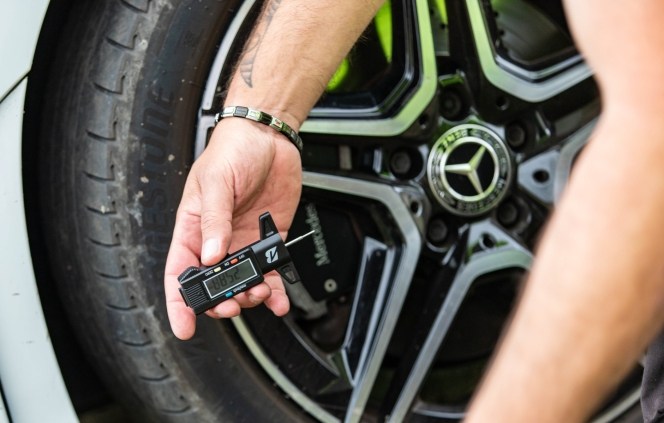
A new Bridgestone report released ahead of Tyre Safety Month 2026 reveals a troubling gap between UK motorists’ stated safety priorities and their actual tyre maintenance habits. While two-thirds of drivers rate safety as extremely important when replacing tyres, nearly half only think about their tyres once a year, and almost a third continue driving on them until an MOT failure forces action.
The manufacturer’s survey of 2,000 motorists found that 47 percent check their tyres only when an MOT is due, while 31 percent wait until being told their car will fail. One in five drivers admits to buying potentially deadly part-worn products despite being warned of the risks. Three in five motorists never check their tyres at all, even though 87 percent claim to know how to do so.
These findings arrive alongside TyreSafe estimates that 6.1 million tyres on UK roads are illegal or dangerously worn at any given time, typically because tread depth falls below the 1.6 mm legal limit. Department for Transport figures show that people killed or seriously injured in collisions involving illegal, defective or underinflated tyres rose from 169 in 2024 to 201 in 2025.
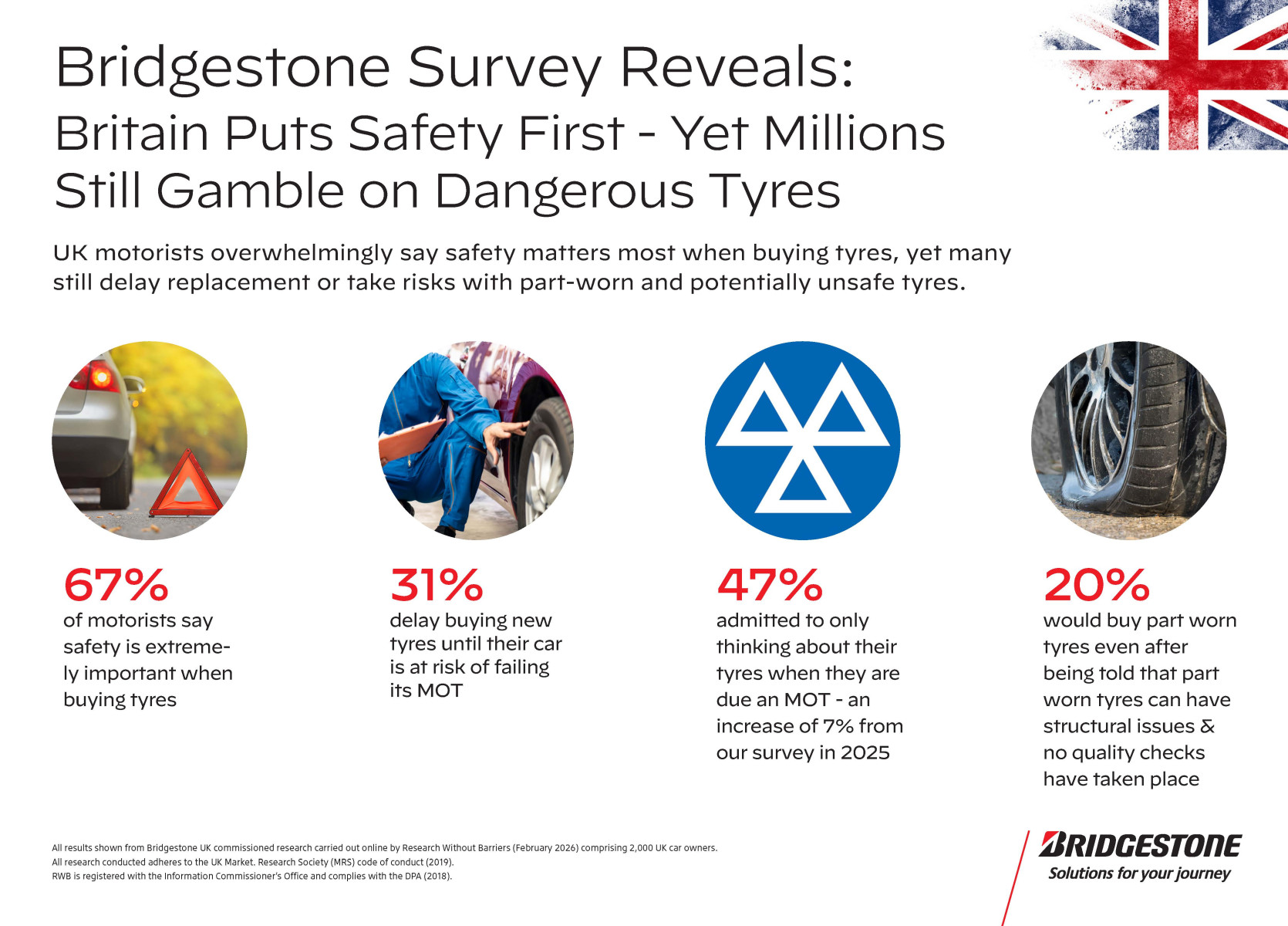
Bridgestone has conducted thousands of complimentary tyre checks across the UK over the past year and runs its Be a Bridgestone Road Safety Hero campaign, which offers drivers practical guidance on tread depth, pressure and tyre condition. The company also advocates mandatory tyre replacement as a penalty for driving on illegal tyres, a stance supported by 30 percent of survey respondents.
Helen Roe, Senior Manager for Brand, Events, Product and Digital Marketing, described the research as a timely reminder of the need to educate motorists. She noted that while drivers recognise tyre safety as the most important purchase factor, life-saving checks still are not happening, possibly because tyres remain an afterthought or because drivers lack confidence in performing them. She emphasised that tyres are the only contact points with the road and that part-worn products carry unknown histories and potential damage.
Bridgestone urges drivers to check pressures monthly when tyres are cold, inspect surfaces for lumps, bulges, cuts and cracks and verify tread depth exceeds 1.6 mm using a gauge or the 20p test. Motorists uncertain about their tyres should seek a qualified professional, with many garages offering free checks. The company says its community campaigns, educational resources and retailer partnerships aim to make correct safety decisions easier and to highlight how essential well-maintained tyres are to preventing accidents and saving lives.

Comments (0)
ADD COMMENT