BKT Expands CVR Distribution With Indore Warehouse

BKT Expands CVR Distribution With Indore Warehouse

Balkrishna Industries Ltd. (BKT) has expanded its commercial vehicle tyre distribution network in central India with the opening of a warehouse in Indore, as it seeks to build its presence in the commercial vehicle radial (CVR) segment.

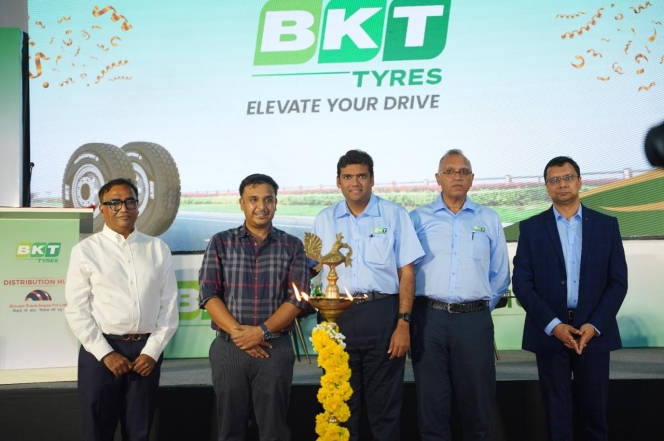
The facility, inaugurated recently, is intended to strengthen product availability and improve regional access in Madhya Pradesh, a state the company identifies as a key growth market.

Indore’s position as a freight and passenger transport hub, coupled with its proximity to the Pithampur industrial belt, underpins the company’s decision to locate the warehouse in the city. The facility will be operated by authorised distributor Shivam Track Impex Pvt. Ltd., supporting closer engagement with dealers, transporters and fleet operators.

The inauguration was attended by senior executives including Rajiv Poddar, Joint Managing Director, Satish Sharma, Senior President and Director of Business Development and Strategy, and Amitkumar Agarwal, National Sales Head for Commercial Vehicle Radial Tyres. Representatives from the regional transport sector were also present.

Agarwal said: “Madhya Pradesh represents an important opportunity for BKT as we build our presence in India’s Commercial Vehicle Radial segment. The expansion in the state reflects our confidence in the opportunity and our commitment to building the right ecosystem, in partnership with our authorised distributors to serve customers effectively. Indore provides a strategic base for us to strengthen our market access and engage more closely with fleet operators and channel partners.

“The new warehouse is an important part of this approach, as it will help us improve product availability and create greater responsiveness across the market. We want to build long-term relationships with transporters, fleet owners and our channel partners and as we expand our CVR business in Madhya Pradesh, our objective is to create sustainable value for the entire ecosystem and grow together with our partners.”

The move follows the launch of the company’s commercial vehicle tyre portfolio in the first quarter of the 2026–27 financial year, including the BKT m.Loadxpert (11.00R20) and BKT Milexpert RG (295/90R20). BKT said it is seeing early traction and is focusing on expanding its reach across key markets through its distribution network.

Magna Tyres Group Names Arnold van Woerkum CFO Amid Acquisition Drive

Magna Tyres Group Names Arnold van Woerkum CFO Amid Acquisition Drive

Magna Tyres Group has bolstered its executive team with the appointment of Arnold van Woerkum to the position of Chief Financial Officer. This strategic appointment is designed to reinforce the company’s leadership structure as it gears up for an aggressive phase of international expansion and pursues new acquisition opportunities on the horizon.

Van Woerkum initially joined the organisation in 2025, taking on a senior financial leadership role prior to this official elevation. He arrives with considerable industry experience, having previously dedicated over a decade to the Van Mossel Automotive Group in a corporate control capacity. His ascent to CFO coincides with a pivotal moment for the tyre manufacturer, which, following its recent integration of Forrez, is projecting a turnover of roughly EUR 275 million for 2026. The firm has laid out an ambitious long-term strategy, targeting a significant increase to EUR 650 million in annual revenue by 2029.

In his new capacity, Van Woerkum is tasked with fortifying the financial infrastructure and guiding critical strategic choices, especially concerning fiscal oversight and future mergers. To support this trajectory, the company is actively recruiting for several new finance roles within his department, creating opportunities for professionals eager to contribute to the next wave of global growth.

Michael de Ruijter, President, Magna Tyres Group, said, “Our ambitions require a strong financial organisation. We want to continue growing internationally, both organically and through acquisitions. Arnold brings more than 10 years of group finance experience and already knows Magna Tyres and our organisation well. His appointment as CFO is an important step in preparing the company for its next phase of growth.”

Van Woerkum said, “Magna Tyres has clear international growth ambitions. After a year within the company, I am excited to take on this role and contribute to that next phase. My focus will be on building the financial structure needed to support sustainable growth and future acquisitions.”

We Remain Optimistic On OE And Replacement Demand To Witness Steady Growth: Arun Mammen

Arun Mammen

The Indian tyre industry continues to demonstrate robust momentum, underpinned by strong automotive demand, significant capacity expansions and a growing global footprint. In an exclusive interview with Tyre Trends, Arun Mammen, Chairman, Automotive Tyre Manufacturers’ Association (ATMA) and Vice-Chairman & MD, MRF, discusses the current landscape, raw material dynamics, replacement market trends and the outlook for the sector over the next few years.

How do you assess the current situation in the Indian tyre industry?

The Indian tyre industry has maintained consistent growth over the years and has now reached a market size of approximately INR 1,100 billion. It is expanding at a healthy 10–12 percent year-on-year, which represents a significant and sustainable pace for a mature sector.

In the last few years, the industry has invested over INR 270 billion in capacity augmentation, strengthening its ability to meet both domestic and international demand. Exports have also emerged as a key pillar, with the sector shipping tyres worth nearly INR 250 billion annually to over 170 countries worldwide. Having evolved over the past 70 years, the Indian tyre industry is now well-positioned for phenomenal long-term growth.

What is your view on Indian automotive sales growing at a record pace?

Original Equipment Manufacturers (OEMs) across segments are performing exceptionally well. Whether it is tractors, two-wheelers or passenger vehicles, strong sales momentum is clearly visible. When OEMs thrive, the tyre industry naturally benefits through higher OE fitments. We expect this positive trend to continue, driving further expansion in both the automotive and tyre sectors in the coming years.

What is the situation on the supply of raw materials, especially natural rubber? Is that something to watch out for in the coming months?

India currently produces only about 60 percent of the natural rubber required by its tyre industry, with the remaining 40 percent met through imports. As domestic demand grows, the volume of imported natural rubber is expected to rise further, potentially creating supply tightness.

To address this strategic vulnerability, a consortium of four major Indian tyre manufacturers has invested over INR 10 billion in rubber plantations in Northeast India over the last four to five years. While these plantations will take additional years to reach full production, they represent a meaningful step towards improving domestic supply security. Though it will not fully resolve the gap, this initiative will certainly help mitigate future shortages.

Replacement demand is also giving a significant boost to overall volumes. How do you see this evolving?

Absolutely. Strong OE sales today lay the foundation for healthy replacement demand in the future as vehicles age and enter the aftermarket. We remain optimistic that both OE and replacement segments will experience steady growth, providing a balanced and resilient demand base for the tyre industry.

Looking ahead to the next three to five years, what will be the key challenges and opportunities for the Indian tyre industry?

Like any dynamic industry, challenges will persist. Geopolitical developments, such as the ongoing Middle East crisis, have already led to rising raw material costs, elevated logistics expenses and higher shipping rates. These external pressures are part of the business cycle and will continue to test industry resilience.

Yokohama Rubber Eyes Mexico As Gateway For Americas

Yokohama Mexico

Yokohama Rubber Company’s decision to establish Mexico as the manufacturing hub for its Americas OTR operations signals more than a capacity expansion. It reflects a strategic overhaul of its global industrial footprint. As geopolitical uncertainties, tariff risks and supply-chain disruptions reshape manufacturing priorities, the company’s ‘local for local’ model seeks to position production closer to customers while strengthening resilience. The move also underlines its broader ambition to emerge as the world’s second-largest supplier of specialised mining and construction tyres.

Yokomaha Rubber Company is seeing Mexico as its gateway for Americas, especially its OTR tyre business. Mexico will serve as the production hub for Yokohama and Goodyear Off-the-Road branded products under its ‘local for local’ manufacturing strategy.

Yokohama Rubber will invest USD 115 million to build a mining and construction machinery tyre plant in Mexico as part of the second phase of expansion at its site, where a passenger car tyre plant is already under construction. The brownfield facility will have an annual production capacity of 10,650 tonnes (rubber weight), with construction due to begin in the third quarter of 2026 and production expected to start in the second quarter of 2028.

The company is also establishing a greenfield OTR tyre plant in Odisha, India, with an annual production capacity of 9,150 tonnes and a planned investment of USD 130 million. Production at the Indian facility is scheduled to begin in the third quarter of 2028.

The facility will supply OTR tyres across North and South America, complementing plants in Romania, India, Japan and the Czech Republic, while maintaining global quality standards supported by research and development centres in Japan and US.

Speaking to Tyre Trends¸ Yokohama OTR President Loic Ravasio said, “Mexico becomes the anchor of our Americas production, part of a broader move towards a ‘local for local’ model in which we manufacture OTR tyres in every major region, closer to the customers who use them. It joins a growing worldwide footprint that already includes Romania, India, Japan and the Czech Republic – every site held to the same quality benchmark backed by our research and development centres in Japan and US. For manufacturing specifically, Mexico’s role is to serve North and South America from one central site, putting product closer to mining, construction and infrastructure customers throughout the Americas.”

The plants in India and Mexico are sized and positioned for the regions they serve. These new facilities are part of the company’s transition from Goodyear-operated production to Yokohama-owned sites while also growing its total worldwide OTR capacity. Japan remains one of the company’s core production sites throughout, added Ravasio.

“Mexico’s plant and India’s greenfield plant will more than replace Goodyear plants capacity, allowing us to continue supplying our existing customers, supporting their growth, and also winning new customers with the additional capacity,” he added.

As for production responsibilities, the company’s goal is to produce tyres closest to the customers that need them. OTR plants are flexible and able to adapt to regional needs. “We’re not locking in specifics yet. We want to listen to customers and show them what the combined portfolio can do first and let that shape where things get built,” Ravasio said.

The Mexico manufacturing facility is being developed in Saltillo, Coahuila. Its centralised location for production and distribution across the entire Americas region will allow Yokohama to produce OTR tyres closer to its customers, shortening the lead time and improving responsiveness to customer requests.

“We’re building the Saltillo site to be state-of-the-art from day one including the technology and quality standards because we’re not planning only for today’s market, we’re planning for where our customers and this industry are heading,” said Ravasio.

MARKET ADVANTAGES

The acquisition of Goodyear’s OTR business has created optimum synergies for Yokohama Rubber Company as it is now leveraging the strengths of two complementary product portfolios, which lets it offer one of the most complete product ranges available and better meet the needs of its customers.

“Manufacturing, logistics, research and development synergies have all played their part, bringing procurement, production planning and engineering together from both organisations rather than running them in parallel. Together, that’s meant retaining the great majority of longstanding accounts from both sides and winning new customers we hadn’t worked with before,” said Ravasio.

He added, “What’s really exceeded our initial expectations is the pace. We said we wanted to move quickly on capacity and within about a year of closing we’d already committed to three new or expanded plants across three continents. The two research and development centres working together have increased our capabilities to launch quicker new products and new technologies into the market. That pace shows real commitment to the OTR industry.”

Commenting on the advantages that Mexico offers the business, he noted that Mexico has a skilled, experienced manufacturing workforce and an established industrial supplier base. Its real advantage is geography as a single site here can efficiently reach customers across North America, Central America and South America, which is central to the company’s local-for-local approach.

Yokohama Rubber Company is also able to build on existing local relationships in the country, giving it a head start on talent and operational know-how as it brings the OTR plant online.

GROWTH DRIVERS

According to Ravasio, global infrastructure development in roads, rail and housing along with continued mining and construction activity continues to drive demand for OTR tyres across the Americas.

Mexico’s centralised location allows for shorter supply lines and tyres built closer to the mines and job sites that use them rather than shipped across oceans, which means less equipment downtime waiting on tyres.

“In a market where total cost of ownership (TCO) and not just tyre price drives the buying decision, minimising that downtime is one of the ways we compete,” he noted.

The Mexico plant is designed first and foremost to serve regional demand across the Americas. Nonetheless, the company’s global network is built for flexibility and the plant’s output can support other markets as needed to balance capacity across our worldwide footprint, said Ravasio.

The primary beneficiaries will be mining and construction operators across the Americas along with the infrastructure projects that depend on them. Yokohama Rubber Company’s priority is to better serve its customers, global or local, and to ensure business continuity.

Moreover, as competition toughens in the global OTR market, Yokohama Rubber Company seeks to secure the second spot in the list of world’s largest suppliers. Alluding to this, Ravasio said, “Our ambition is clear. We want to become the world’s second-largest supplier of specialised mining and construction tyres and the right manufacturing footprint is one part of how we get there alongside the same high-quality standards we’re building into every new site including Mexico.”

“Product quality and performance matter just as much and our research and development centres in Japan and US design tyres built specifically for this segment backed by services like tyre pressure management systems TPMS and EMTrack that give customers real-time visibility into tyre health and performance,” he added.

The target behind all of it is straightforward, which is to lower Yokohama customers’ TCO and help them run more competitive operations. Total cost of ownership matters more to OTR customers than any other measure and Yokohama Rubber Company is building everything including research and development, service tools and manufacturing around living up to its TCO leadership position in the market.

FIGHTING CHALLENGES

The plant is being built around modern, energy- and water-efficient lines with the digital process controls needed to hold consistent quality at scale. Producing closer to its customers also means less long-distance transportation of finished tyres and fewer transport-related emissions as a result.

Workforce training will be built around Yokohama Rubber Company’s current manufacturing standards and the plant’s operations will be measured against the environmental targets in its medium-term management plan.

Furthermore, this project is as much about people as it is about capacity. The company is leaning on local expertise and know-how in the region to build the Mexico manufacturing team paired with quality training grounded in its manufacturing experience from other parts of the world.

Hence, the site benefits from both perspectives from day one and creates meaningful skilled employment, directly at the plant and through the broader supplier network around it.

“It’s the same approach we’ve used successfully as we’ve expanded elsewhere. We invest in local talent, train heavily and hold everyone to the same standards we apply globally. Wherever we build, the people on the floor get the same training and hold the same standards as any other Yokohama site. That’s non-negotiable,” Ravasio said.

Alluding to tackling supply chain setbacks, the executive noted that producing closer to the customer is the clearest way to build resilience too as it reduces the company’s exposure to long cross-continental shipping routes and the risks that come with them, plus it helps mitigate the impacts of tariffs.

“Our plant in Mexico makes our overall industrial footprint stronger, which is what helps us weather supply-side setbacks rather than depending on any single site or transit lane. It also lets us react faster to swings in product trends and other unforeseen events because the people and the production capacity making that call are closer to where the need actually is. That kind of diversified, local-for-local footprint is deliberately designed to avoid the kind of supply shocks the industry has seen in recent years,” he added. And over the next five years, Mexico becomes one of the clearest proof points for the company’s local-for-local approach. “We expect continued growth from infrastructure and mining activity and customers pushing equipment harder, which raises the bar for durability and service as much as tyre technology. Regional manufacturing, closer partnerships with customers and the network we’ve built over the past year are how we intend to become the world’s second-largest supplier in the OTR industry,” Ravasio said.

Mexico’s emergence as the company’s Americas manufacturing hub represents a calculated investment in regionalisation rather than simple capacity addition. Whether this strategy translates into sustained market share gains will depend on execution, customer adoption and competitive pressures, but it firmly positions the company to respond faster to an increasingly demanding global OTR market.

Mexico’s Rise As Bridgestone’s Strategic Hub

Bridgestone Mexico

The Country Manager of Bridgestone Mexico on regional strategy, the Cuernavaca plant, the rise of retreading and why the future belongs to companies that evolve with their customers.

Mexico has spent the past decade transforming itself from a low-cost manufacturing base into something far more strategic within North America’s automotive supply chain. Few executives are better placed to explain that shift than Alexandre Lopes Araujo, Country Manager of Bridgestone Mexico, who believes the country is living through one of the most significant moments in its automotive history, recognised today not only for its manufacturing strength but for the strategic role it plays in the wider development of the North American industry.

For Bridgestone, he says, that shift represents ‘a tremendous opportunity’. Araujo is careful to frame the company’s ambitions in broader terms than production volumes alone: Bridgestone’s goal, he explains, is not simply to manufacture tyres but to act as a strategic partner to OEMs, fleet operators and the replacement market, helping customers navigate an industry evolving at unprecedented speed.

Customer expectations, in his view, have shifted considerably. The market now demands products that deliver strong performance, safety and efficiency while also offering solutions that help optimise operations – which is why Bridgestone continues to strengthen its manufacturing capabilities and draw on the group’s global expertise to meet those evolving needs. He also points to the regionalisation of supply chains as a further tailwind, arguing it presents an opportunity to strengthen North America’s competitiveness and respond more quickly to market demands. “I am convinced that Mexico will continue to play an increasingly important role within this ecosystem, and at Bridgestone we are committed to contributing to that evolution through technology, talent and a long-term vision,” says Araujo.

FROM FACTORY FLOOR TO STRATEGIC HUB

What sets Mexico apart, Araujo argues, is not manufacturing capability alone. The expertise built up over decades and its proximity to North America’s key markets allow the tyre major to respond quickly to customer needs while working closely with OEMs, distributors and business partners throughout the region. For Araujo, this reflects a broader shift in how success is defined across the industry. “Success today is no longer defined solely by building a great product. It also depends on understanding where the industry is heading and having the ability to evolve alongside it,” explains Araujo.

His outlook for the country remains firmly upbeat. Araujo describes Mexico as having a solid industrial base, a strategic location and, above all, talented people with an extraordinary ability to adapt to an ever-changing environment – strengths he believes position the country for continued growth in the years ahead.

FORTY-FIVE YEARS AT CUERNAVACA

Araujo is quick to underline the continued significance of Bridgestone’s Cuernavaca plant, which has anchored the company’s Mexican operations for more than four decades and, in his words, “continues to play a strategic role within our regional operations.”

Competitiveness, the Bridgestone executive says, is about more than technology and infrastructure alone – it also depends on the ability to respond quickly to a constantly evolving market. Accordingly, the focus at Cuernavaca has been on continuously strengthening productivity, quality, operational flexibility and sustainability, ensuring the plant remains competitive and resilient within Bridgestone’s global manufacturing network. Rather than preparing for any single anticipated market shift, Araujo says, “the company is building an agile, efficient operation ready to meet the future needs of both the industry and its customers.”

DEEPER TIES WITH OEMs

Bridgestone’s relationship with vehicle manufacturers has evolved substantially, Araujo says. It is no longer simply a matter of developing a tyre that meets specific technical requirements; the company now collaborates with manufacturers from the earliest stages of development to better understand each vehicle’s needs and the driving experience they want to deliver to consumers. “Electrification, connectivity and higher performance standards are reshaping the industry, prompting increasingly specialised solutions and deeper collaboration with OEM partners worldwide,” adds Araujo.


He also identifies a shift in how customers weigh up value, with decisions now driven more by total cost of ownership and lifecycle value than by initial purchase price – a perspective that, Araujo says, shapes how Bridgestone develops products and works alongside manufacturers. According to Araujo, close collaboration with OEMs allows the company to anticipate industry trends and translate those insights into better products, something he regards as one of the key factors behind Bridgestone’s global leadership in technology, quality and performance.

COMMERCIAL FLEETS AND THE RISE OF RETREADING

As per Araujo, the commercial vehicle segment is highly strategic for Bridgestone given its close links to the growth of logistics, transportation and distribution. Behind every fleet are businesses looking to operate more efficiently, reduce costs and keep vehicles on the road – and purchasing decisions have shifted accordingly, moving beyond simple tyre quality to encompass total cost of ownership, cost per kilometre and overall operational efficiency.

Within that shift, Araujo singles out tyre retreading as one of the clearest examples of the circular economy in the industry, extending tyre life while maximising operational efficiency without compromising safety or performance. “This evolution is pushing Bridgestone to go beyond the product itself, offering an integrated value proposition that combines high-performance tyres with services designed to improve fleet productivity,” says Araujo.

Bandag, Bridgestone’s retreading business, sits at the heart of that strategy. “Through Bandag, this approach becomes a strategic solution with an even greater impact,” Araujo says. Sustainability, in his view, is no longer a standalone concept but a business imperative: fleet operators want to reduce their environmental footprint while also optimising costs, maximising resource utilisation and improving profitability, which is precisely where Araujo believes Bandag delivers meaningful value. He frames the approach as part of a lifecycle-wide sustainability commitment, one fully aligned with Bridgestone’s E8 Commitment and its aim of helping customers strengthen their competitiveness while contributing to a more efficient, sustainable transportation industry.

NAVIGATING A VOLATILE SUPPLY CHAIN

Global tyre makers are contending with volatile raw material costs and shifting trade policy. Araujo says the past few years have taught the industry that resilience is just as important as efficiency. Today’s supply chains must be agile enough to adapt to fluctuating raw material costs and an increasingly dynamic global trade environment, says Araujo.

Against that backdrop, Bridgestone is focused on building a flexible operation closely connected to local market needs. The growing regionalisation of supply chains presents an important opportunity to strengthen North America’s competitiveness, with Mexico playing a strategic role by enabling faster, more responsive service to the market. Data-driven decision-making and digital tools have become key competitive differentiators, improving visibility

across the value chain and helping the company anticipate customer needs. As he puts it, the objective is “not simply to respond to market changes but to build a resilient organisation capable of evolving sustainably alongside the industry and our customers.”

DEFENDING A PREMIUM POSITION

Price sensitivity remains a fact of life in the tyre market, but Araujo is firm that Bridgestone’s premium positioning rests on more than the sticker price. Price, he acknowledges, will always be an important part of the purchasing decision – but looking at the conversation solely from that angle tells only part of the story. Araujo adds that what truly matters is the value a tyre delivers across its entire lifecycle: customers who choose Bridgestone are investing in technology, safety, durability and long-term performance, attributes that translate into a lower cost per kilometre and a lower total cost of ownership, particularly for commercial fleets.

“Being a premium brand is not about having the highest price. It is about delivering the highest return on investment through high-quality products and value-added solutions,” Araujo says. That commitment, he believes, is what allows Bridgestone to build long-term trust with customers and sustain its position as a premium brand in an increasingly competitive market.

FROM REACTIVE TO PREDICTIVE

Digital technology is reshaping fleet management, and Araujo sees Bridgestone moving from a reactive posture to a predictive one. Technology, he says, now allows the company to anticipate issues, optimise resources and make data-based decisions in ways that were unimaginable only a few years ago. For fleet operators in particular, Araujo believes this represents a significant transformation – it is no longer just about having a high-performance tyre but about having access to insights that improve vehicle availability, optimise maintenance and reduce total cost of ownership.

Araujo describes digitalisation as a natural extension of Bridgestone’s core products rather than a separate line of business, with connected solutions and data analytics helping the company deliver actionable insights that improve operational performance. Looking ahead, Araujo expects data-driven decision-making to become one of the industry’s greatest competitive advantages. “The true value of technology is not simply collecting data but turning that information into actions that make operations safer, more efficient and more profitable,” Araujo says. That trajectory mirrors the company’s own evolution from tyre manufacturer to strategic partner combining premium products with innovative solutions, he adds.

SUSTAINABILITY AS A DAILY DISCIPLINE

Bridgestone has promoted its E8 Commitment globally, and Araujo says the framework shapes priorities at the local level in Mexico too. Sustainability, in his view, is often narrowly associated with reducing environmental impact, when in fact it represents something much broader – making better decisions every day that create value for customers, employees, the communities in which the company operates and the environment. Araujo explains, “The E8 Commitment serves as the foundation for that approach, guiding efforts to strengthen product safety and quality, develop people and continuously improve operations and manufacturing processes.”

It also shapes how Bridgestone collaborates with customers, he says, whether through higher-performing products, expanded solutions such as tyre retreading or new technologies – the underlying objective being to help customers operate more efficiently while creating value across the entire tyre lifecycle. Ultimately, the E8 Commitment is a reminder that sustainable business growth must go hand in hand with creating a positive impact, a balance he sees as central to what Bridgestone Mexico continues to build.

THE NEXT FIVE YEARS

Asked to look further ahead, Araujo believes the industry is entering an entirely new chapter – one in which the challenge is no longer simply building better vehicles and tyres but building a more competitive, integrated industry capable of responding quickly to an ever-changing marketplace. He sees Mexico as unusually well positioned to capitalise on that shift, citing the country’s strong manufacturing base, highly skilled talent and strategic position within the region as the growing regionalisation of supply chains continues to strengthen North America’s competitiveness.

“For Bridgestone Mexico itself, the priorities ahead are threefold: strengthening the competitiveness of operations, accelerating customer-centric solutions and advancing sustainability initiatives that create value throughout the tyre lifecycle. More than anything, the company wants to anticipate market trends and help customers navigate the challenges they will face in the years ahead,” Araujo adds.

Pressed to sum up his vision in a single sentence, Araujo offers a line that captures his broader philosophy: “The future will not belong only to the companies that build the best products but to those that best understand their customers and evolve alongside them.” That, he says, is the kind of company Bridgestone Mexico is committed to building – one defined less by the products it makes today than by how quickly it can adapt, innovate and deliver meaningful results for the customers who place their trust in it. As Araujo puts it, that is the challenge that excites him most, and the one that will define the company’s success in the years to come.