

Competitive Aggression
- By Gaurav Nandi
- October 15, 2026
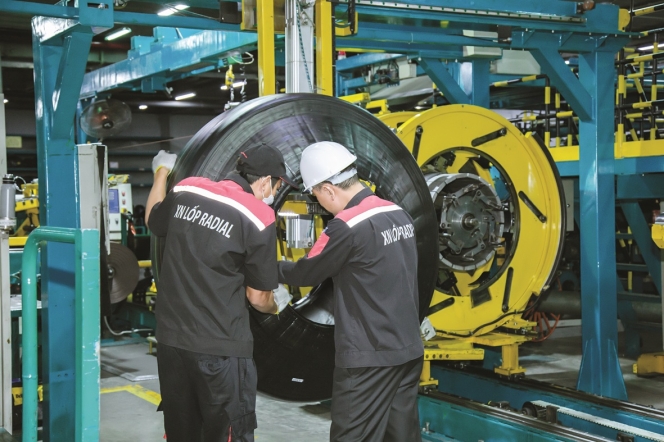
Vietnam’s growing role as a global tyre manufacturing base is creating new opportunities for domestic producers, but breaking into established international markets remains difficult. Da Nang Rubber Joint Stock Company is expanding exports and production capacity while confronting larger Chinese rivals on price and established global manufacturers on technology, distribution and brand strength. General Director Le Hoang Khanh Nhut tells Tyre Trends that competing globally will require Vietnamese manufacturers to move beyond cost advantages and demonstrate quality, operating efficiency and long-term customer value.
Southeast Asian tyre manufacturers have evolved as an aggressive competitor in the global tyre race. Tyre makers from China, Vietnam, India, Thailand etc. are constantly competing for a share of the bigger pie. While one nations tyre manufacturer competes on price advantage, another competes on quality.
The tyre manufacturing scene in Vietnam resonates quality and pricing in the global stage. But that is not the end of the story. On one hand, many manufacturers from other countries are leveraging the strategical importance of Vietnam for pushing products into international markets.
And on the other hand, trade tariffs and anti-dumping duties are creating hurdles for such companies. “Trade defence measures, anti-dumping actions, rules of origin and tariff changes have become ongoing factors in export management,” said Da Nang Rubber Joint Stock Company (DRC) General Director Le Hoang Khanh Nhut during an exclusive interaction with Tyre Trends magazine.
He confidently stated that DRC closely monitors each market to select appropriate products, pricing structures, distribution partners and production plans while ensuring that origin documentation, technical compliance and trade compliance are properly standardised.
“Trade barriers can increase costs and risks, but they can also create opportunities when customers seek to diversify their supply sources beyond a single country. The pre-requisite is that Vietnamese companies maintain transparency regarding origin, control their supply chains and retain genuine competitiveness,” he quipped.
Explaining the current situation within the country’s broader market economics, a confident Nhut averred that Vietnam’s expanding infrastructure, logistics network and export connectivity are creating favourable conditions for tyre manufacturers operating in the country.
He added that the country was investing heavily in highways, transportation and logistics infrastructure. That development is supporting both domestic demand and the country’s ambitions to become a manufacturing and distribution hub for global markets.
For DRC, the expansion of Vietnamese tyre manufacturers into global markets will depend less on competing solely on price and more on leveraging manufacturing experience and product quality.
Asked how Vietnamese manufacturers could compete with Chinese tyre makers, which often operate with larger research and development budgets, Nhut said, “The strategy is to focus on experience and quality rather than entering a price-led competition. We don’t follow the price competitively like Chinese companies.”
STRATEGIC PLACEMENT
International markets, especially Europe and America, are crucial to Vietnamese tyre manufacturers including DRC. The company states that the US is an established and important export market.
In April 2024, DRC signed an export agreement with Oceanside One Trading covering Brazil and the US with the stated aim of increasing exports to those markets.
Europe is strategically important but not one of its mature core markets yet. The company’s 2024 annual report explicitly states that it aims to increase its market share in Europe.
Nonetheless, the local market assumes a similar importance for the company. “The domestic market remains a strategic foundation for us. It is where the brand has been built over several decades. We have an extensive distribution network here and the market helps us maintain a balanced production volume,” said Nhut.
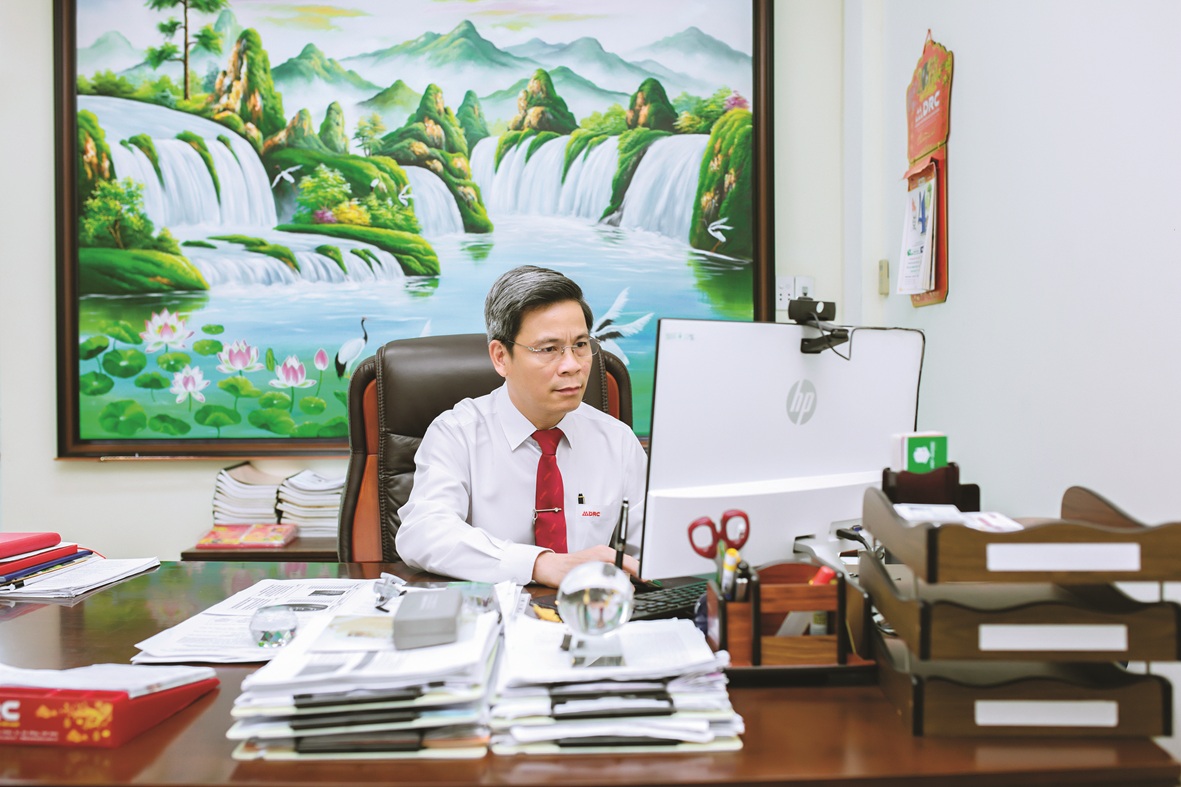 Le Hoang Khanh Nhut, General Director, Da Nang Rubber Joint Stock Company (DRC)
However, the challenges include periods of weaker purchasing power, strong competition from imported products and FDI-based companies and pricing pressure. “Unlike many export markets, Vietnam has a fragmented distribution structure; customers are price-sensitive but also place strong importance on durability, product availability and warranty response time,” explained Nhut.
On the broader spectrum of market-linked business advantages, the country has become a manufacturing base for many international tyre manufacturers. “Vietnam has several practical advantages including a favourable location for exports, access to many markets through FTAs, an increasingly skilled technical workforce and a developing supporting-industry ecosystem,” stated Nhut.
DRC perceives these advantages are complemented by accumulated manufacturing experience, a domestic brand, an established workforce and a production management system that is being modernised.
“However, we still face disadvantages in terms of economies of scale, the degree of self-sufficiency in strategic raw materials, logistics costs, supply-chain depth and resources available for foundational technologies compared with China, Thailand, Indonesia or India. These areas need to be addressed through focused investment and supply-chain integration,” he noted.
INTERNATIONAL TUSSLE
DRC’s manufacturing operations are based in Da Nang, where it operates separate facilities for different tyre categories. Nhut cited production covering passenger car tyres, motorcycle and bicycle tyres, agricultural tyres, OTR products and other categories.
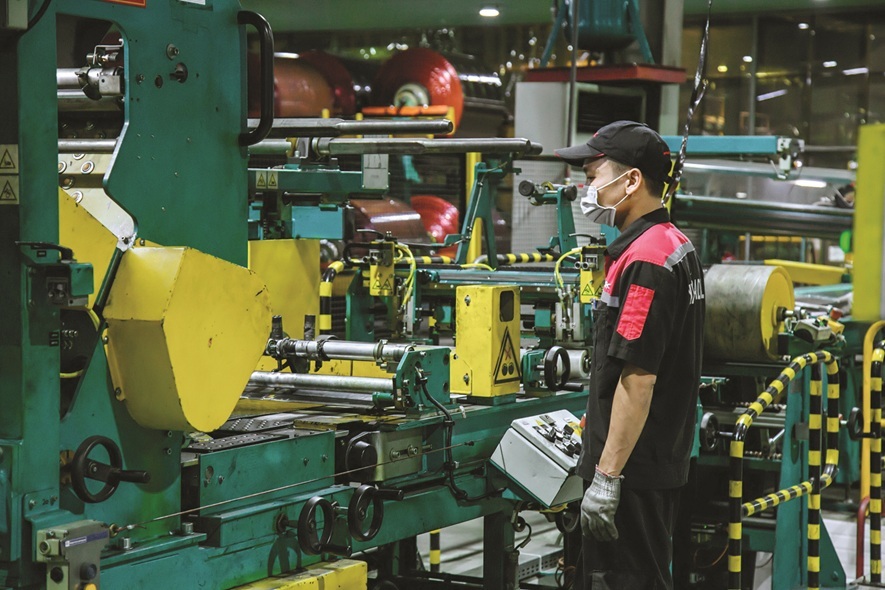
The chief executive estimated its overall production at around five million tyres. And in recent years, its international business has seen clear growth in both scale and geographical reach.
By the end of 2024, export turnover had exceeded USD 100 million, and its products are currently present in more than 50 countries and territories including markets with high standards such as the US, Europe, Japan, South Korea and Brazil.
“Our focus remains on strengthening markets where we already have a solid foundation, particularly in the Americas and developed markets, while selectively expanding into regions with significant room for growth,” contended Nhut.
He added that demand is shifting towards greater emphasis on consistent quality, durability, operational efficiency, reliable supply and technical compliance. Therefore, exporting is no longer simply about selling products but about building the capability to serve markets over the long term.
Nonetheless, Chinese tyre companies are a much stronger competitor in international markets for Vietnamese counterparts. Explaining how DRC navigates the challenge of competing head-to-head with Chinese tyre markets, Nhut said, “The expansion of Chinese tyres has intensified price competition in the replacement market, particularly in mainstream segments. This has created direct pressure on selling prices and margins across the industry.”
“We do not compete solely on price and focus on consistent quality, durability, technical service and real-world operating efficiency to retain customers. The market has indeed become more challenging, but it also creates opportunities for manufacturers that demonstrate product lifecycle value, consistently meet delivery commitments and reliable after-sales support,” he added.
GLOBAL STRONGHOLD
According to Nhut, DRC’s strongest international growth opportunities are in segments where it already has capabilities and credibility that include radial truck and bus tyres, industrial and agricultural tyres and speciality tyres.
“The expansion of radial truck tyre capacity to one million tyres per year is an important step in increasing our ability to serve the market. At the same time, we need to continue shifting our product mix towards higher-value products with higher technical requirements, durability and specialisation,” he added.
Product lines for next-generation vehicles and technical rubber products are also focus areas for the company. It also does not consider expanding the product portfolio to be an objective in itself. It must be aligned with research and developmental capabilities, investment efficiency and market demand.
The investment sentiment within the country’s tyre industry is also seeing heightened demand. It has attracted significant investment and substantially increased production capacity.
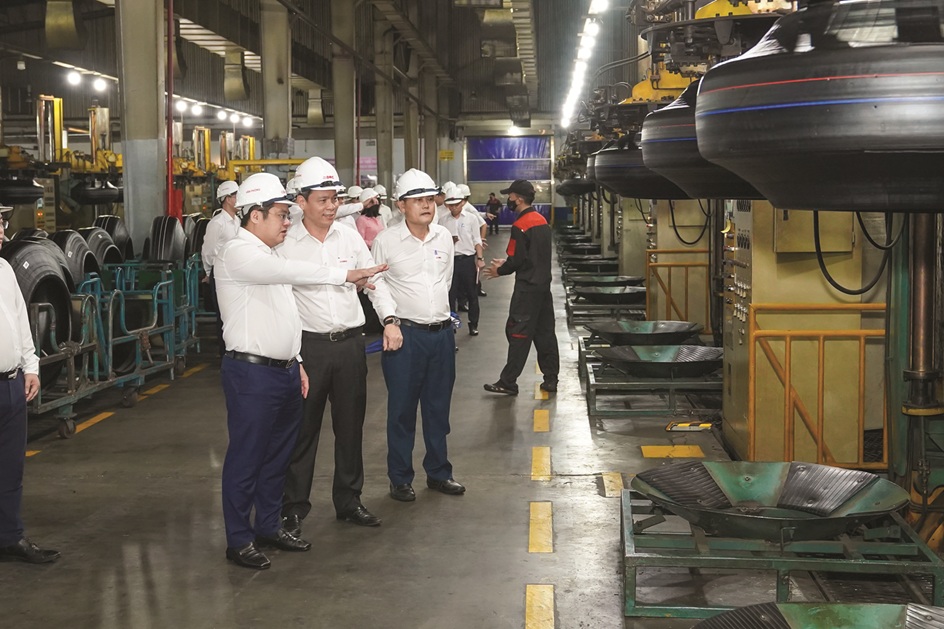 But the additional investment in Vietnam’s tyre industry is both an opportunity and a source of pressure, said Nhut.
“The opportunity lies in improvements to the supply chain, technical workforce, logistics services and Vietnam’s attractiveness as a manufacturing base. The pressure comes from greater competition for skilled labour, raw materials, customers and quality standards,” he added.
The company, however, views the current situation as a driving force to improve productivity, enhance quality and penetrate its own brand deeper into markets.
And to become a major name in the global tyre market, the company needs to shift from a mindset of exporting products to building a brand and the capability to serve international markets, contended an excited Nhut.
“The focus should be on maintaining consistent quality; investing in research and development; green manufacturing technologies; developing higher value-added segments; building sufficiently strong distribution and after-sales networks in key markets; applying international standards in
quality, ESG, trade compliance and data management and strengthening global human resources capabilities,” added the executive.
Expanding radial production capacity is necessary, but ultimately, success lies in DRC’s ability to build long-term trust in quality, operating efficiency and responsibility towards customers worldwide, noted the executive.
PERSISTENT HURDLES
The biggest challenge for DRC is competing with groups that have significantly greater scale, larger research and development budgets, distribution networks and purchasing power for raw materials.
According to Nhut, Chinese companies have advantages in terms of price and speed. Japanese, Korean and European companies are strong in technology, branding and OEM relationships, while Indian companies have scale advantages in certain segments.
He further noted that DRC’s strengths lie in its longstanding experience in radial truck, bias, agricultural and speciality tyres; its flexibility in responding to market needs; proven quality in many demanding markets and manufacturing base in Vietnam.
However, scale remains a limitation when it comes to long-term research and development investment, rapidly expanding after-sales networks, maintaining regional inventories and increasing global brand recognition.
“We cannot compete with multi-national groups in terms of the scale of research and development spending. Therefore, our approach is to focus resources on issues that have a direct impact on customers and production efficiency,” explained Nhut.
He added, “Our priorities include tyre structure and rubber compound design to improve durability, reduce heat generation, enhance load-carrying capability and improve fuel efficiency. Optimisation of radial products, development of products for emerging needs such as electric vehicles, high-speed tyres and specialty products as well as automation, digitalisation, traceability and green manufacturing are also priorities.”
The company also places strong emphasis on strengthening its engineering team, technical cooperation and shortening the cycle from testing to commercialisation.
Customers are increasingly evaluating tyres based on total cost of ownership rather than simply the initial purchase price. And to convince international fleets and distributors, DRC needs to speak through operating data rather than relying solely on catalogues.
“We are increasing real-world testing and monitoring mileage, wear, fuel consumption, incident rates and reusability or recyclability depending on the product line. Based on this data, we work with distributors to provide technical advice, clear warranty policies and rapid feedback,” stated Nhut.
The objective of the company is to help its customers see a product with a reasonable purchase price that lasts longer, operates more consistently and reduces vehicle downtime to create greater value over its entire lifecycle.
The company has a retreading facility and stated that some casings can be retreaded two or three times.
FORWARD PATH
Nhut expects Southeast Asian tyre manufacturers to continue expanding their presence in global markets.
“Over the next 3–5 years, significant room for growth lies in replacement markets with demand for radial truck tyres, agricultural, industrial and speciality tyres as well as among customers seeking a stable and diversified source of supply outside traditional manufacturing centres,” said Nhut.
The Americas, selected European markets, the Middle East, Africa and Latin America all need to be approached selectively based on trade conditions and service capabilities, he added.
The factors limiting faster expansion include the need to build distribution networks, inventory, after-sales support and local technical certifications together with working capital requirements, foreign-exchange risks, logistics and trade barriers.
“These are long-term investments and cannot be pursued at the expense of sustainable growth,” noted Nhut.
Asked how manufacturers from Vietnam and other Asian markets could position themselves against established European tyre makers, DRC said its focus would be on expanding its market presence rather than retreating from competition with larger international manufacturers.
The current situation in Vietnam reflects a broader shift in the tyre manufacturing landscape, with Asian producers increasingly seeking opportunities in overseas markets while established manufacturers face changing cost structures and production strategies.
Vietnam’s emergence as a competitive tyre manufacturing base gives DRC a platform for international expansion, but geography, trade access and manufacturing costs alone will not secure a global stronghold.
The bigger test is whether the company can translate rising capacity and decades of production experience into stronger technology, distribution, after-sales support and brand recognition.
As competition intensifies and trade barriers multiply, DRC’s global ambitions will increasingly depend on proving lifecycle value rather than simply offering another competitively priced alternative from Asia.
Giti Tire USA Promotes Michael Markoff To Chief Operating Officer
- By TT News
- November 18, 2026
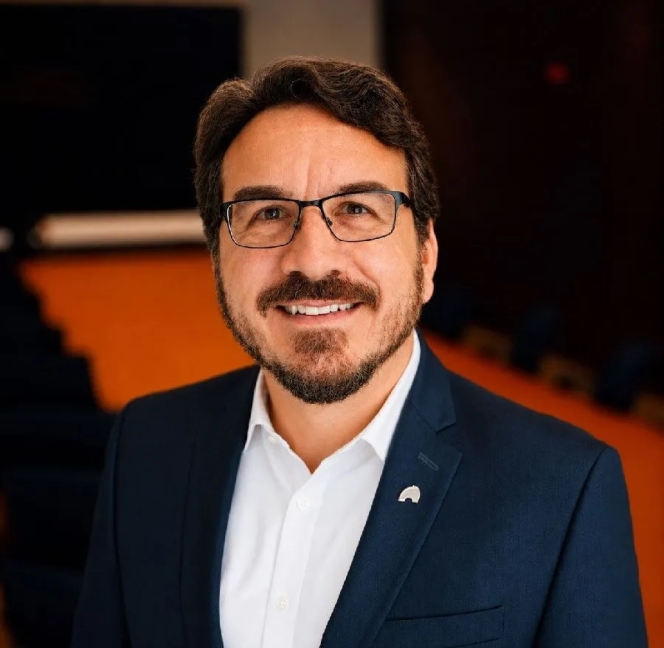
Giti Tire USA has named Michael Markoff Chief Operating Officer effective 1 November 2026, a promotion tied to a planned leadership transition as the company enters a major growth phase featuring the US debut of the Giti brand and sustained GT Radial momentum.
Phang Wai Yeen, previously Chief Executive Officer of North American operations, now leads global research and development. Markoff, formerly Executive Vice President of Sales and Marketing, answers to Executive Chairman Dr Enki Tan and adds Logistics, Supply Chain, Technical Service, Industry Relations and Product Development to his Sales and Marketing oversight.
A 29-year tyre industry veteran, Markoff spent over 26 years with The Goodyear Tire & Rubber Company in research and development, manufacturing, marketing and sales leadership roles across the United States and Europe. The US Army veteran steps into his duties at a moment of considerable opportunity for the brand portfolio.
Giti entered the US market this year, and GT Radial gained new products, wider awareness and its strongest Formula DRIFT season, taking the PRO Driver Championship with Conor Shanahan, a second straight Tire Cup Championship and Rookie of the Year honours with Cole Richards. The fastest road legal EV tyre Guinness World Record also fell recently. The Champiro SX2 RS was engineered and built at the Richburg, SC, plant, where both brands are produced.
Markoff said, “I am honoured to take on this role and build on the strong foundation our team has established. I look forward to working with our employees, customers and partners to strengthen our operations, enhance customer service and support Giti Tire USA’s continued growth.
“We have tremendous momentum across our business. The introduction of the Giti brand to the US market opens an exciting new chapter for our company while GT Radial continues to build on its success with innovative new products and an outstanding year in Formula DRIFT. Winning three major championships is a tremendous validation of our tire technology and performance capabilities.”
Synthomer Names Investment Banking Veteran Anthony Fitzpatrick As CFO
- By TT News
- November 17, 2026

Synthomer, a leading supplier of high-performance, highly specialised polymers and ingredients, has named Anthony Fitzpatrick as its incoming Chief Financial Officer and Executive Director. He arrives as CFO Designate on 1 March 2027 and steps into both roles on 1 April 2027, succeeding Iain Torrens, interim CFO since May 2026. Torrens will stay on as CFO and Director to steer the 2026 year-end results, working with Fitzpatrick through March on a smooth handover before leaving the Board and the company.
Fitzpatrick's background combines board-level finance with hands-on operational leadership. At Croda International Plc, the FTSE 100 speciality ingredients firm, he has sat on the executive committee since 2014, filled the interim Group Chief Financial Officer chair during 2024 and 2025 and now heads Strategy, Corporate Development and Industrial Specialities. His Croda tenure also includes running the Latin America region and the Performance Technologies & Industrial Chemicals division. Earlier, he spent over 20 years in global investment banking with Goldman Sachs, Bank of America and UBS across London and New York, concentrating on chemicals and allied sectors.
A Durham University chemistry graduate holding a BSc (Hons), Fitzpatrick brings extensive financial, strategic and corporate finance experience to the group. His appointment caps a planned leadership transition, with the outgoing and incoming finance chiefs overlapping during March to safeguard continuity. Torrens will formally depart once Fitzpatrick assumes the CFO and Executive Director positions, closing out his interim tenure on the Board.
Michael Willome, CEO, Synthomer, said, “I am delighted that Anthony will join Synthomer as our next Chief Financial Officer. Anthony brings highly relevant financial, commercial and industry expertise to Synthomer, combining experience as interim Group CFO of Croda with more than 20 years in investment banking and deep knowledge of the speciality chemicals sector. I am looking forward to working with him as we continue to strengthen the business and deliver on our priorities.
“I very much enjoy working with Iain. Since he joined Synthomer as interim CFO, he has made a significant contribution, particularly in helping to steer Synthomer through a volatile period for the chemicals sector while continuing to strengthen the balance sheet and the finance function. On behalf of the Board, executive committee and all colleagues, I thank Iain for his continued contribution and wish him every success for the future following his handover to Anthony on 1 April 2027.”
Fitzpatrick said, “I am excited to join the Synthomer team. The Group has substantial opportunities for further value creation ahead and I look forward to working with Michael and the team to help realise them.”
Torrens said, “It has been an exciting time to serve as interim CFO of Synthomer, which has clear momentum and is in an increasingly strong position to embrace the opportunities ahead. I would like to thank the Board, Michael and the team for their support, and I look forward to completing the year end and working with Anthony on a smooth handover.”
PCBL Chemical Names Rituraj Singh Kalra As Executive Director And Chief Of International Markets
- By TT News
- November 13, 2026
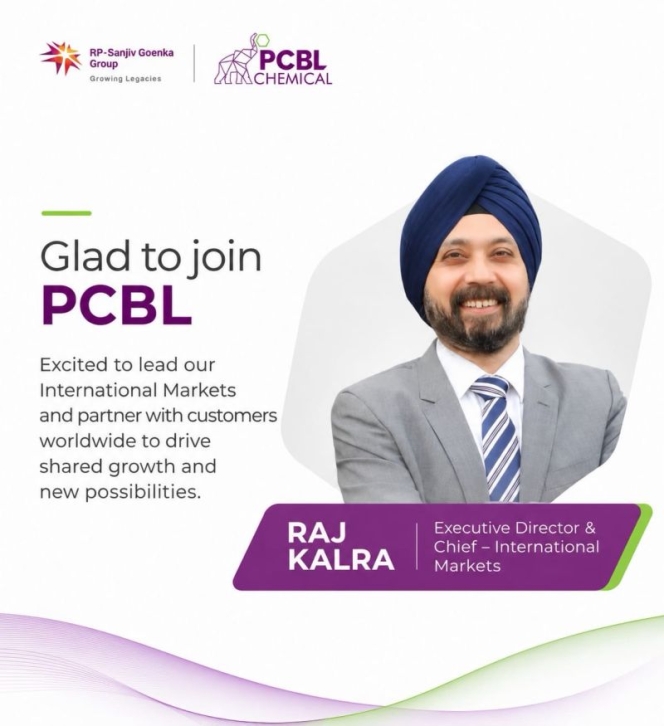
PCBL Chemical has named Rituraj Singh Kalra as Executive Director and Chief – International Markets (Rubber Blacks), effective 9 November. The Kolkata-based company disclosed in a regulatory filing that Kalra will also serve on its Senior Management team and will be based in Belgium.
Kalra brings roughly three decades of expertise in international sales, marketing and business strategy, with senior leadership roles at Bekaert, GKN Driveline and MAHLE. He will oversee operations across Europe, the Americas and key Asia-Pacific markets, lead the Innovation Centre and drive Green Carbon initiatives, prioritising close customer relationships, resilient supply chains and commercial and technical partnerships built on shared sustainability goals. He previously served as Senior Vice-President of Global Sales, Marketing and Strategy at Bekaert in Belgium and holds a mechanical engineering degree from the University of Leeds and an MBA from Warwick Business School.
The appointment strengthens PCBL's global ambitions as a unit of the RP-Sanjiv Goenka Group, a conglomerate tracing its roots to 1820 that now generates about USD 5 billion in annual turnover and employs more than 55,000 people. With over six decades of operations behind it, PCBL stands as India's largest and the world's sixth-largest carbon black manufacturer, positioning itself as a global partner across carbon black, speciality chemicals and advanced materials.
Tyrecycle's Jim Fairweather Concludes 10-Year Run As ATRA President
- By TT News
- November 13, 2026
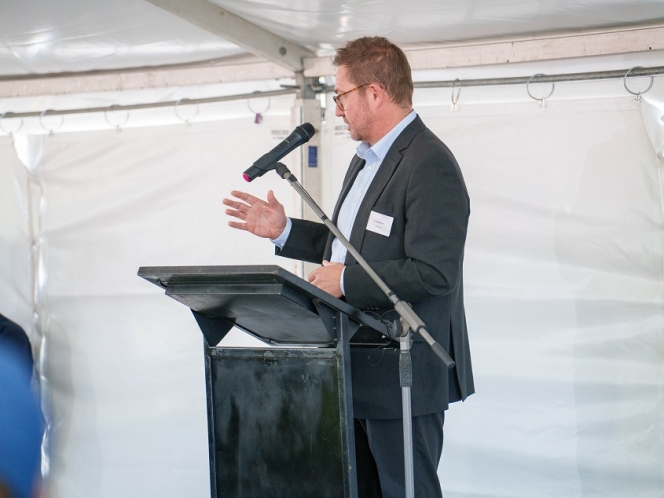
Tyrecycle CEO Jim Fairweather has stepped down after more than 10 years as President of the Australian Tyre Recyclers Association (ATRA), passing the role to Leigh Cometti, Managing Director of CTS Tyre Recycling. Fairweather will remain involved with ATRA and the wider industry.
His departure closes a period in which the association and Tyrecycle jointly pressed government to adopt the prohibition on exporting whole-baled waste tyres. That measure stopped such shipments reaching developing markets, where poor handling, storage or disposal could endanger human health and the environment, and it pushed the sector towards more accountable end-of-life tyre management and more processing and recovery on Australian soil.
Tyrecycle describes engagement with bodies like ATRA as central to its aim of building up the country's tyre recycling and resource recovery sectors. The company argues that recyclers, governments, regulators and other parties must work together if tyre recovery is to rise and end-of-life tyres are to be handled better nationally.
Looking ahead, ATRA has flagged several priorities: lifting off-the-road market recovery volumes, tightening compliance and enforcement, maintaining close ties with State and Federal regulators and pursuing regulatory changes that leverage existing Australian recycling capacity. Tyrecycle says it will keep contributing its experience, expertise and national outlook to ATRA and its members.
Comments (0)
ADD COMMENT