

Hein de Wind Appointed As Magna Tyres Chief Commercial Officer
- By TT News
- April 22, 2025
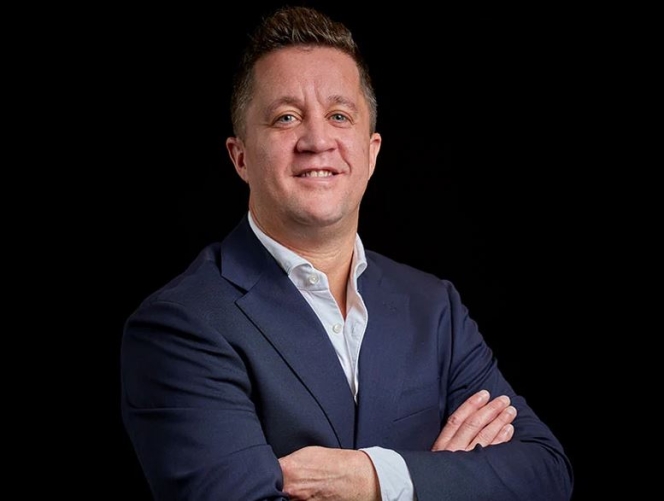
Magna Tyres Group, a leading global manufacturer of OTR and industrial tyres, has appointed Hein de Wind as its new Chief Commercial Officer (CCO) with immediate effect.
Bringing extensive experience and successful track record to the role, de Wind’s contribution to Magna Tyres' global development and commercial success since joining the firm as Commercial Director has been crucial. Magna Tyres was able to effectively establish itself in key growing regions, such as Australia and South Africa, under his guidance. His foresight and practical attitude were crucial in starting full-scale operations in these areas, which allowed Magna Tyres to provide local customer service while solidifying its standing as a really worldwide force in the industrial and off-the-road (OTR) tyre industries. In his new role, de Wind will be in charge of developing and carrying out the company's worldwide commercial strategy with a focus on spurring expansion and strengthening client ties in every area.
Michael de Ruijter, CEO, Magna Tyres Group, said, “Hein has been a cornerstone of our international growth over the past years. His in-depth industry expertise, commercial acumen and unwavering focus on customer value make him the ideal person to lead our commercial organisation. With Hein as CCO, we are confident that Magna Tyres will continue its upward trajectory and set new standards of excellence worldwide.”
“It is a great honour to take on the role of Chief Commercial Officer at such a dynamic and forward-thinking company. I look forward to working closely with our talented teams around the world to build on our strong foundation, deepen our customer partnerships, and continue delivering high-quality solutions that meet the evolving needs of our markets,” said de Wind.
Continental Taps Ashok Vedanayagam To Lead Commercial Specialty Tires Americas
- By TT News
- October 20, 2026

Continental has named Ashok Vedanayagam as Head of Commercial Specialty Tires Americas, a move underscoring the company's dedication to growth and customer service across its speciality tyre operations. In this capacity, Vedanayagam will manage the Earthmoving, Material Handling and Port Operations segments throughout North and South America.
He will direct every facet of the CST business in the region, advancing Continental's push to provide inventive tyre solutions and superior value to customers working in the challenging material handling, earthmoving and port settings.
With over 20 years of experience, Vedanayagam has served in numerous leadership roles spanning both the Commercial Truck Tire and Passenger and Light Truck Tire divisions, where he has consistently propelled growth, reinforced customer relationships and promoted market-driven approaches across various regions. The appointment reflects Continental's resolve to serve Americas customers through innovative products, sector knowledge and a sharp emphasis on operational excellence.
Renato Sarzano, Senior Vice President, Commercial Tires Americas, Continental, said, “Ashok’s extensive experience in sales, marketing and international business leadership makes him exceptionally well qualified for this role. His proven ability to build strong customer relationships, develop high-performing teams and deliver results across both consumer and commercial markets will be invaluable as we continue to strengthen our Commercial Specialty Tires business throughout the Americas.”
SI Group Appoints Speciality Chemicals Veteran Marcello Boldrini As CEO
- By TT News
- October 20, 2026

SI Group has named Marcello Boldrini as its new Chief Executive Officer, with the appointment taking effect on 19 October 2026. He will take over from David Bradley, who has held the President and Chief Executive Officer role since 2019. The company is a global developer and manufacturer of performance additives, process solutions and chemical intermediates.
Boldrini arrives with over 30 years of leadership experience in speciality chemicals and materials, having worked across Europe, Asia and the Americas. He most recently served as Chief Executive Officer and a Director of Kraton Corporation, a Houston-based global speciality chemicals company. At Kraton, he drove growth and transformation efforts, including establishing a Transformation Office that delivered more than USD 100 million in annual EBITDA improvements. His earlier career included senior leadership positions at Houghton International, Momentive/Hexion and Ashland.
Based at SI Group's headquarters in The Woodlands, Texas, Boldrini resides in the Houston area. The leadership team will collaborate closely with him to sustain a strong emphasis on safety, operational performance and customer commitments. Customers, suppliers and other business partners are expected to continue working through their existing SI Group contacts.
Daryl Roberts, member of the SI Group Board of Directors, said, “We are pleased to welcome Marcello Boldrini as SI Group’s next CEO. Marcello brings significant experience in the global speciality chemicals industry and a strong track record of leading growth, transformation and operational improvement. His experience and perspective will serve SI Group well as we continue to strengthen our performance, serve our customers and execute our priorities.”
Boldrini said, “I am honoured to join SI Group as CEO and look forward to working with our employees, customers and partners. My initial focus will be on listening and learning, spending time with our teams and customers and collaborating with the leadership team to build on SI Group’s strengths and set clear priorities for the business. Safe and reliable operations, disciplined execution and delivering value for our customers will remain at the centre of our work.”
Shawn Abrams, member of SI Group’s Board of Directors, said, “On behalf of the Board, I want to thank David Bradley for his leadership and many contributions to SI Group. David led SI Group through significant change and some of the most challenging conditions our industry has faced. During his tenure, the company successfully completed its 2025 recapitalisation, strengthening SI Group’s financial position and providing greater flexibility for the future. We are grateful for David’s commitment to SI Group and its people, and we wish him continued success.”
Getting closer To customers
- By Nilesh Wadhwa
- October 19, 2026
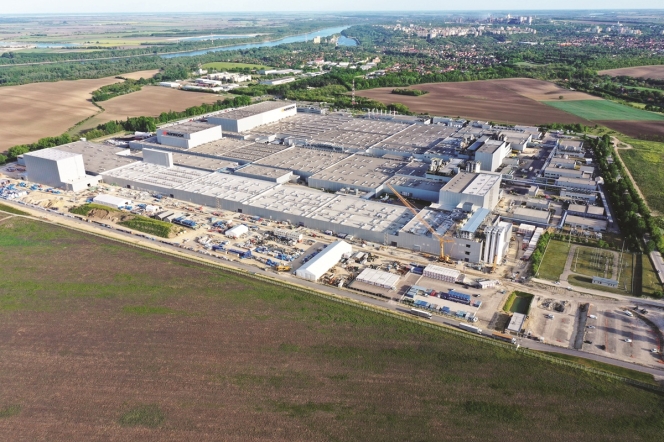
As Europe’s commercial vehicle industry moves towards electrification, alternative fuels and tighter sustainability requirements, Hankook Tire is pinning its growth strategy on being closer to the customers.
The South Korean tyre maker is beginning Truck & Bus Radial (TBR) production in Europe while developing longer-lasting products and flexible fleet services as it seeks further growth in the region.
In an exclusive interaction with Tyre Trends on the sidelines of IAA Transportation 2026, Richard Bezzant, Marketing Director – Truck & Bus at Hankook Tire Europe, said the company is not merely reacting to market shifts but actively pursuing growth.
He described a strategy centred on matching product development with the evolving requirements of transport fleets, including lower Total Cost of Ownership (TCO), digital solutions, regulatory compliance and higher fuel efficiency. For this, the Korean tyre maker is starting production closer to customers and offer services designed to support higher vehicle uptime.
According to Bezzant, Europe already accounts for around 45 percent of Hankook’s global revenue, making the region an important growth market rather than simply a mature market to defend.
LOCALISING PRODUCTION
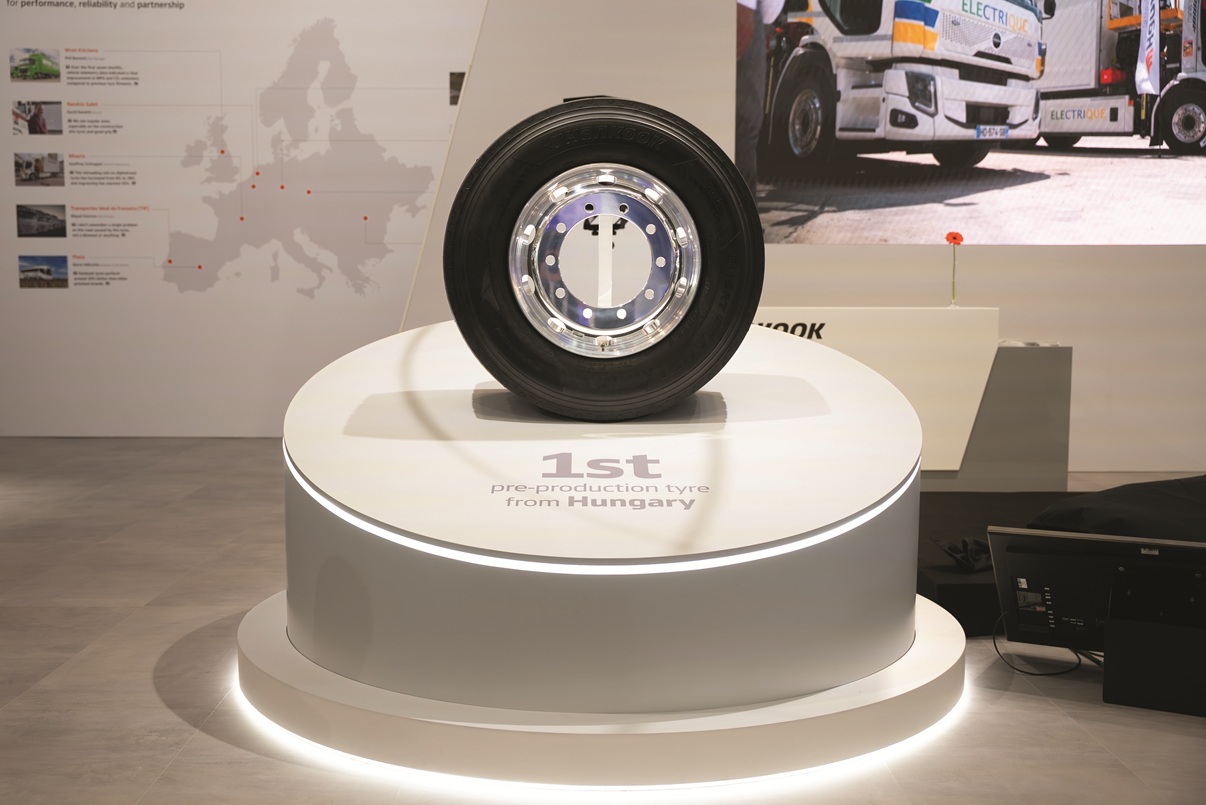
One of the clearest expressions of this strategy is Hankook’s TBR tyre production in Europe. The company is investing about EUR 540 million in TBR line at its Rácalmás facility in Hungary, which currently produces PCR tyres. The first set of commercial products is expected to begin production from October.
“Our response to that trend in Europe specifically is the new production line that we are opening at the beginning of October to start producing TBR tyres in Europe. It is about bringing products closer to our customers, reducing supply chain delays and making it more sustainable because the less distance travelled in logistics, the better it is for our customers,” Bezzant explained.
With the new line, the company will have a production capacity of more than 800,000 units of TBR per year, according to Bezzant. The production is significant for Hankook as it seeks to increase its presence in Europe’s commercial vehicle tyre market while making greater use of locally produced tyres.
To begin with, it will focus on 22.5-inch tyres for trucks and buses. The plan is to increase capacity and add further specifications as they are approved.
The strategy also reflects the changing requirements of commercial vehicle manufacturers and fleets. As powertrain technologies evolve, tyre manufacturers need to respond to different vehicle characteristics, including changes in weight, axle loads, torque delivery and efficiency requirements.
DESIGNING FOR THE CHANGING TRUCK
Electrification and alternative fuels were among the most visible themes at IAA Transportation 2026, according to Bezzant. While battery-electric vehicles are gaining ground in several applications, the transition is not following a single path across all commercial vehicle segments or markets.
“At IAA, the most visible trend you see is electrification and alternative fuel. That’s the first thing you notice in trucks and buses, among others. It is important for us to follow the trend and make sure we produce the right products to meet the needs of those vehicles and customers,” he said.
The powertrain mix will ultimately be shaped by vehicle manufacturers and the operating requirements of individual applications. Bezzant said Hankook’s role is to support those developments through tyre technology.
 “Those things are going to be led by the OEMs. Our role as a tyre manufacturer is to support what those vehicles need and to support the way that power is going to be delivered to the road, the additional weight and loads that they might need to carry. We will follow those OEM partners in the direction to support them in where they need,” he averred.
The transition is already more visible in some bus applications, particularly where municipal procurement is accelerating the adoption of electric buses. Truck applications, meanwhile, continue to involve a broader mix of powertrain technologies.
For tyre manufacturers, this creates a requirement to balance durability, load-carrying capability, rolling resistance and overall efficiency as vehicle architectures evolve.
That balance is also becoming increasingly important as fleets face greater pressure to reduce operating costs and environmental impact. For Hankook, longer tyre life remains a central part of that proposition.
“The fundamental first part is about the longer the tyre stays on the vehicle, the better for the environment. And that is a core piece of Hankook’s value proposition to our customer. We pride ourselves on very strong performance in mileage,” Bezzant said.
The company is also developing products aimed at improving rolling resistance without compromising mileage performance. For fleets, the objective is to combine tyre longevity with vehicle efficiency and lower total cost of ownership.
SMART FLEX COMPLETES REGIONAL-TRANSPORT LINEUP
The company used IAA Transportation to present the world premiere of its Smart Flex TH51 trailer tyre, completing its Smart Flex tyre line for regional-distance transport alongside the Smart Flex AH51 for the steering axle and Smart Flex DH51 for the drive axle.
Compared with its predecessor, the TH51 is designed around the requirements of high mileage and low rolling resistance. At launch, Hankook will offer the tyre in 385/65 R22.5, with the tyre carrying the 3PMSF certification mark for use in winter conditions and as part of a year-round application strategy.
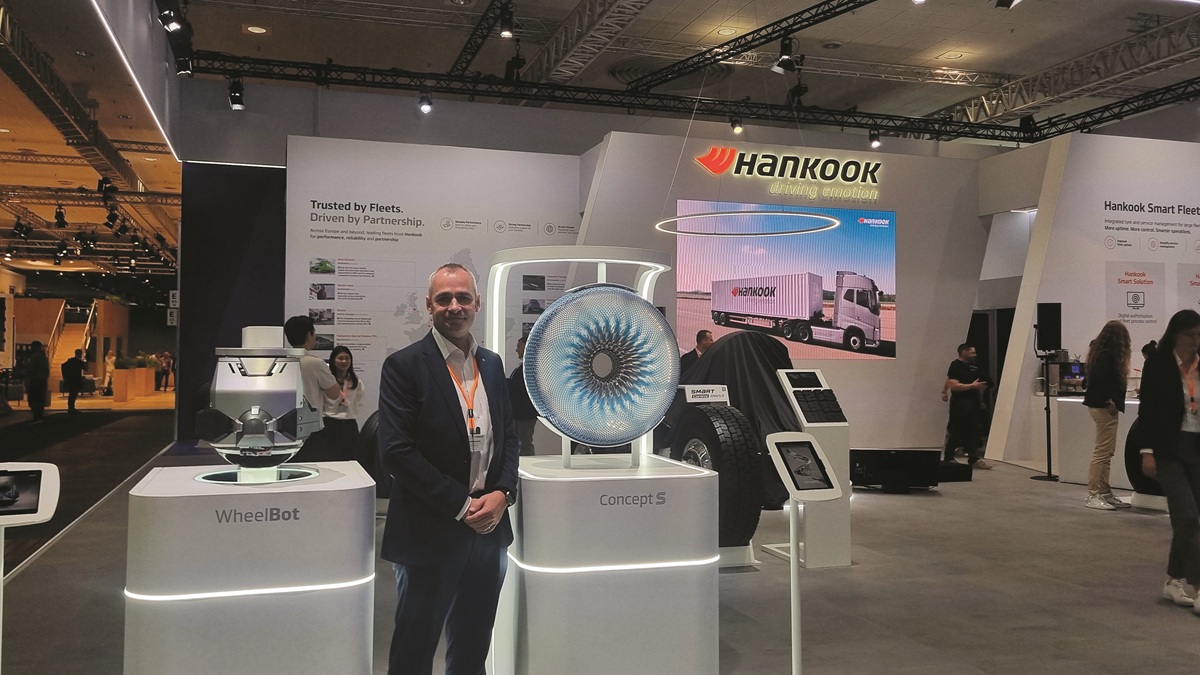 Richard Bezzant, Marketing Director – Truck & Bus at Hankook Tire Europe
The TH51 is intended for single-axle applications on semi-trailers and trailers. Its tread, the company said, is designed as a key element of the tyre’s performance strategy, using concealed grooves manufactured through 3D-printed tread moulds.
The design is intended to progressively reveal additional tread features as the tyre wears. When approximately 40 percent of the tread has worn, interlocking 3D sipes are revealed to increase tread-block rigidity and support grip. At around 70 percent wear, additional concealed grooves become exposed to support wet grip. By around 90 percent wear, the concealed grooves are fully exposed, with Hankook positioning the design as a means of maintaining performance towards the end of the tyre’s service life.
The tread combines zigzag grooves with drainage grooves and channels. The zigzag grooves are designed to provide grip, counter irregular wear and support water evacuation under changing road and weather conditions. Water is channelled through the drainage grooves and discharged through the drainage channels.
The product therefore links several of the requirements highlighted by Bezzant – mileage, rolling resistance, grip and efficiency – in a single trailer application. Rather than being a standalone launch, the TH51 illustrates how Hankook is applying its product-development strategy to different axle positions within regional transport.
As regulatory attention increases on tyre abrasion and other non-exhaust emissions, the ability to deliver longer service life and improved efficiency is likely to become increasingly relevant to tyre selection.
EXPANSION AMID COMPETITION
Hankook’s investment comes at a time when the global tyre industry is seeing continued competitive pressure, capacity adjustments and increasing participation from manufacturers from emerging markets.
Against this backdrop, Bezzant described Hankook’s approach as expansionary. “For us, it’s much more growth-oriented,” he stated.
The company has also expanded its TBR manufacturing footprint in the United States and is targeting growth in both North America and Europe.
“We’re growing in both the United States and in Europe across the board. Europe represents 45 percent of our global revenue in total, and this year we are seeing growth, substantial growth. We witnessed good growth last year and next year too we expect the same,” he explained.
The additional European production capacity will therefore need to be absorbed through increased sales, with Hankook looking to build demand across both replacement and OE channels.
Responding to what is next for the tyre maker, Bezzant said that the company will now focus on consuming the additional capacity within its global production, especially with the new TBR tyre production starting in Europe.
The company’s approach to growing competition from Chinese tyre manufacturers in Europe is similarly pragmatic. Rather than viewing new entrants purely as a threat, Bezzant sees potential benefits if products are manufactured locally and meet the quality, sustainability and performance requirements of European fleets.
He said the European market benefits from a broad choice of products, while local production can make it easier for customers to access tyres and manage supply.
Bezzant also highlighted the importance of sustainability and retreadability as the market develops. For fleet operators, the ability to maximise tyre life and support multiple lives through retreading can contribute to both operating efficiency and resource efficiency.
REBUILDING OE PARTNERSHIP
Hankook is also looking to strengthen its original equipment presence in European truck applications.
“In Europe today, in OE truck, we are just restarting that business. So today we are not an OE supplier as it stands now,” Bezzant said.
While Hankook is rebuilding its European truck OE presence, the company has established relationships with trailer manufacturers including Schmitz Cargobull, Wielton and Fruehauf.
The company’s strategy extends beyond the tyre itself, with fleet services becoming an increasingly important part of its offering.
FLEXIBLE FLEET SERVICES
Hankook already operates its Smart Fleet offering in the UK, the Netherlands, France and Germany. The model is designed to give fleets flexibility in selecting the services they require across different markets.
“It’s almost like an à la carte menu. A customer can say, ‘I need breakdown service across Europe’, or ‘I only need it in one country’. We will provide a platform to manage authorisations and billing,” Bezzant explained.
The Hankook Smart Solution authorisation and tyre management platform can be combined with the Smart Partner Network, which provides contracted services. The objective is to help fleets reduce downtime, maintain vehicle availability and gain greater control over tyre-related expenditure.
For fleets operating across multiple countries or through several distributors, such a model can simplify tyre management while allowing operators to select services according to their individual requirements.
As Bezzant puts it, the underlying strategy is straightforward: get closer to the customer, understand how commercial vehicles are changing and build the products, production footprint and services around those requirements.
Jacques Fourie Named President Of Bridgestone Canada
- By TT News
- October 16, 2026
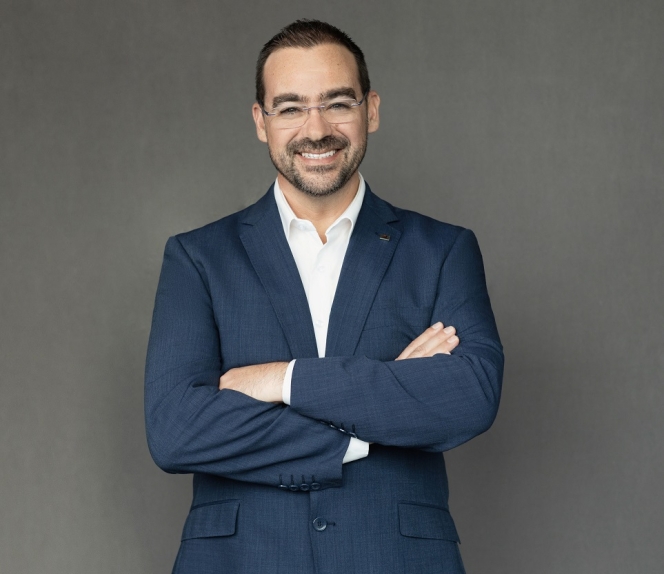
Bridgestone has named Jacques Fourie as President, Canada, a newly created position underscoring the market’s strategic value to the company. Operating from Mississauga, he will oversee Canadian strategy, commercial activities and long-term growth, with full end-to-end accountability.
The dedicated in-country leadership structure is intended to accelerate decision-making, improve coordination and bring the business closer to customers and teammates. Bridgestone said the role reinforces its commitment to stronger leadership and accountability across Canada.
Fourie joined Bridgestone in 2019 and most recently led its Africa Middle East region from Dubai. He previously spent 15 years at Cummins in finance, sales, operations and executive roles, including leading Cummins Rocky Mountain. He holds an Honours Bachelor’s Degree in Finance and Accounting from the University of Pretoria.
Robert Johnson, Group President, North America, Bridgestone West, said, “Canada is an important market for Bridgestone, with strong potential for continued growth. Jacques brings extensive international leadership experience, a strong customer focus and a proven ability to build successful businesses and teams. His understanding of the North American market makes him well positioned to lead our Canadian business and strengthen the value we deliver to our customers across the country.”
Fourie said, “Canada is a dynamic and strategically important market with significant opportunities ahead. I am honoured to take on this role and look forward to working closely with our customers, partners and teammates across the country. Together, we will build on the strengths of the Canadian business, deepen our customer relationships and position Bridgestone for sustainable, long-term growth.”

Comments (0)
ADD COMMENT