MESNAC Demonstrates 35-Second Tyre Production At Media Briefing
- By TT News
- August 29, 2025
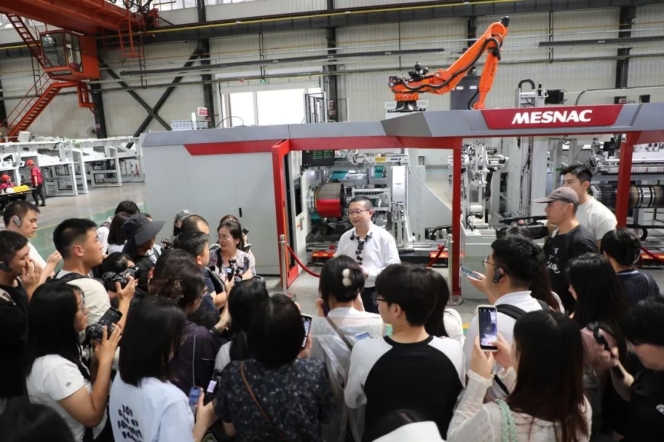
The Qingdao Municipal Government Information Office recently hosted a media briefing on ‘Shandong's Top Brands on the Industrial Chain – Intelligent Equipment Industrial Chain’ at the MESNAC Jiaozhou Equipment Industrial Park. Senior leaders from MESNAC and three other prominent firms were in attendance to present their advancements and field questions from journalists.
A central focus was on MESNAC's proprietary ROC R&D platform, a unique modular system engineered specifically for the rubber equipment sector. This platform is fundamentally structured around client requirements, integrating comprehensive product design, technological development and rigorous testing protocols. This architecture facilitates a configurable development process, allowing for both large-scale customisation and remarkably agile product delivery. The company's operational philosophy was explained as a dedicated team model, where a single unit focuses its expertise on one product for its entire lifecycle. This meticulous approach has generated significant industry innovations in recent years, including fully automatic material weighing systems, unmanned tire building machinery and intelligent tyre curing press workshops capable of operating as fully unmanned ‘lights-out’ facilities.
The event included a practical demonstration of this technology in action. Attendees witnessed the NPS Semi-steel One-stage Building Machine, which achieves a single-tyre production cycle of just 35 seconds through complete automation. This system boasts world-class efficiency, requiring only one person to supervise multiple machines simultaneously. It embodies a new generation of intelligent manufacturing by seamlessly integrating cutting-edge technologies such as precision machine vision, industrial robotics, sophisticated industrial IoT software and autonomous learning capabilities.
Getting A Grip On India’s Tyre Waste
- By Gaurav Nandi
- December 19, 2025
India’s mounting tyre waste problem has found a determined challenger in Home Zone Rubber Solutions, a young but ambitious company from Vapi, Gujarat. Founded just four years ago by stainless-steel-industry veteran Jitendra Agarwal, the recycler has quickly scaled to processing more than half a million scrap tyres annually with plans to double capacity through an upcoming IPO. Armed with cutting-edge Danish Eldan technology and a vision that blends environmental responsibility with industrial innovation, Agarwal is positioning Home Zone not just as a recycler but as a pioneer of India’s circular economy in rubber.
Home Zone Rubber Solutions, headquartered in Vapi, Gujarat, is rapidly establishing itself as one of India’s foremost tyre recycling companies. Established just four years ago by Managing Director Jitendra Agarwal, the company’s roots trace back to a legacy in stainless steel manufacturing. However, post-pandemic, Agarwal saw an opportunity to pivot towards environmental sustainability through tyre recycling owing to its immense potential but significant challenges.
Speaking exclusively to Tyre Trends, Agarwal said, “Our family has always been in the stainless steel business, but I have long been passionate about environmental issues and recycling. When the opportunity presented itself after lockdown, we grabbed it with both hands.”
Today, Home Zone processes around 5,000 tonnes of scrap tyres every month, which translates to over half a million tyres annually. Agarwal shared that with an upcoming initial public offering, the company plans to double this capacity, targeting recycling of up to 10 million scrap tyres annually.
“This is a huge achievement because tyres are among the most hazardous wastes worldwide. They can take 150 to 200 years to decompose if left unchecked. They pollute landfills and oceans alike, so taking millions of tyres off the roads and recycling them is vital to protecting our environment,” Agarwal explained.
INNOVATIVE METHODOLOGY
At the heart of Home Zone’s process is a sophisticated tyre recycling line sourced from Denmark, known as Eldan. This machinery stands out as one of the most advanced globally, capable of reclaiming 99.9 percent crumb rubber granules from shredded tyres, claimed the executive.
“Separating components like steel is fairly straightforward, but the fibre and rubber separation is incredibly complex. Our line is the only one currently in India with a full Eldan setup, and it delivers unparalleled efficiency and quality,” Agarwal said.
The crumb rubber generated is classified in mesh sizes in granular levels ranging from 5 up to 20 mesh currently. The company is working towards finer mesh granules going up to 40 and eventually 80 to 120 mesh, which are essential for manufacturing new tyres from recycled material. Agarwal notes that this progression is gradual given the technological challenges of grinding tyres to such fine granularity in a controlled environment.

The applications for crumb rubber extend beyond new tyres. The company’s crumb rubber is widely used in diverse sectors including sports turf grounds, anti-slip tiles, automotive components, conveyor belts, industrial footwear and infrastructure projects.
The company maintains a research and development team, including experts in robotics technology, to ensure product quality and innovation. “As we move into finished products ourselves, quality testing and consistent innovation are vital,” Agarwal stressed.
One particularly unique product is the cow mat, exported from India to dairy-producing countries worldwide. Made from crumb rubber, these mats improve cow comfort, reduce blood pressure of animals and consequently increase milk production. This innovation exemplifies how recycling can impact even agricultural practices.
MARKET WATCH
While Home Zone currently primarily serves the domestic market, exports are an important growth area. Plans include selling crumb rubber and finished mats to markets in the Middle East, Europe and China. Agarwal sees China as a significant opportunity, especially for finished rubber products rather than just raw crumb rubber.
To support this expansion, the company has identified a 25-acre land parcel near Mundra port, approximately 9.5 kilometres from the port itself. This facility aims to be a fully integrated recycling and manufacturing hub, where crumb rubber will be processed into finished products before export. The target for beginning operations is late 2026.
Furthermore, while India remains the third largest generator of scrap tyres globally, Agarwal pointed out that the supply of these tyres for recycling is fragmented and inefficient, forcing Indian recyclers to import scrap tyres from the US and Europe, often at lower costs due to government subsidies and more streamlined collection systems abroad.
To tackle this, Agarwal has launched Re-Tyre Bazar, India’s first organised scrap tyre collection network. Initially rolling out centres in states like Tamil Nadu, Telangana, Rajasthan, Maharashtra and Madhya Pradesh, this initiative aims to consolidate the fragmented supply chain and enable recyclers to source Indian scrap tyres exclusively in the near future.
“If we can organise this chain effectively, we won’t need imports except as a bonus. That would validate the model and mark a major step forward for the Indian recycling industry,” Agarwal said.
Re-Tyre Bazar operates as an independent company and is intended to serve the entire Indian recycling sector, rather than being exclusive to Home Zone Rubber Solutions.
FOCUS VIEW
Agarwal highlighted that about 70 percent of Indian scrap tyres come from the truck and bus segment. “TBR scrap tyres generally lend themselves to higher quality recycling applications, compared to passenger car tyres,” he explained. This focus area presents significant opportunity for the company as it scales production and refines crumb rubber quality.

Addressing common misconceptions about tyre quality, he stated, “Many believe that American and European tyres are superior, but it’s not true. Indians may even have a 5 to 10 percent advantage due to how tyres are used and road conditions.”
He was also candid about rumours that some importers misuse scrap tyre imports licenses, selling raw material rather than using it in production. “Such misuse is limited to a small minority, but government agencies must enforce regulations strictly to protect industry credibility,” he said.
On the regulatory front, Agarwal views government initiatives such as Extended Producer Responsibility (EPR) as positive developments that place recycling obligations on tyre manufacturers. However, careful enforcement is needed. He also advocates for consumer awareness campaigns and incentives like green labelling for recycled products.
“Consumers want environmentally friendly choices. A green label on products made from recycled rubber could boost demand and support the circular economy,” Agarwal noted.
FUTURE PROSPECTS
The upcoming IPO is a major step towards funding Home Zone’s expansion. Public filings indicate the company aims to increase production capacity from around 57,000 metric tonnes annually and invest in new machinery and facilities.
“We expect the next decade to be very exciting for the industry,” Agarwal said confidently.
Reflecting on the company’s environmental mission, Agarwal concluded, “We inherited this planet from our parents and grandparents. If we cannot leave it better, let us at least leave it as we found it.”
- Ian Andrews
- NTDA
- National Tyre Distributors Association
- National Tire Conference and National Tire Awards
Charting A New Course For NTDA
- By Gaurav Nandi
- December 12, 2025
Ian Andrews steps into the role of NTDA Chief Executive at a precarious moment for the UK tyre industry, where skills shortages, demographic shifts and mounting environmental pressures threaten to outpace the sector’s readiness. New to tyres but not to membership organisations, Andrews must prove his ability to turn fresh perspective into actionable solutions bridging gaps in recruitment, diversity and sustainability while convincing members that the nearly century-old association can adapt quickly enough to safeguard its relevance.
Ian Andrews, the newly appointed Chief Executive Officer of the National Tyre Distributors Association (NTDA), has embarked on a mission to address urgent challenges within the UK tyre sector, undertaking a comprehensive strategy to tackle recruitment issues, enhance member engagement, promote collaboration and advance environmental sustainability.
Coming from two decades of senior leadership in membership-based organisations but new to the tyre industry itself, Andrews brings a fresh perspective combined with seasoned leadership skills to the nearly 100-year-old trade association.
Upon assuming his role, Andrews emphasised a grounded approach focused on learning directly from NTDA members. “My immediate priorities are to understand the challenges and opportunities that face the tyre sector here in UK, principally, but globally as well,” he shared.
Approaching the role without preconceived notions, he aims to listen and respond to member feedback. Early indications point to recruitment and careers as pressing issues. “Careers and recruitment seem to be one of the early areas of work that we need to focus on. There are significant recruitment issues here in UK, not just in tyres but across the whole motor vehicle sector,” said Andrews during the exclusive interview with Tyre Trends.
TACKLING GAPS
The UK tyre sector faces a looming demographic shift with a substantial number of experienced professionals expected to retire over the next decade, risking a critical loss of institutional knowledge and technical skills.
Andrews warned, “The sector has got a significant number of people who will retire in the next 10 years. So there’ll be a significant loss of knowledge and skills.”
While larger companies have training and HR departments to manage recruitment and development efforts, smaller businesses face a heavier burden. “They are doing it themselves, and if you’re employing somebody new, then it’s a huge commitment to train and develop that person until they start generating revenue and making a return on the investment,” he explained.
Recognising the sector’s traditionally male-dominated nature, Andrews stressed the imperative of building a more diverse workforce. “We need to look at getting a better and more diverse workforce. Moreover, any business should be reflective of the community it’s working in. If you’re in an ethnically diverse community, your workforce will be best when it’s ethnically diverse,” he noted.
Yet he acknowledged the cultural shift required will take time and that’s not going to happen overnight.
Furthermore, Brexit has complicated recruitment by reducing access to talent from Europe, shifting the focus predominantly to UK-based recruitment. “Most of the tyre sector focus is on UK recruitment, perhaps more so now after Brexit,” Andrews noted.
Despite these constraints, his message was clear: “If we keep doing what we’ve always done, we’ll end up with what we’ve always had. So we need to look at doing different things. Reaching different groups of people.”
To address the skills and professionalism gap, NTDA has expanded its tyre technician licensing schemes significantly. Andrews reported robust uptake with over 16,000 technicians licensed by the NTDA.
This growth is particularly notable in the past two years. Acknowledging the specialised skills needed in emerging technologies, he highlighted the introduction of licensing for electric vehicle tyre (EV) technicians. “The whole electric vehicle is bringing a new plethora of challenges and opportunities. It’s a different skill set. Everything is different in EVs,” he said.
ENGAGING MEMBERS
Member engagement and retention stand as foundational pillars for Andrews’s leadership as well. He aims to increase members’ awareness of
NTDA’s benefits and encourage their active participation. “Often, members pay their membership fee but don’t really explore all the member benefits,” he observed.
Plans include surveying members on their benefit awareness and usefulness while exploring additional services that may be introduced. To foster greater connection, Andrews is looking at enhancing local engagement through regional events across UK, alongside leveraging digital platforms.
He mentioned, “We run large national events in October, including our National Tire Conference and National Tire Awards, which are very well supported. But we need to explore how else we can engage with members on a more local basis for physical events but also on a digital basis.”
His previous experience includes organising half-day digital forums with speakers and interactive participation, offering participants the flexibility to attend live or watch recorded sessions later.
Collaboration within the sector forms a cornerstone of Andrews’s strategic outlook. While mindful and cautious of anti-competitive regulations, he believes substantial benefits can come from sharing resources and best practices, especially on recruitment and sustainability challenges.
“There’s always greater advantage in collaboration than there is in competition. Who is doing it well? What are they willing to share? What resources do they have that might be made more widely available?” he asserted.
At the same time, he acknowledged the necessity of protecting commercially sensitive information: “There will always be things that are commercially sensitive and need to be kept such, but that’s fine. Let’s collaborate on the 90 percent that isn’t commercially sensitive and keep the 10 percent that is.”
ENVIRONMENTAL STEWARDSHIP
Environmental stewardship and sustainability have emerged prominently on the NTDA agenda. Andrews described active engagement with the UK Environment Agency regarding the management of end-of-life tyres.
“We’re engaged with the agency that is responsible for where end-of-life tyres end up, making sure that they end up in the right place at the right time and don’t clog up our rivers, canals and green spaces,” he stated.
Growing government interest in tyre runoff impacting watercourses may further intensify oversight. “There’s government interest in where runoff from tyres is ending up in the water courses,” Andrews noted, emphasising the importance of proactive dialogue. “With all aspects of working with government, it’s about getting to them before they get to you.”
He committed to openness and transparency if issues arise, stating, “If there’s an issue, then be upfront and open that there’s an issue and we’re working on it and there is a solution.”
Looking to the future, Andrews identified his plans for NTDA’s next three to five years that include member growth, recruitment and environmental awareness. “Internally, it is driving member engagement and member value and therefore driving up member growth,” he shared.
Externally, recruitment and environmental matters are key concerns. Noting that larger companies typically have sustainability specialists, Andrews highlighted the need to support smaller businesses struggling to navigate sustainability practices. “Helping the whole sector regardless of the size of the business is important,” he said.
Throughout the interview, Andrews repeatedly underscored the fundamental role of the tyre industry in public health and safety. “The tyre sector is fundamentally about health, safety and well-being,” he emphasised.
“You wouldn’t put your most precious things anywhere without some assurance that they’re going to be safe. Let’s not put our partners, children, parents into vehicles without some assurance that the tyres are going to do the job that’s expected of them,” he asserted.
Based in Halesbury, Buckinghamshire, Andrews expressed enthusiasm for leading the NTDA forward. While new to tyres, he is confident in his ability to learn quickly with the board and executive council’s support. “The tyre stuff I will learn. When I joined the BPCA, I knew nothing about pest control. Now I’d like to think the same will be true of tyres. It’s all learnable,” he said.
He also stressed his readiness to bring expert colleagues to discussions, for example, when facing government ministers, to ensure the expertise needed is present.
As he takes charge of NTDA during a time of transformation, Andrews seeks to position the association as the collective voice of the tyre sector, delivering professional standards and fostering a collaborative, diverse and sustainable industry that prioritises safety and well-being.
Fornnax Inaugurates 12-Acre Global Hub For Recycling Innovation
- By TT News
- November 27, 2025
Fornnax has officially launched one of the world's largest integrated hubs for recycling innovation: a New Product Development centre and demo plant spanning over 12 acres. This facility is a critical milestone in the company's strategic vision to become a global leader in recycling solutions by 2030. It is designed to accelerate the advancement of recycling technology through a comprehensive, customer-focused approach.
The centre’s core function is its New Product Development framework, which is built upon a meticulous Gate Review Process. This system ensures precision from conception to completion. The journey begins with market research and ideation from the Sales and Marketing team, followed by a strategic review by the Leadership Team. The Design Team then creates detailed plans that are evaluated by Manufacturing, Service and Safety teams. After final approval, a functional prototype is built and subjected to a rigorous six to eight-month validation phase. The process concludes with design optimisation for mass production, officially launching the equipment for the global market. This method not just upgrades Fornnax's shredders and granulators – enhancing their capacity, energy efficiency and operational availability to 18–20 hours per day – but also validates the equipment for up to 3,000–15,000 hours under real-world conditions

A key feature of the facility is its open-door policy for clients. Customers can bring their specific materials to the demo plant to test equipment performance across various machines and conditions, providing a risk-free environment for informed investment decisions. The centre will also drive research into emerging recycling applications, such as E-waste, cables and lithium-ion batteries, where specialised engineering teams will conduct feasibility studies to design tailored solutions.
Beyond technology, the facility includes an OEM training centre dedicated to developing a skilled workforce. The programme trains operators and maintenance engineers, who gain hands-on experience before being deployed to support Fornnax's customer base. The company will also deliver comprehensive corporate training to domestic and international clients, empowering them with the expertise for optimal plant operation and maintenance. By uniting R&D, testing and training under one roof, Fornnax is establishing a powerful foundation to scale its offerings and lead the next generation of recycling technology.
Jignesh Kundariya, Director and CEO, Fornnax, said, "Innovation in product development is the key to success of becoming a global leader. With this new facility, we now have the speed, flexibility and controlled environment to design, test and validate new technologies in just six to eight months, something that would take significantly 4–5 years at a customer site. Each machine will undergo validation according to global standards, with every critical part and assembly rigorously tested under Engineering Build (EB) and Manufacturing Build (MB) protocols. Our goal is to empower customers with clarity and confidence before they invest. This facility allows them to test their own materials under real-world conditions, compare machines and see results firsthand. It’s not just about selling equipment; it’s about building trust through transparency and delivering solutions that truly work for their unique needs.”
Smithers to Expand Rolling-Resistance Testing Capabilities in China
- By TT News
- November 21, 2025
Smithers, the US-based testing and consulting group, is expanding its tyre testing operations in China with three new capabilities designed to better replicate real-world driving conditions. The investment will enhance the company’s rolling-resistance testing at its Suzhou tyre and wheel centre, strengthening its offering to global carmakers and tyre manufacturers.
The new features focus on factors that can influence vehicle energy loss, range, and overall efficiency—a growing concern as regulators tighten standards and EV makers push for longer driving range.
One new capability will allow rolling-resistance testing to be carried out with variations in slip and camber angles for passenger car and light truck tyres. Standard tests are performed at zero degrees, but even small changes in wheel alignment or body movement during real driving can affect energy consumption. The enhanced system lets customers study these effects and refine tyre designs accordingly.
Smithers is also adding high- and low-temperature rolling-resistance testing for truck and bus tyres, an extension of the temperature-controlled testing it introduced for passenger tyres in 2022. The company said demand has risen as manufacturers look to understand how cold weather affects range—a key issue for electric commercial vehicles.
A third new service will allow tyres to be tested together with chassis components such as half-shafts and brake discs. This gives OEMs independent data on how these parts contribute to overall resistance, helping them to identify where energy is being lost and to fine-tune vehicle efficiency.
All three capabilities are expected to be online by 1 December 2025.
“Smithers is seeing increased demand on a global scale for testing of tires and vehicles that more closely mimics real-world conditions,” said Derek Read, Vice President of Asia Pacific / Global Development, Materials Science and Engineering, Smithers. “These new capabilities are strategic investments into the refined, scenario-based testing our clients require to improve both tire and tire-chassis-vehicle system performance.”

Comments (0)
ADD COMMENT