


The Association of Natural Rubber Producing Countries (ANRPC) revised its natural rubber production for 2020 to 12.597 million tonnes, a 9% fall from the previous year.
The Association said the revised outlook represents a downward revision by 304,000 tonnes or 2.2% from the outlook for 2020 which ANRPC had reported in September 2020.
In 2021, the world production is anticipated to recover by posting an 8.6% increase to 13.678 million tonnes. Even if it increases at the anticipated 8.6% rate, the output in 2021 will remain lower than that in 2019 (13.842 million tonnes) or 2018 (13. 839 million tonnes), added ANRPC.
The world production of NR fell by 8.5%, year-over-year, to 10.098 million tonnes during Jan-Oct 2020 and is expected a 10.8%, year-over-year, drop during Nov-Dec 2020.
The world consumption of NR fell by 8.6%, year-over-year, to 10.496 million tonnes during Jan-Oct 2020. Accounting an anticipated 1.2% increase during Nov-Dec, the likely world consumption during the full year 2020 is expected at 12.811 million tonnes by representing a 6.9% fall from the previous year. The revised outlook represents an upward revision by 200,000 tonnes or 1.5 percentage points compared to the outlook reported by ANRPC in September 2020. The outlook for 2020 as reported in September 2020 was 12.611 million tonnes at an 8.4% decline. In 2021, the world consumption is anticipated to make a recovery by increasing at a 4.9% rate to 13.436 million tonnes. Despite growing at the anticipated 4.9% rate, the consumption in 2021 will not reach the quantity consumed in 2019 (13.768 million tonnes) or 2018 (13.898 million tonnes).
The key global events and geopolitics had influenced NR prices, both in the futures and physical markets, during October and November. Sentiment in the market during the two months was influenced by the outbreak of the second wave of the COVID-19 pandemic especially in the U.S. and Europe, reported success in the development of the COVID-19 vaccines by global pharmaceutical majors, the outcome of the U.S. presidential election, depreciation of the U.S, the dollar against a basket of currencies, and developments in the crude oil sector.
Kraton To Raise Polymer Prices In North America Starting December 2026
- By TT News
- November 07, 2026
Kraton Corporation, a leading global producer of speciality polymers and high-value bio-based chemicals derived from pine wood pulping co-products, has announced a price increase of USD 220 per metric tonne, equivalent to USD 0.10 per pound, across all polymer products sold in North America. The affected lines include Kraton D SBS, Kraton D SIS and Kraton G SEBS/SEPS.
According to the company, the adjustment is necessary to offset significant and sustained increases in feedstocks, energy, logistics, process materials and other manufacturing costs. The increase will take effect on 1 December 2026 or as permitted by applicable contracts.
Evonik Strengthens Global Silicone Network With Essen Expansion
- By TT News
- November 04, 2026
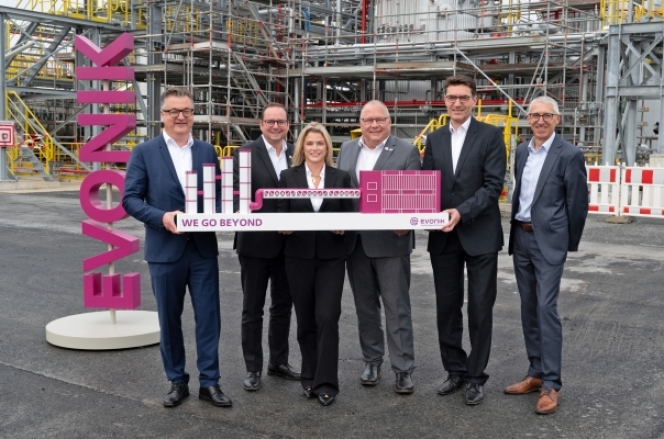
Evonik, a global speciality chemicals company, has completed a EUR 52 million expansion of its silicone platform at the Essen Goldschmidtstrasse site in Germany, constructing a new production plant and a large tank farm. The facility raises output capacity for organomodified silicones, a core product group in the company’s global silicone network.
The Essen site operates as a central node in that network, closely tied to Evonik facilities in Geesthacht, Obernburg and Wittenburg in Germany, Pandino in Italy, Shanghai in China and Hopewell, Virginia, in the United States. The expansion strengthens the resilience of this international production system by lessening the need to ship intermediates and finished goods between locations.
Logistics infrastructure has been optimised to support more efficient operations. A new 150-metre pipe bridge links four production units and 15 manufacturing assets to the tank farm, which comprises five stainless-steel tanks, the tallest standing 24 metere and holding substantial quantities of key raw materials. The result is steadier production, more robust supply chains and reduced reliance on short-term deliveries. The tank farm has enlarged the Essen site from 32 to 35 hectares.
The project was executed with the site fully operational and despite constrained space, drawing on roughly 80 Evonik employees and over 230 contractors from 25 partner companies. Essen Goldschmidtstrasse also features in Evonik’s newly developed long-term plans, which assign a clear profile to each of six major production sites – Essen Goldschmidtstrasse, Marl, Wesseling, Darmstadt/Weiterstadt, Rheinfelden and Hanau – as guidelines for future development. Under this framework, Essen Goldschmidtstrasse is positioned as a centre of excellence for customer-specific formulations.
Lauren Kjeldsen, the Evonik Management Board member responsible for the Custom Solutions segment, to which the business belongs, said, “This expansion strengthens our silicone production platform, enhancing supply chain resilience and creating a strong foundation for profitable growth. This latest investment highlights the important role that our innovative German sites play in the success of our global operations.”
Roberto VilaKeller, head of the responsible Business Line Interface & Polyurethane Additives, said, “The investment in Essen strengthens our global production network and further enhances our ability to serve customers reliably around the world. It significantly expands our production capabilities, reduces potential bottlenecks and creates opportunities for future growth in attractive markets.”
Thomas Kufen, Mayor of Essen, said, “At a time when industrial investment is more important than ever, projects of this scale send a strong signal for Essen’s economy and the wider region. They secure high-quality jobs, strengthen competitiveness and demonstrate the international attractiveness of our city as an industrial hub.”
- Association of Natural Rubber Producing Countries
- ANRPC
- Natural Rubber
- Monthly NR Statistical Report
ANRPC Publishes Monthly NR Statistical Report For September 2026
- By TT News
- October 31, 2026
The Association of Natural Rubber Producing Countries (ANRPC) has published its Monthly Natural Rubber Statistical Report for September 2026, a month marked by broad-based price gains. Firm fundamentals, constrained supply and steady downstream demand combined with geopolitical and macroeconomic uncertainty to lift prices. Renewed Middle East conflict and disruptions to major shipping routes weighed on sentiment, while energy markets were especially affected by the closure of the Strait of Hormuz and attacks on transiting vessels, which raised risks to global energy supplies and strengthened the crude oil risk premium.
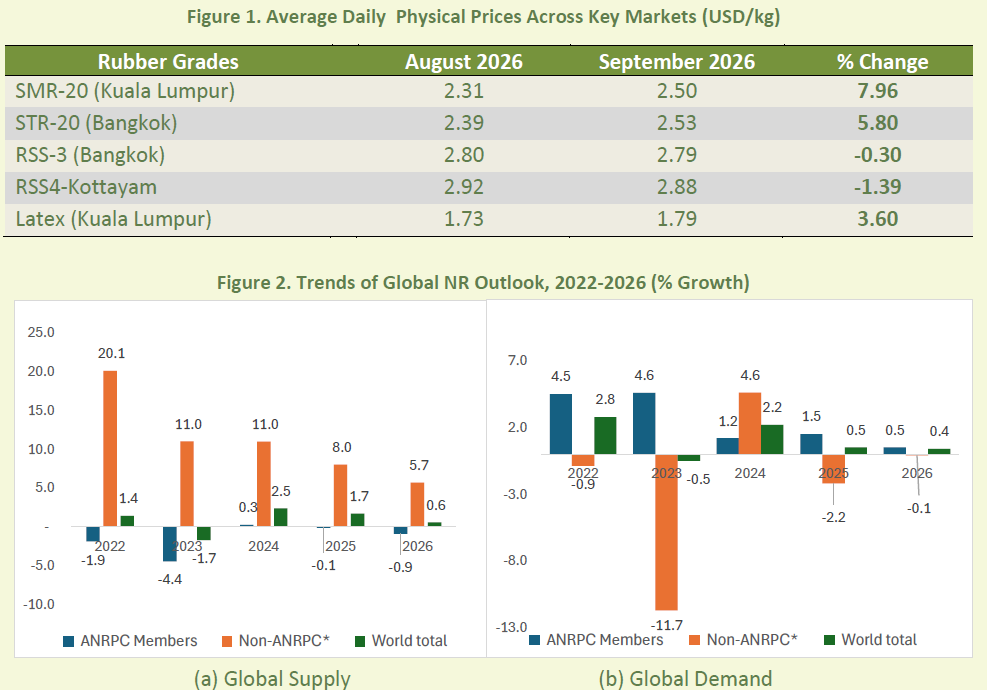
According to the report, physical prices for most major grades advanced. SMR-20 in Kuala Lumpur averaged USD 2.50/kg, up 7.96 percent month-on-month, and STR-20 in Bangkok rose 5.80 percent to USD 2.53/kg. RSS-3 in Bangkok slipped 0.30 percent to USD 2.79/kg, while RSS-4 in Kottayam eased 1.39 percent to USD 2.88/kg. Latex-in-bulk in Malaysia gained 3.60 percent to average USD 1.79/kg. Cautious tyre-manufacturer purchasing, limited to immediate needs after earlier increases, weighed on the RSS market. Latex drew support from tight supply, as persistent rainfall disrupted tapping and limited fresh and concentrated latex availability, while glove, healthcare and industrial demand held stable.
Trade flows diverged. China's imports grew 2.56 percent month-on-month, India's 11.36 percent and Malaysia's 17.85 percent, whereas Viet Nam's fell 3.40 percent. Exports rose 3.07 percent in Thailand, 7.30 percent in Malaysia and 1.91 percent in Cambodia, while Indonesia edged down 1.40 percent and Viet Nam recorded the steepest decline at 9.72 percent.
Global production is projected at 15.039 million tonnes in 2026, up 0.6 percent from 14.953 million tonnes in 2025, with September output estimated at 1.4 million tonnes. Uneven rainfall and elevated temperatures slowed supply recovery across Southeast Asia. Global demand is forecast to rise 0.4 percent to 15.356 million tonnes from 15.301 million tonnes, with the largest volume increases among ANRPC member countries. Prospects depend on vehicle sales, tyre production, shipping conditions and weather-related disruptions, while expanding electric-vehicle markets in China, India and Europe support modest growth.
The ringgit traded between RM4.04 and RM4.10 per US dollar, and the baht between THB 32.89 and 33.55. The SHFE January 2027 contract averaged CNY 19,070/tonne, up 5.3 percent month-on-month, and the SGX December 2026 contract averaged USD 2.41/kg, up 7.6 percent. Brent crude averaged USD 114.16 per barrel, a 25.3 percent monthly increase driven by geopolitical risks and shipping disruptions through the Strait of Hormuz.
- Birla Carbon
- Carbon Black
- Sustainable Carbonaceous Materials
- Sustainable Carbon Blacks
- International Rubber Conference
Birla Carbon To Showcase Electric Mobility-Focused Carbon Black Portfolio At IRC 2026
- By TT News
- October 28, 2026

Birla Carbon, a leading global supplier of carbon materials, will exhibit at the International Rubber Conference (IRC) 2026, scheduled for 2–6 November in Nagoya, Japan, at Booth B. The company aims to address application-specific demands arising from the shift towards electric mobility, which places greater emphasis on tyre wear and energy efficiency while requiring automotive rubber components to balance durability with ride comfort.
A Very High Structure (VHS) lineup awaits manufacturers of passenger car, light truck, truck and bus tyres. These grades were engineered to meet electrification requirements and tightening standards such as Euro 7, delivering gains in tread wear, energy efficiency and tyre longevity.
Sustainability also features prominently. The company's Continua Sustainable Carbonaceous Materials (SCM) and Sustainable Carbon Blacks (SCB) lines, which contain higher levels of recycled or bio-based material, are intended to help tyre makers pursue circularity targets. Their dependable quality and ability to be supplied at scale in large volumes make them viable for production use, and the Continua range carries ISCC PLUS certification.
Mechanical rubber goods round out the display. Grades aimed at bushings enhance mixing and dispersion, contributing to fatigue life and component durability, while formulations for mounts pair low hysteresis and low stiffness with reinforcement so that durable parts can be produced without sacrificing ride comfort. Drop-in grades for extrusion reduce defects, scrap and screen-pack changes while raising throughput and extending service life. Simulation and technical expertise help customers assess materials, and global production plus Asian capacity growth support long-term supply.
Amit Kumar, President – Asia, Birla Carbon, said, “Asia’s tyre and rubber manufacturers are shaping the next phase of mobility, and their material requirements are becoming increasingly stringent. As the clear leader in our industry, Birla Carbon aims to grow alongside our customers, combining application-focused innovation with dependable local supply. We see performance and circularity as priorities that must progress together. By expanding our capabilities in Asia and strengthening customer partnerships, we aim to help manufacturers meet evolving market needs and build greater long-term competitiveness.”


Comments (0)
ADD COMMENT