

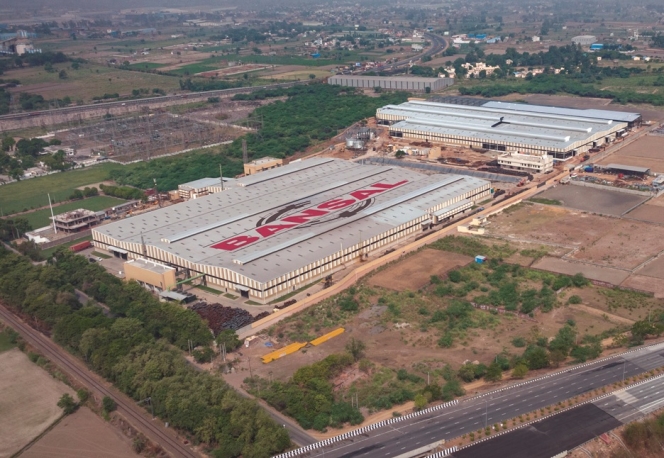
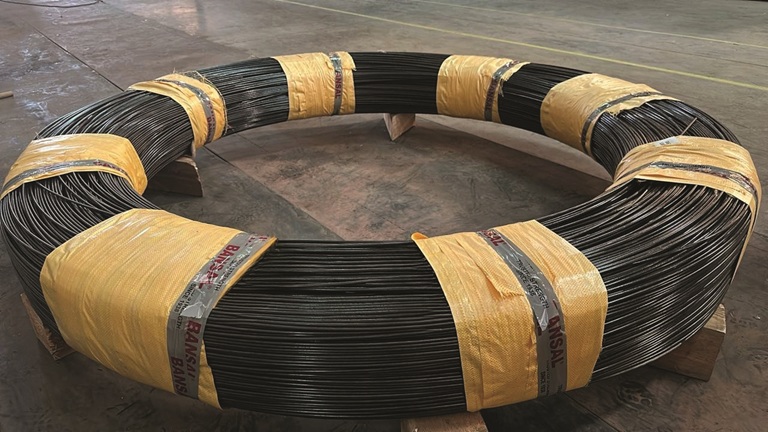
Bansal Wire Industries makes steel wire – bead wire for tyres, springs for suspension systems, cables for automotive assemblies – the sort of components that disappear into finished products and are only noticed when they fail. It is a business built on specification sheets and delivery schedules, not product launches.
Yet the company is in the middle of something that warrants attention. Installed capacity now exceeds 600,000 tonnes. Volumes in the most recent fiscal year grew by over 30 percent. The company is entering the steel tyre cord segment – a product India has never meaningfully manufactured domestically – and is simultaneously pushing into higher-specification wire grades that command better margins and serve more demanding applications.
Pranav Bansal, the Managing Director and Chief Executive Officer, attributes none of this to fortune. The automotive sector is changing, he says – electrification, premiumisation, tighter quality requirements across the supply chain – and the company has been positioning itself for those changes for some time. The conversation that follows is about where that positioning leads.
AUTOMOTIVE TAILWINDS
The automotive sector, he says, is at the centre of everything. Not because car sales are booming – though they are – but because the nature of what a car now demands from its components has changed in ways that reward exactly what his company does.
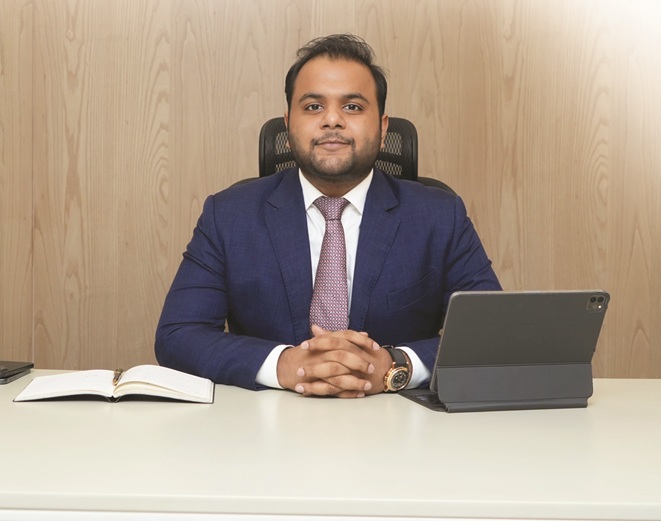
“Across vehicle segments, there is a clear increase in requirements for reliability and consistency in core components. This directly impacts demand for steel wire products used in applications such as tyre bead wire, steel tyre cord, springs, auto cables and other critical automotive components where performance and durability are essential, “he says.
The shift towards electric vehicles has sharpened that dynamic considerably. EVs are heavier than their internal combustion equivalents. That additional weight increases mechanical stress on every load-bearing component, including tyres. Premium tyre grades – already in growing demand as Indian consumers trade up – require reinforcement materials built to tighter tolerances. The thread running through all of it is quality: the ability to hold a specification, batch after batch, without drift. That is, in Bansal’s telling, precisely what the company has spent years building the capacity to deliver. “While infrastructure and engineering continue to support overall demand, the automotive sector remains a key driver, both in terms of scale and the evolution of product requirements,” Bansal says.
THE CORD BET
The more immediately consequential wager, however, is steel tyre cord – the high-tensile reinforcing material woven into a tyre’s carcass and belt structure. It is a product that India has, for the most part, not made. The domestic tyre industry has historically imported it, primarily from a small number of established global producers. Bansal Wire intends to change that.
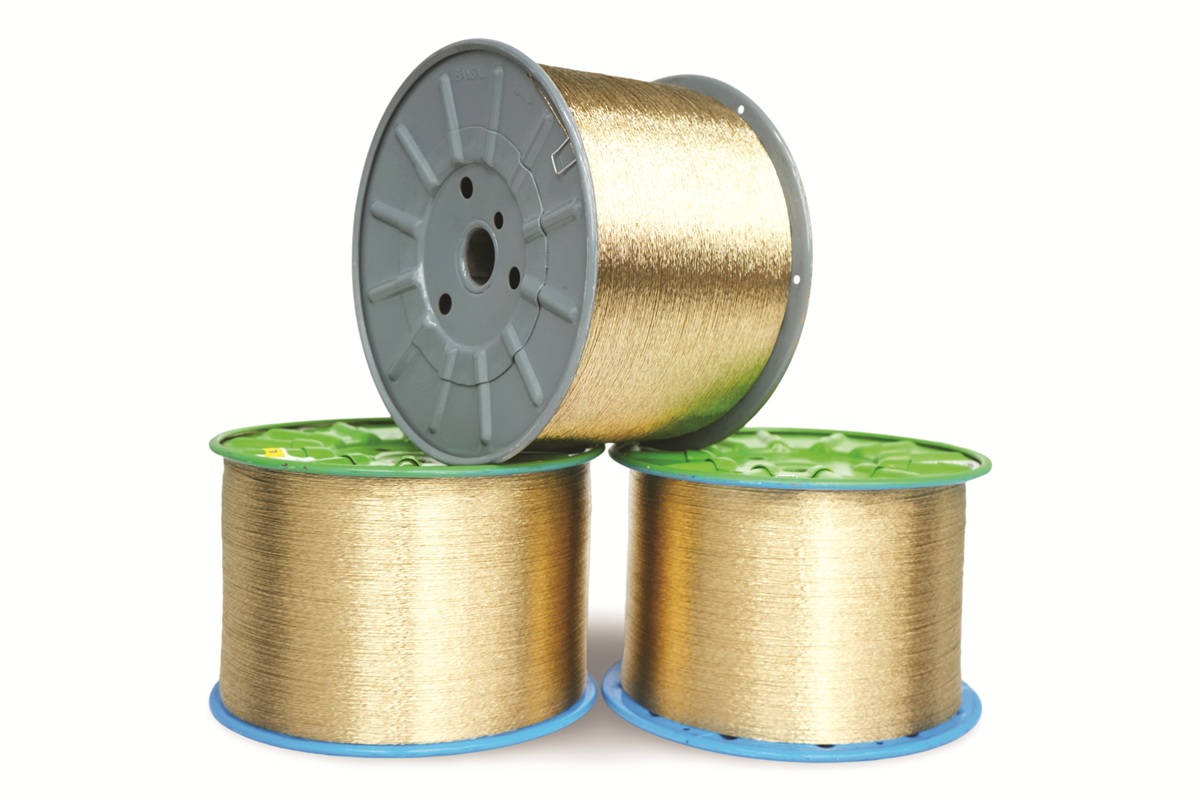 "India currently relies on imports of steel tyre cord, creating a strong opportunity for domestic manufacturing. Our entry into this segment is a focused step towards building this capability in India," Bansal says.
He is careful about how he frames the competitive case. Steel tyre cord is not a market one enters by undercutting on price. Global tyre OEMs run structured, multi-stage validation processes before approving a new supplier, and those processes are neither quick nor forgiving. Bansal does not try to compress that timeline rhetorically. “Approvals from global OEMs follow a structured and time-intensive process, involving multiple validation stages. Our approach is to build capability, demonstrate consistency over time and then scale relationships once approvals are in place,” he explains.
What he is offering, in the near term, is not a displacement of established players but a domestic alternative for a supply chain that has good reason to want one. The argument intersects neatly with national industrial policy – Make in India, Atmanirbhar Bharat – without depending on it. The structural case stands independently: a reliable domestic source of a critical input, available without the freight, lead time and currency exposure that imports carry. The company is simultaneously working towards pairing steel tyre cord with bead wire, which it already produces. For a tyre manufacturer, sourcing from a single domestic supplier simplifies procurement considerably and improves supply assurance. That integration is central to the pitch.
MOVING UP
Alongside the tyre cord push, Bansal Wire has launched in-house-treated, oil-hardened and tempered wires – products used in high-performance automotive applications such as valve springs and suspension components. These are not commodity lines. They require tighter dimensional tolerances, more demanding heat-treatment processes and more rigorous quality documentation than standard wire grades. They also command better margins.
“Unlike standard wires, these applications require tighter specifications and greater reliability, which allows for better realisation and more stable margins over time,” Bansal says.
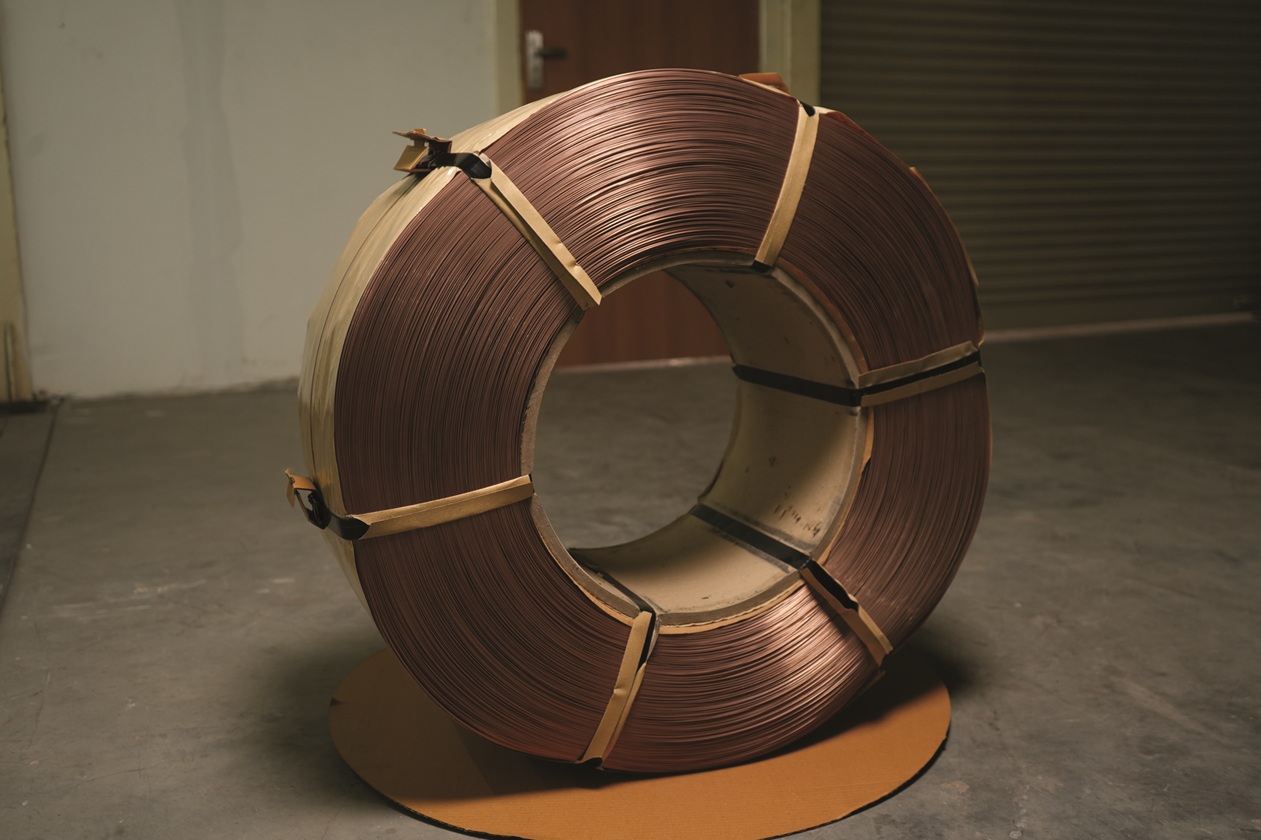
The logic of the portfolio shift is deliberate. Moving into higher-specification products does not require abandoning the volume business – the two coexist within the same manufacturing footprint – but it gradually shifts the revenue mix. As speciality products take a larger share of output, the company becomes less exposed to commodity price cycles and more valuable to customers with fewer alternative suppliers. “This allows us to move higher up the value chain while maintaining a balanced portfolio and positions us well to support future requirements of the automotive industry,” Bansal says. It is a repositioning years in the making, and he shows no impatience with its pace.
PLI AND CAPITAL
Bankrolling part of that transition is a commitment of INR 700 million under the Production-Linked Incentive Scheme for speciality steel, which will fund approximately 90,000 tonnes of new capacity at the company’s Sanand facility. The PLI incentive improves the investment’s return profile; the speciality focus means the new capacity generates better margins per tonne than an equivalent expansion of a commodity would. “This investment is therefore aimed at strengthening our product mix and supporting long-term growth,” Bansal says.
Expansions are also underway at the Dadri facility. Bansal’s framework for thinking about capital allocation across sites is deliberately non-ideological. He does not treat brownfield and greenfield as competing philosophies, or as choices that require one to be favoured over the other. “We look at brownfield and greenfield not as separate choices but as complementary approaches depending on the requirement,” he says. Brownfield works where existing infrastructure can be leveraged and operational continuity matters; greenfield is necessary when new technical capabilities need to be built without the constraints of a legacy layout. Steel tyre cord, given its technical specificity, falls clearly into the latter category.
In both cases, investment decisions are anchored in demand visibility, not just growth goals. “We focus on measured capital deployment, emphasising efficiency, consistency and long-term value over scale for its own sake,” he says. Industry overcapacity can erode returns, so maintaining this restraint is vital.
MARGIN ARCHITECTURE
That instinct for discipline extends to how the company manages its cost structure day to day. Bansal Wire operates on a cost-plus basis, which provides a degree of insulation from raw material price volatility that purely market-priced competitors lack. The model means that swings in wire rod costs – the primary input – do not automatically compress margins as they might for a company selling at fixed market prices.
Combined with rising asset utilisation – which distributes fixed costs across higher volumes as the capacity base fills – the model has allowed the company to grow margins alongside revenue. “As utilisation increases, fixed costs are distributed across higher volumes, which supports margins,” Bansal explains. The simplicity of the statement belies the operational consistency required actually to deliver it.
Customer retention has also played a role that Bansal is reluctant to understate. The company’s key customer relationships have proved durable over time, and Bansal notes that retention among its most important accounts has remained strong. That durability provides demand visibility – a meaningful advantage when planning capacity additions – and reduces the kind of revenue volatility that can destabilise an investment cycle.
EXPORT AMBITIONS
Bansal Wire currently serves customers in more than 50 countries. The geopolitical turbulence of recent years has not prompted a strategic retreat from export markets, though it has reinforced the value of running a diversified book. Global supply chain disruptions have increased international buyers’ appetite for suppliers who can demonstrate reliability and financial stability. “Demand across markets has remained stable, and global customers continue to look for reliable suppliers,” Bansal says.
The company intends to maintain a balanced split between domestic and international revenue, expanding both in parallel rather than trading one off against the other. India’s domestic demand base – across automotive, infrastructure and industrial sectors – provides the stability and visibility that allows the export business to be pursued opportunistically rather than defensively. Bansal says, “Going forward, we will continue to strengthen both domestic and export markets. The focus will be on maintaining a balanced mix while expanding our presence in key international markets.”
TECHNOLOGY’S ROLE
Underlying all of it is a sustained wager on technology – specifically, on the role of automation and in-house research and development in sustaining quality at scale. In the speciality segments Bansal Wire is moving into, process control is not incidental to the value proposition. It is the value proposition. Steel tyre cord that varies from one coil to the next is not the steel tyre cord that a global OEM will put through qualification. The margins that speciality products command exist precisely because producing them consistently is difficult.
“We are investing in advanced machinery, automation and in-house R&D to strengthen these capabilities. Automation and process improvements help us maintain consistent quality while operating at higher volume,” Bansal says. The investment extends beyond equipment to the quality systems, testing infrastructure and technical personnel needed to operate at the standards global customers require.
Industry trends, he argues, only reinforce the case for continued investment. Demand for high-performance wire products across automotive and industrial applications is rising, driven by the same forces – electrification, premiumisation and tighter safety standards – that are reshaping the broader materials landscape. In that context, technology is not a discretionary spend. It is the price of remaining relevant.
Vipal Rubber Launches VT290 Tread For European Truck Market
- By TT Bureau
- October 13, 2026
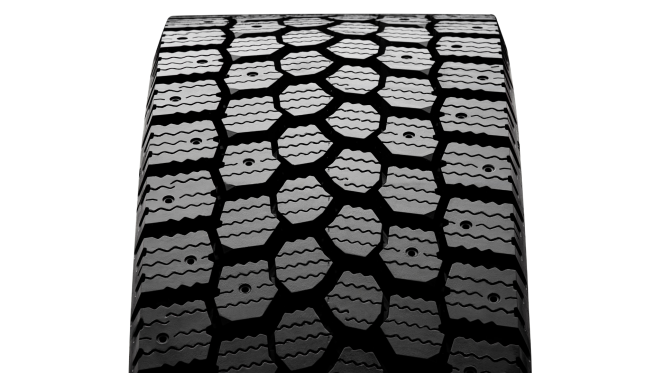
Vipal Rubber has launched the VT290, a tread designed for truck drive axles used on motorways and paved roads, targeting regional and long-distance transport operations in Europe.
The product is available in widths of 240mm, 250mm, 260mm, 270mm and 280mm. It is designed to provide traction and stability on dry and wet roads, as well as in demanding conditions involving snow.
Frederico Schmidt, General Manager of Vipal EMEA, said, “The launch of the VT290 reinforces Vipal’s ongoing commitment to offering technologically advanced solutions suited to the specific characteristics of European roads and climate.” “We want to further consolidate our presence in the region, delivering a high value-added product that combines innovation, operational efficiency and safety,” he added.
The VT290 carries the M+S marking and 3PMSF certification. Its design includes side sipes and grooves intended to help remove snow and mud from the tread, improving grip on slippery surfaces.
The tread pattern is also designed to distribute engine torque more evenly, helping to reduce uneven wear. Tie bars between the tread blocks add structural stability, supporting vehicle control during driving.
Fabrício Nedeff, Commercial Manager of Vipal EMEA, said, “With the VT290, weare responding directly to the real needs of fleet operators and truck drivers, combining performance, adherence and efficiency in different driving conditions. [RS2.1]In addition to expanding options for our customers, the product strengthens business opportunities for our partners in the region,”
Vipal said the launch would expand its offering for retreaders, distributors and fleet operators in the European market.
- Association of Natural Rubber Producing Countries
- ANRPC
- Monthly NR Statistical Report
- Natural Rubber
ANRPC Publishes Monthly NR Statistical Report For August 2026
- By TT News
- October 02, 2026
The Association of Natural Rubber Producing Countries (ANRPC) published its Monthly Natural Rubber Statistical Report for August 2026, noting firmer prices in several markets. Supply constraints, stable downstream demand and persistent geopolitical and macroeconomic uncertainty shaped the month. Renewed conflict and disruptions to major shipping routes added further pressure.
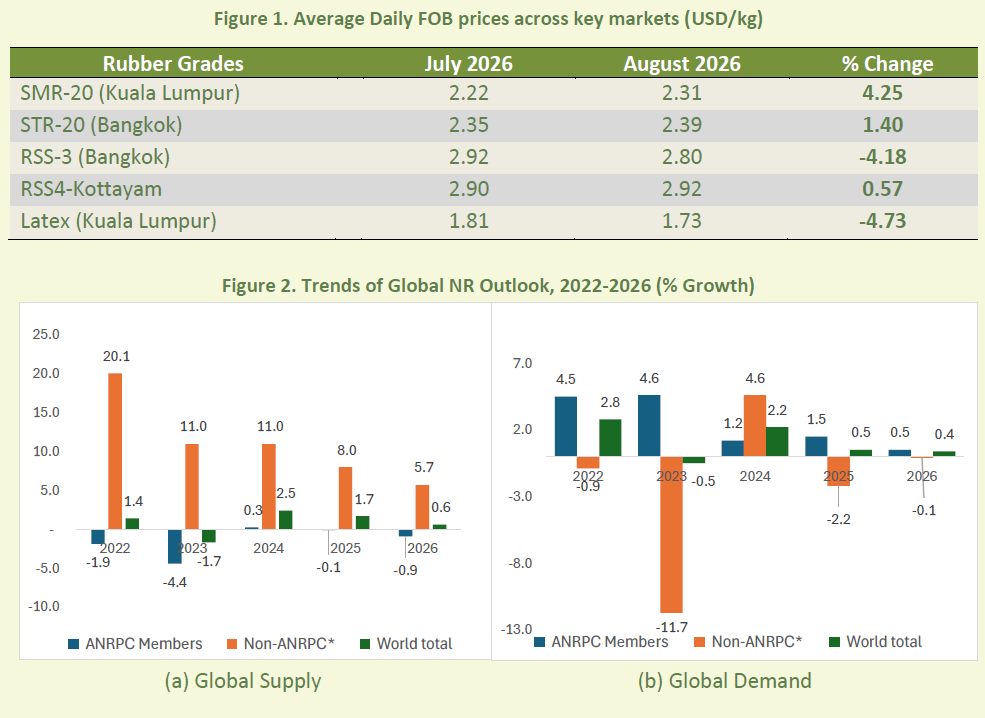
Physical prices for major grades moved in different directions. SMR-20 in Kuala Lumpur averaged USD 2.31 per kg, up 4.25 percent from July, while STR-20 in Bangkok rose 1.40 percent to USD 2.39 per kg. RSS-3 dropped 4.18 percent to USD 2.80 per kg, but RSS-4 in Kottayam gained 0.57 percent to USD 2.92 per kg. Latex-in-bulk fell 4.73 percent to USD 1.73 per kg. Brent crude averaged USD 91.08 per barrel, driven by concerns over possible restrictions on oil shipments through the Strait of Hormuz and wider Middle East instability, which raised energy supply risks and strengthened the oil market risk premium.
On trade, China's imports climbed 3.39 percent month-on-month, while India fell 10.18 percent and Malaysia dropped 8.24 percent; Viet Nam rose 5.08 percent. Exports advanced 5.63 percent in Viet Nam but declined in Thailand (-5.24 percent), Indonesia (-5.36 percent), Malaysia (-1.48 percent) and Cambodia (-1.88 percent).
Global production is projected to rise 0.6 percent to 15.039 million tons in 2026 from 14.952 million tonnes in 2025, after revisions to Thailand's 2025 output and updated 2026 estimates for Thailand, Malaysia and Indonesia. Weather, including erratic rainfall and drier Southeast Asian conditions, affected output. August 2026 production was estimated at 1.396 million tonnes, down 4.51 percent from 1.462 million tonnes a year earlier. Demand is forecast to grow 0.4 percent to 15.356 million tonnes in 2026 from 15.301 million tonnes, with the largest consumption gains expected in China, Malaysia and Cambodia. Prospects depend on vehicle sales, tyre production, shipping conditions and weather-related supply disruptions, while steady EV-linked demand supported modest growth led by China and India. The ringgit traded between RM4.02 per USD and RM4.09 per USD, and the baht between 32.68 and 33.34. The SHFE January 2027 contract averaged 18,109 CNY per tonne, up 7.78 percent month-on-month, while the SGX November 2026 contract averaged USD 2.24 per kg, up 4.32 percent.
Epsilon Carbon Advances Scope 3 Emissions Measurement Across Value Chain
- By TT News
- October 01, 2026
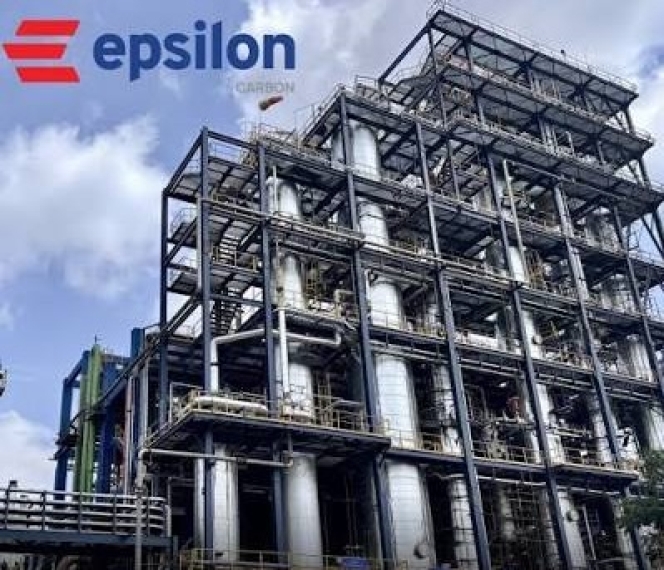
Epsilon Carbon Pvt. Ltd., a global speciality carbon and carbon black manufacturer, has broadened its emissions accounting to include value chain impacts beyond its direct operations. The move advances measurement and management of Scope 3 emissions across its supply and distribution network, according to the company.
The initiative spans Epsilon Carbon’s integrated carbon complex in Vijayanagar, Karnataka. That site has a production capacity of 500,000 tonnes per annum of speciality carbon and 215,000 TPA of carbon black. It combines carbon manufacturing with energy circularity efforts in one integrated ecosystem. The company assessed material Scope 3 categories under GHG Protocol guidelines.
Scope 3 emissions are indirect and arise from purchased goods and services, transportation, business activities and downstream product use where relevant. The assessment gives Epsilon Carbon clearer visibility into emissions outside its direct control and a foundation for spotting reduction opportunities. It builds on existing operational emissions and energy efficiency work.
The company previously reported a 98 percent Scope 2 reduction against its baseline year. A 17 MW captive power plant uses waste heat from carbon black operations, energy consumption intensity fell 6 percent from baseline, and 77 percent of energy needs came from waste heat recovery, avoiding over 89,000 tonnes of CO₂. Epsilon Carbon now emphasises supplier engagement, data transparency and circularity, aligning disclosures with global sustainability frameworks to track value chain emissions consistently and develop measurable reduction initiatives.
Vikram Handa, Managing Director, Epsilon Carbon, said, “Meaningful climate action requires us to look beyond the boundaries of our operations and understand the impact of the entire value chain. Scope 3 measurement gives us greater visibility into the emissions and enables deeper engagement with our partners and suppliers. Building this visibility will help us make more informed decisions as we scale our operations and advance our decarbonization plans.”
HS HYOSUNG To Expand Mexico Investments From 2027 Under New State Agreement
- By TT News
- September 30, 2026
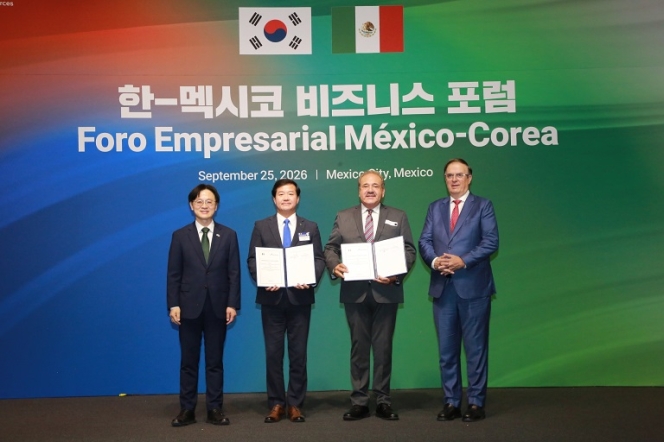
HS HYOSUNG has formalised a memorandum of understanding (MoU) with the State Government of San Luis Potosí, with the signing taking place at the World Trade Center Mexico City. The event formed part of the Korea-Mexico Business Forum, held alongside the Korean economic delegation's visit to Mexico.
Attending officials included Marcelo Ebrard, Mexico's Secretary of Economy, and Mario García Valdez, Secretary of Economic Development of San Luis Potosí. The two sides confirmed their shared resolve to back the company's local investment and regional growth. Separately, HS HYOSUNG's leadership met bilaterally with Secretary Ebrard to elaborate on its strategic vision and investment plans.
The agreement sets out a phased expansion of HS HYOSUNG's investments in San Luis Potosí beginning in 2027, with the goal of creating a major advanced materials production hub that bolsters supply for North American and wider global markets. The company's advanced materials span tyre cord, a flagship world-leading product, along with mobility, energy, aerospace and defence applications. Its North American operations, spanning Mexico and the United States, turn out tyre cord, airbag materials and mobility interior components for global leaders such as General Motors and Goodyear, underpinned by a highly dependable global supply chain.
Nak-yang Sung, CEO, HS HYOSUNG ADVANCED MATERIALS, said, “This investment goes beyond establishing a simple manufacturing base – it reflects our strategy to turn Mexico into a pivotal hub connecting North America with global supply networks. We are also committed to strengthening local supply chains and creating high-quality jobs to contribute directly to the region's industrial ecosystem.”

Comments (0)
ADD COMMENT