

Continental’s Focus On Reducing Operating Costs Of Fleets
- By TT News
- March 24, 2025

Continental is giving the total cost of ownership (TCO) of a fleet even more consideration when creating tyres for commercial vehicles. The company is focusing on retreading and rolling resistance as crucial components for lowering operating costs and creating more environmentally friendly transportation.
The most significant challenge, according to the recent study ‘The Future of Fleets’, which was presented by Continental at the end of 2024 and was based on a Dataforce survey of 850 fleet managers from France, UK, Germany and US, is rising costs, which are followed by economic uncertainties brought on by crises (46 percent) and the need to reduce CO2 emissions (40 percent). Continental claims that retreaded tyres are substantially less expensive than new tyres and that tyres with optimal rolling resistance help conserve fuel and lower CO2 emissions. Furthermore, Continental truck, van and bus tyres satisfy all specifications needed to be used on battery-powered electric vehicles.
Explaining the significance of rolling resistance with regard to TCO, Hinnerk Kaiser, Head of Product Development Bus and Truck Tyres EMEA at Continental, said, “For fleets with diesel vehicles, our TCO calculation shows that a tyre with optimised rolling resistance and lower mileage can be the more efficient product. The new Conti Eco 5 performs well in both regional and long-distance transport. We are talking about an improvement of up to 12 percent in rolling resistance and up to 10 percent in mileage compared to the previous model.”
Regarding the importance of retreading, he said, “Our ContiLifeCycle concept has been successfully established on the market for years. Retreaded tyres are about 40 percent cheaper than new tyres – with the same safety and mileage. What's more, we use around 70 percent less material than for a new tyre. If we retread the sidewall and tread of a casing twice, we get three tyre lives. This amounts to a total saving of EUR 500 to 600 compared to buying three new tyres.”
By 2030 at the latest, battery electric trucks (BEV) should be the most economical choice in the majority of classes, according to the International Council on Clean Transportation (ICCT). The ICCT analysed the total cost of ownership of several truck drives in Europe for the current study, ‘Vision 2050 – Update on the global zero-emission vehicle transition in 2024’. According to the analysis, by the end of 2025 or the start of 2026, the total cost of ownership for heavy-duty long-haul trucks should be the same. These predictions align with the findings of Continental's fleet study. The results show that 65 percent of fleet managers have either made an investment in alternative drive technologies already or are actively considering doing so, whereas 61 percent want to increase efficiency by saving fuel or energy in the next five years.
Maxam Expands Solid Skid Steer Range With Non-Marking MS705 NM Tyre
- By TT News
- September 29, 2026
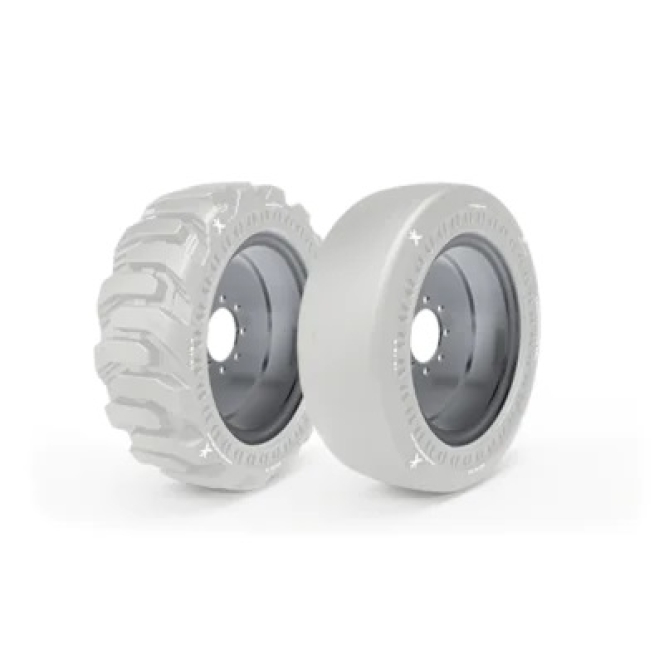
Maxam Tire has broadened its range of solid skid steer tyres by launching the MS705 NM, a non-marking iteration of its current MS705 model. The new tyre targets construction machinery operated indoors or on surfaces where leaving marks is undesirable.
By pairing the resilience of a solid tyre with a non-marking tread compound, the MS705 NM suits jobs that demand protection for finished flooring and other delicate surfaces. Its solid design removes the risk of punctures and sidewall failures while also doing away with regular air pressure checks, which helps lower maintenance demands.
The tyre incorporates a three-stage, all-rubber build and an aperture sidewall that together produce a gentler ride. Steel ring reinforcement internally works to prevent wheel slip, while a heat-resistant cushion centre compound adds durability for tough applications. With this non-marking option, Maxam now gives customers greater flexibility in matching skid steer tyres to specific jobsite needs.
Evonik Reshapes Business Portfolio To Improve Geostrategic Balance
- By TT News
- September 28, 2026
Evonik, a global speciality chemicals company, has outlined a three-year strategy to sharpen its focus and accelerate growth, assigning distinct roles across its business portfolio and setting specific tasks for its major German sites. Targeted growth projects are also intended to improve the group's geostrategic balance. To fund these investments, the company is relying on its Evonik Tailor Made restructuring programme to further reduce its cost base. The plan involves cutting 3,200 jobs worldwide, with roughly 2,150 of those losses falling in Germany.
At the annual strategy meeting, the executive and supervisory boards reviewed plans through 2030. Interim CEO Claus Rettig said the industry faces a structural and economic crisis, and Evonik will use this polycrisis to reshape old structures and improve its positioning. Many parts of the business are still growing, so efforts will concentrate on strengths, future topics and lucrative markets, with better cost positions creating room to manoeuvre.
Transformation will proceed at every level. Healthcare and biotechnology projects in Canada and Slovakia, worth several hundred million euros, will strengthen the portfolio, while business units are aligned by role as growth drivers or cash generators. A new business line, Designed Polymer Solutions, bundles growth areas in aerospace, automotive and gas separation, including biogas and hydrogen. Asia and America offer strong opportunities, and further investments there are under review. Each of the six major German sites will receive a clear profile, with implementation starting shortly.
Evonik is also exiting activities with no internal prospects. Rettig said long-term leadership requires leading in what the company does, and volatility demands flexible responses. Closures of smaller sites fit this approach, and divestments of C4 chemicals and infrastructure are progressing as planned. Tailor Made's second phase begins in 2027 and runs to 2029. Measures will be finalised by late 2026, including unfilled vacancies, early retirements and voluntary severance departures. Chief Human Resources Officer Thomas Wessel said Evonik has long lived social responsibility and maintained intensive dialogue with employee representatives, and this transformation will be completed together.
Continental Tests New TerrainContact A/T2 Across Iceland's Rugged Terrain
- By TT News
- September 28, 2026

Continental recently showcased its new TerrainContact A/T2 tyre during a five-day driving event in Iceland, held from 14 to 18 September 2026. Journalists and invited customers tested the tyre across winding roads, rugged highlands, glaciers and volcanic terrain.
Starting at Þingvellir, the group travelled through Iceland's Western Highlands and the Kaldidalur valley, where gravel routes highlighted the tyre's blend of on-road comfort and off-road traction. The TerrainContact A/T2 targets pickup and SUV owners who mainly drive on pavement but require extra grip when conditions change.
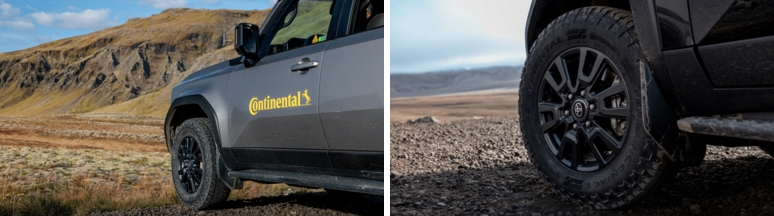
Compared with its predecessor, the tyre offers better wet braking and snow traction while preserving a quiet ride and off-road ability. A new tread compound boosts wet performance, greater tread depth aids snow grip, and optimised zig-zag grooves and traction teeth add control on loose or snowy surfaces. It carries the Three-Peak Mountain Snowflake symbol and is engineered with electric vehicles in mind.
Okan Sen, National Marketing Manager, Continental Tire Canada, said, “The TerrainContact A/T2, as one of the best-balanced performance all-terrain tyres in the market, was developed for drivers who want the freedom to explore without compromising their everyday driving experience. Iceland was the perfect setting to bring that versatility to life, giving attendees the opportunity to experience the tire across the kind of changing terrain it was designed to handle.”
Tyres Europe Study Urges EU Industrial Policy To Look Beyond Raw Materials
- By TT News
- September 28, 2026
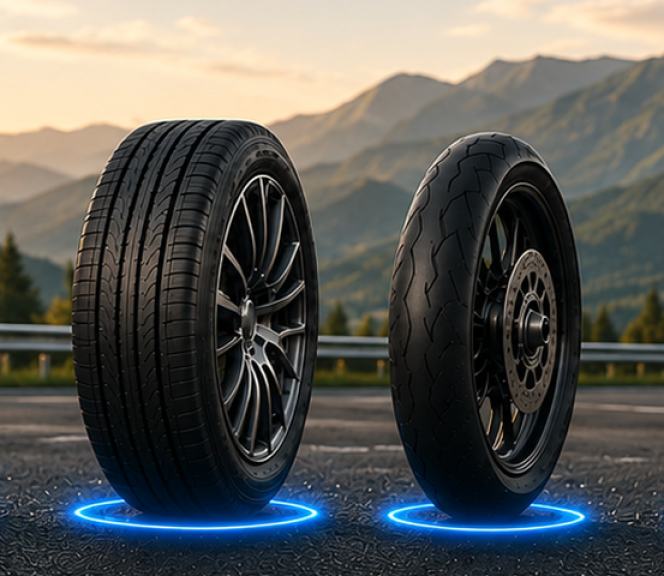
A new Oxford Economics study commissioned by Tyres Europe underscores the tyre sector's vital economic and social contribution, arriving as Brussels shapes its Industrial Accelerator Act to reinforce European industrial competitiveness. The report, titled ‘The Critical Importance of the EU Tyre Industry’, makes the case that EU industrial policy ought to encompass the finished products sustaining Europe's economy and essential services, rather than focusing solely on raw materials and technologies.
Through the lens of tyres, the research maps the relationships between European manufacturing capacity, reliance on external sources and the smooth operation of mobility, freight and public services. It concludes that EU-produced tyres potentially enabled freight, agriculture and passenger transport, directly yielding EUR 1.5 trillion in GDP – 9 percent of the EU's total – and providing work for 30.5 million people, 13 percent of EU employment.
The study further reveals exposure on both sides of the tyre value chain. Imported intermediate inputs constitute 11.9 percent of EU tyre production value, exceeding the EU economy average of 7 percent, while natural rubber supplies depend wholly on imports. In 2024, imported tyres made up 40 percent of newly fitted tyres across the EU, a proportion that continues to climb.
Adam McCarthy, Secretary General, Tyres Europe, said, “Economic resilience depends not only on access to materials but also on retaining the capacity to transform them into safe, advanced products in Europe. The Industrial Accelerator Act is an opportunity to recognise strategically-important finished products and support competitive manufacturing in Europe. A strong EU tyre manufacturing base reduces reliance on external suppliers and helps build a more resilient, competitive automotive value chain.”
Pete Collings, Managing Director, Oxford Economics, said, “Europe’s tyre industry is far more than a manufacturing sector: it is a critical enabler of mobility, trade and wider economic activity. Our analysis shows that EU-produced tyres support hundreds of billions of euros in GDP and millions of jobs across key customer sectors, while the industry itself depends on complex global supply chains. The findings underline the economic value of maintaining a strong European tyre manufacturing base.”

Comments (0)
ADD COMMENT