

CEAT’s Road Ahead Sustainability, Scale And A Five-Year Innovation Roadmap
- By Nilesh Wadhwa
- December 15, 2025
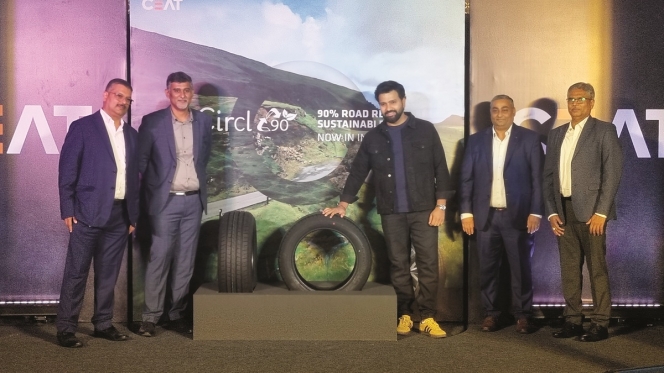
With a series of new product launches aimed at meeting diverse needs, CEAT aims to target new set of customers who are looking beyond just cost.
Mumbai-based RPG Group’s flagship company CEAT, one of India’s most recognisable tyre brands, is at the cusp of a transformation. From being known for durability and value-for-money tyres, the company is repositioning itself as a technology and sustainability leader – offering products that don’t just meet performance benchmarks but also embody environmental responsibility.
The company recently launched SecuraDrive CIRCL, a limited-edition road-ready tyre with up to 90 percent sustainable materials. This feat makes the company one of the few global players to have introduced sustainable tyre that is just not a concept but a ground reality.
For CEAT, the immediate priority is to educate consumers about sustainable tyres. With the launch of the SecuraDrive CIRCL, available in limited numbers (264 tyres), it is taking a deliberate step to spark conversations around eco-conscious choices.
Lakshmi Narayanan B, Chief Marketing Officer, CEAT Tyres, told Tyre Trends, “The first piece is customers becoming aware. This isn’t just a conceptual product – it absolutely matches the performance of a conventional tyre. The idea is to give consumers a clear-cut option and an opportunity to buy into the philosophy of sustainability.”
The company has introduced two variants for the CIRCL range – Circle 50 (50 percent sustainable content) and Circle 90 (90 percent sustainable content). The limited-edition approach, according to CEAT, is intentional. “We want consumers to make a conscious choice to understand the value of sustainability in a product they use daily,” he added.
The focus, then, is not only on selling a product but on creating a new mindset. As Lakshmi Narayanan B put it: “This is as much a product story as it is a brand story. We want consumers buying into it for the right reasons.”
FROM CONCEPT TO MANUFACTURING REALITY
While many companies experiment with prototypes or pilot runs, CEAT insists that its CIRCL tyres are not small-scale experiments. Instead, they are proof of manufacturing readiness at scale.
“When you can make 264 tyres using 90 percent sustainable content, you have the capability to scale it up to any number,” said Lakshmi Narayanan B, pointing to the three years of dedicated work on CIRCL within CEAT’s broader five-year innovation journey. “This is not a pilot run – it’s literally scale manufacturing. What you see today is the outcome of years of work,” shared Lakshmi Narayanan B.
The company has also leveraged its past innovations – such as run-flat tyres and CALM technology – to strengthen manufacturing processes. “Each innovation adds capability. Whether it is sourcing sustainable materials or manufacturing in a new way, we’re now confident of handling such things at scale,” he explained.
For CEAT, scale is not just about numbers but about readiness. “We have proven that sustainability and performance can co-exist. And when consumer interest builds, we are absolutely ready to scale this into mainstream adoption,” Lakshmi Narayanan B added.
EMBEDDING SUSTAINABILITY ACROSS VALUE CHAIN
The tyre major recognises that sustainability cannot be restricted to a single product line – it must cut across the entire value chain. Renji Issac, Senior Vice President – R&D and Technology, CEAT Tyres, pointed out that CIRCL is only the beginning. “All the learnings from this programme will flow into circular product development, extended producer responsibility (EPR) and end-of-life tyre management. Sustainability doesn’t stop at manufacturing – it extends to what happens after the product’s lifecycle,” said Issac.
This approach also means working closely with suppliers, including MSMEs and startups, to adopt new processes and materials. “Initially there was resistance; why should they change (suppliers)? But over time, they have seen the opportunity. Today, our entire supplier ecosystem is committing to our sustainability goals. It’s a challenge but also a transformation,” averred Lakshmi Narayanan B.
Issac added that part of CEAT’s role has been to handhold startups developing new materials, helping them scale their innovations into market-ready solutions. “Some of these materials come from startups, and it’s not just about us developing the product. We are helping them bring their products to market,” he explained.
This ecosystem development is crucial because CEAT believes that innovation is only as strong as its supply chain. “It’s not only about what we make in-house but how the entire chain contributes to sustainability,” said Lakshmi Narayanan B.
A STRUCTURED FIVE-YEAR ROADMAP
Looking ahead, CEAT is guided by a five-year roadmap that balances near-term launches with long-term capability building.
Issac explained that CEAT has developed “a very firm two-year plan on products that will hit the market. Beyond that, the next three years are about developing enabling technologies. For every product roadmap, there’s also a technology roadmap and a capability roadmap. This ensures we’re not just reacting to the market but anticipating it.”
This structured approach allows CEAT to introduce innovations faster while preparing for regulatory and consumer shifts globally.
Lakshmi Narayanan B stressed that the company wants to stay ahead of the curve. “Our intent is to be proactive, not reactive. Whether it’s a current trend or a future wave, we want to be in the right place at the right time,” he said.
The roadmap is part of CEAT’s larger R&D strategy, which has already delivered multiple first-to-market products in recent times. “Run-flat tyres, 21-inch ZR rated tyres, CALM technology and now the sustainable tyre – all of these are stepping stones in our long-term direction,” Lakshmi Narayanan B explained.
GLOBAL RELEVANCE WITH INDIAN CONSUMER FOCUS
Although CEAT operates in global markets, the company deliberately chose India as the first market for CIRCL. The rationale is clear: while European demand is often regulation-led, CEAT sees India as a consumer-driven opportunity.
“In Europe, sustainability is often about regulation. In India, we want it to be a conscious consumer choice. That’s why we launched here first – we know Indian consumers are asking these questions, especially EV owners and younger buyers. It’s an early adopter segment, but it will grow,” shared Lakshmi Narayanan B.
The CIRCL tyres will initially be available in 8–10 metros, targeting discerning consumers with compact SUVs and EVs. The company acknowledges that the products come at a premium but insists the value proposition lies in sustainability with uncompromised performance. “The promise is clear: sustainability and performance equal to any conventional tyre,” Lakshmi Narayanan B emphasised.
Looking forward, the company believes the CIRCL project positions it strongly for future regulatory shifts worldwide. “With capabilities like this, we can leapfrog in global markets when the time comes,” Lakshmi Narayanan B noted.
From CIRCL’s limited-edition launch to a broader five-year innovation pipeline, CEAT’s future focus revolves around three pillars:
1. Consumer-first sustainability – creating awareness and demand among discerning buyers, particularly EV owners.
2. Ecosystem transformation – enabling suppliers, startups and partners to align with CEAT’s sustainability vision.
3. Structured innovation roadmap – delivering near-term product launches while building long-term capabilities.
As Issac summed it up: “A sustainable tyre is also a low rolling resistance tyre. There’s no conflict between sustainability and performance. In fact, they move in the same direction.”
“It’s a long game, but we’re happy to take the first step. Future is always bright,” concluded Lakshmi Narayanan B.
Grismer Tire & Auto Service Appoints New CEO And CFO
- By TT News
- September 28, 2026
Grismer Tire & Auto Service, a tyre and automotive service centre operator backed by CenterOak Partners LLC, has named Chris Blanchette as Chief Executive Officer and Mark Hedstrom as Chief Financial Officer. The announcement marks a significant leadership transition for the portfolio company.
Blanchette arrives with over two decades of senior leadership experience in multi-site consumer services, specialising in operations, strategy and business development. He most recently served as Chief Executive Officer of Service Minds, a residential electrical, plumbing and HVAC services provider. His background also includes serving as Chief Operating Officer of QAS, which operates Valvoline Instant Oil Change locations, along with senior operational positions at Advance Auto Parts, Bridgestone Retail Operations and Best Buy.
Hedstrom brings more than three decades of finance expertise to his new role. He previously held the Chief Financial Officer position at W.S. Connelly & Co., a multi-regional specialty distributor, and has also served as Chief Financial Officer for several private equity-backed consumer and distribution companies.
Eric Holter, Managing Director, CenterOak, said, “Chris Blanchette brings highly relevant leadership experience in the automotive aftermarket. He has led complex, multi-location organisations and understands how to translate operational discipline into sustainable growth. Together, Chris and Mark add important depth to Grismer’s leadership team as the Company pursues expansion in existing and new markets.”
Blanchette said, “Grismer’s 90-year history and the trust it has earned with customers set the Company apart. I am excited to join a business with such a strong legacy and see significant
- International Rubber Conference
- Society Of Rubber Science And Technology Japan
- James Busfield
- Nobuyuki Tamura
- Bridgestone Corporation
- Japan Rubber Manufacturers Association
- Aichi International Exhibition Center
- Aichi Sky Expo
Japan To Host International Rubber Conference After Decade-Long Gap
- By TT News
- September 25, 2026
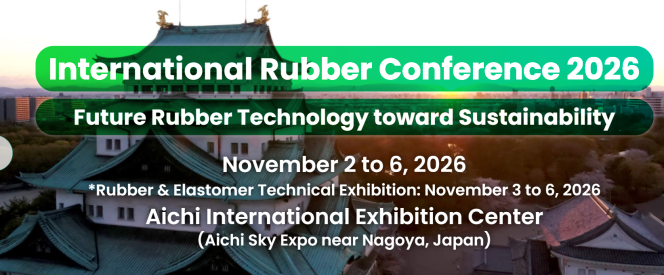
The International Rubber Conference (IRC) will return to Japan in November for the first time in a decade, with more than 271 technical presentations and over 117 exhibitors expected to take part.
The event, known as IRC 2026 Aichi, will be hosted by the Society of Rubber Science and Technology, Japan, alongside the Rubber & Elastomer Technical Exhibition in Aichi. It is scheduled to run from 2nd to 6th November, with the exhibition opening a day later and continuing until 6th November .
Held at the Aichi International Exhibition Center, also known as Aichi Sky Expo, the venue is located near Chubu Centrair International Airport and can be reached from Nagoya Station in about 28 minutes by train.
The conference programme will feature more than 271 presentations spanning rubber science, technology and industrial applications. Participants include James Busfield of Queen Mary University of London and Nobuyuki Tamura of Bridgestone Corporation, who also chairs the Japan Rubber Manufacturers Association. More than 400 delegates have already registered.
Running alongside the conference, the Rubber & Elastomer Technical Exhibition will host more than 117 exhibitors, ranging from raw material suppliers and machinery manufacturers to tyre makers and testing-equipment providers. The exhibition will be open to visitors free of charge.
The International Rubber Conference, first held in 1966, rotates annually across global host cities. The last event in Japan took place in Kitakyushu in 2016, with subsequent editions held in Haikou, Istanbul and Bangkok.
Pirelli Board Approves EUR 1 Billion US Investment Plan And Organisational Restructuring
- By TT News
- September 23, 2026
Italian tyre major Pirelli has announced a multi-year investment plan worth approximately EUR 1 billion (USD 1.2 billion) to expand its manufacturing facility in Rome, Georgia in the United States. The motion passed by majority vote, with board members Zhang Haitao, Xi Xiaohong and Wang Kun voting against the proposal.
The capital expenditure program, scheduled to begin in 2027 and will go through 2033, aims to expand annual production capacity at the Georgia site to six million tyres and create approximately 1,000 jobs.
The United States represents the largest market for high-value tyres globally, accounting for roughly 40 percent of global volumes. The project will be carried out in two phases without altering Pirelli's financial targets for 2026.
Phase one of the expansion will introduce modular robotised production systems based on Pirelli's Modular Integrated Robotised System technology, scaling annual output to three million tyres starting in 2028.
In phase two, the company will begin construction of an automated production facility to add three million units of annual capacity. The expanded plant will produce connected tyre systems, including Cyber Tyre technology, following market authorisation granted by the US Bureau of Industry and Security under Italy’s 2026 Golden Power Decree.
Alongside the investment decision, the board approved an organisational restructuring resulting in the immediate elimination of the Corporate General Management function. As part of the changes, Corporate General Manager Francesco Tanzi will step down from his executive role, maintaining an employment relationship through 31 December 2026 to facilitate the leadership transition.
Under the terms approved by the board and the Remuneration Committee, Tanzi will receive a severance payment equivalent to 13 months’ remuneration, payable by February 2027, alongside accrued rights under existing short-term and long-term incentive plans. He has agreed to a two-year non-compete covenant covering Pirelli's primary operating regions in exchange for 130 percent of his gross annual salary, paid in eight quarterly instalments. Following the end of his employment, Tanzi will provide advisory services under a two-year consultancy contract with an annual fee of EUR 350,000, plus non-monetary benefits valued at EUR 45,000.
Bridgestone Appoints Stefano Sanchini As President Of Europe Sales
- By TT News
- September 19, 2026
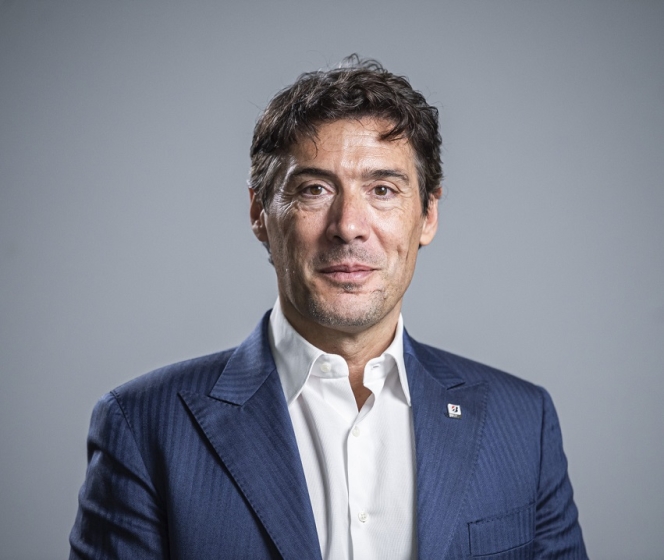
Bridgestone has announced a European leadership appointment aimed at sharpening customer focus, streamlining engagement across product groups and supporting its ongoing growth plans. Stefano Sanchini will become President, Europe Sales, effective 1 October 2026, leading the company’s European sales organisation across both Consumer and Commercial segments.
The expanded role unites sales activities spanning passenger car, truck and bus, agriculture, off-the-road, motorcycle and original equipment. Sanchini brings over 20 years of international leadership experience in the automotive and tyre sectors, with a career covering Europe, Middle East, Africa and India. Since joining Bridgestone in 2017, he has held several senior positions, including Managing Director of Bridgestone India.
Most recently, as Vice President for Consumer Replacement in Europe, he helped strengthen customer engagement, commercial performance, profitability and regional market growth. Bridgestone said the appointment underscores its commitment to customer relationships, commercial execution and simpler cross-market operations. Sanchini will pursue sustainable growth while developing capabilities and partnerships supporting the company’s long-term European strategy.
Mete Ekin, Group President EMEA, said, "Our customers increasingly operate across multiple product categories and expect a consistent experience wherever they engage with Bridgestone. By bringing our sales activities together under one European structure, we are creating a simpler, more connected organisation that will help us respond faster, collaborate more effectively and continue building strong partnerships with our customers."

Comments (0)
ADD COMMENT