

HOW IT CREATES A FUTURE- PROOF TYRE MANUFACTURING…
Conventional tyre manufacturing systems require too much human skill and intervention, so the impact and consequences of digitalisation on the tyre industry are even greater. Standard manufacturing processes require strict monitoring, corrections and automation at every stage. Digitalisation offers numerous benefits for sustainable production improvements. They achieve measurable results in manufacturing, quality improvement, marketing and sales.
Tyre manufacturers monitor and automate their processes, reduce manual labour and gain real-time insights into production line status and performance. Barcode and QR code labelling streamlines production processes, enables efficient and cost-effective tracking and improves accuracy and efficiency. Traceability is simple and feasible, improving profitability and customer satisfaction.
Scanning simplifies the location, tracking of parts and materials and provides manufacturers with real-time insights into their production processes. RFID applications are gaining momentum in the passenger tyre segment, having already demonstrated numerous benefits in commercial applications.
Digitalisation technologies help quick identification of production defects in the final product and increase productivity with AI based scanning, inspection, real-time decision-making processes.
Digitalisation in the tyre industry is a gradual process that will improve performance, quality and profitability being on the way of real Industry 4.0 applications in tyre manufacturing. It continually opens up new opportunities to leverage data for better decision-making. Overall, digitalisation in tyre manufacturing is a powerful tool that unlocks the full potential of production. However, after implementation, continuous investment, as well as internal research and improvements, are required.
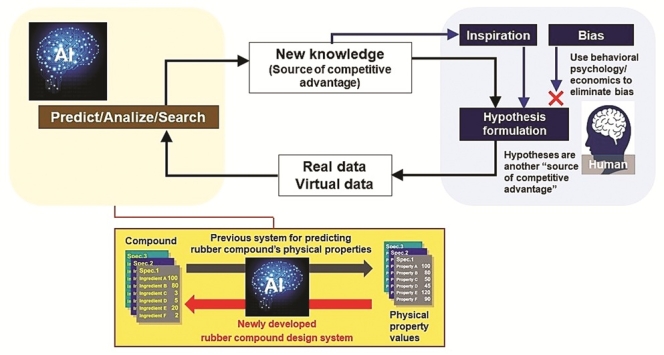
The tyre manufacturing industry is constantly evolving. Machines are becoming increasingly automated, more precise and data-driven. Recent advances based on the principles of Industry 4.0 include the aforementioned IoT, AI (artificial intelligence), robotics and sustainability.
Industry 4.0-driven digitalisation is based on the concept of the ‘digital twin’, meaning every machine is a data node. Data from every step (compound parameters, component dimensions, curing profiles) is collected for each tyre. This creates a virtual replica of the physical tyre, which is a ‘digital twin’ that enables complete traceability and data-driven process optimisation.
The role of humans is evolving from simple manual tasks to monitoring, diagnostics and data analysis. Robots, especially collaborative robots or cobots,
are taking over tasks such as final inspection and material handling. These revolutionary steps and concepts are having a major impact on manufacturing, optimising quality, performance, customer satisfaction and contributing to business success.
Modern mixing systems are increasingly replacing conventional tangential mixers. The intermeshing of the two rotors ensures more efficient and homogeneous mixing with better temperature control. This leads to higher mixing quality and consistency.
New mixing technologies, on the other hand, utilise ‘continuous mixing systems’, i.e. the continuous and simultaneous supply of all raw materials in precisely controlled quantities. The materials are continuously mixed in a series of specialised extruders and mixing units. At the end, a continuous stream of a perfectly homogeneous mixture emerges. This represents a revolution compared to conventional batch mixing. It improves energy efficiency, reduces the carbon footprint and enables unprecedented consistency and traceability.
Highly automated ‘multi-calender systems’ are equipped with multiple rollers that can simultaneously produce multiple layers (e.g. carcass ply, squeegee layer or inner liner) with extreme precision in thickness and width. Similar to extrusion lines with laser thickness control, these systems ensure 100 percent control and transmit data immediately to the extrusion head and calender roll clearances for automatic adjustment and maintenance of tolerances down to a fraction of a millimetre.
Thanks to the ‘multi-stage transfer’, the tyre casing is transferred between drums for the various production steps automatically and without human intervention, automatic cutting and splicing prevent deviations in quality. RFID technology integrated fully assures correct recipe and security in component application.
The robotic application and component preparation, such as with 6-axis robots, is now widely used for the fast and precise gripping and placement of complex components such as bead and apex assemblies.
Electric vulcanising presses are equipped with intelligent mould controls, whose integrated sensors monitor temperature and pressure in real time across multiple zones. The AI system dynamically adjusts the vulcanisation cycle (time, temperature, steam pressure) to ensure perfect curing of each tyre and compensate for any mould or material deviations.
Furthermore, predictive maintenance is now essential to avoid unplanned production downtime. Vibration, temperature and pressure sensors installed on manufacturing machines monitor all machine functions and alert when maintenance is required. High-precision servomotors, replacing pneumatic or hydraulic systems, work with servo-electric robots and are used in various production phases with submillimetre precision, reducing energy consumption and maintenance requirements.
The most visible technological advances in finishing and inspection lines today are fully automated with full sensitive cameras, AI-integrated and non-destructive testing (NDT) machines. Automated high-resolution X-ray machines scan each tyre to detect hidden defects such as trapped air, steel cord separation, or bead wire issues. Shearography and holography – being traditional but now equipped with intuitive, incredibly fast and precise modes – use lasers and intelligence to detect underlying defects or separations by measuring stress-induced deformations.
Uniformity and force variation measurement systems utilise AI algorithms to not only identify a tyre as ‘good’ or ‘bad’ but also diagnose the root cause of the deviation. Robotic trimming and polishing machines automatically locate and remove burrs (excess rubber) from the tyre using precise grinding tools – a traditionally manual and laborious task.
Of course, the future of tyre manufacturing, driven by advanced digitalisation, IoT and robotics, is rapidly evolving into a model for a smart, autonomous and sustainable industry, often referred to as ‘Tyre Industry 4.0’.
This transformation isn’t just about doing the same things faster; it will fundamentally change tyre design, production, sales and even performance. Tyre production facilities will become more autonomous, adaptable, efficient, predictive, personalised and, as expected, more sustainable.
Industry 4.0 and AI-powered digitalisation will accelerate sustainability. Precision manufacturing minimises material waste through the use of high-precision components. AI can easily manage energy consumption throughout the factory. IoT sensors monitor the overall condition of tyres, ensuring fast tyre changes, safety and performance.
This transformation will lead to safer, more efficient and more environmentally friendly tyres.
Grismer Tire & Auto Service Appoints New CEO And CFO
- By TT News
- September 28, 2026

Grismer Tire & Auto Service, a tyre and automotive service centre operator backed by CenterOak Partners LLC, has named Chris Blanchette as Chief Executive Officer and Mark Hedstrom as Chief Financial Officer. The announcement marks a significant leadership transition for the portfolio company.
Blanchette arrives with over two decades of senior leadership experience in multi-site consumer services, specialising in operations, strategy and business development. He most recently served as Chief Executive Officer of Service Minds, a residential electrical, plumbing and HVAC services provider. His background also includes serving as Chief Operating Officer of QAS, which operates Valvoline Instant Oil Change locations, along with senior operational positions at Advance Auto Parts, Bridgestone Retail Operations and Best Buy.
Hedstrom brings more than three decades of finance expertise to his new role. He previously held the Chief Financial Officer position at W.S. Connelly & Co., a multi-regional specialty distributor, and has also served as Chief Financial Officer for several private equity-backed consumer and distribution companies.
Eric Holter, Managing Director, CenterOak, said, “Chris Blanchette brings highly relevant leadership experience in the automotive aftermarket. He has led complex, multi-location organisations and understands how to translate operational discipline into sustainable growth. Together, Chris and Mark add important depth to Grismer’s leadership team as the Company pursues expansion in existing and new markets.”
Blanchette said, “Grismer’s 90-year history and the trust it has earned with customers set the Company apart. I am excited to join a business with such a strong legacy and see significant
- International Rubber Conference
- Society Of Rubber Science And Technology Japan
- James Busfield
- Nobuyuki Tamura
- Bridgestone Corporation
- Japan Rubber Manufacturers Association
- Aichi International Exhibition Center
- Aichi Sky Expo
Japan To Host International Rubber Conference After Decade-Long Gap
- By TT News
- September 25, 2026
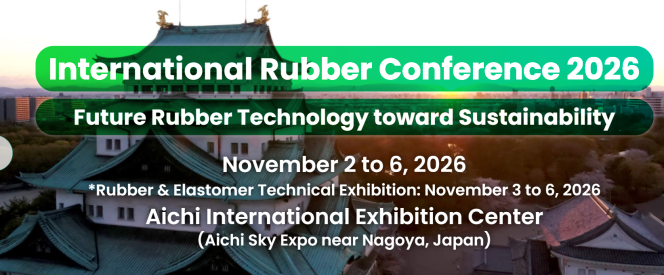
The International Rubber Conference (IRC) will return to Japan in November for the first time in a decade, with more than 271 technical presentations and over 117 exhibitors expected to take part.
The event, known as IRC 2026 Aichi, will be hosted by the Society of Rubber Science and Technology, Japan, alongside the Rubber & Elastomer Technical Exhibition in Aichi. It is scheduled to run from 2nd to 6th November, with the exhibition opening a day later and continuing until 6th November .
Held at the Aichi International Exhibition Center, also known as Aichi Sky Expo, the venue is located near Chubu Centrair International Airport and can be reached from Nagoya Station in about 28 minutes by train.
The conference programme will feature more than 271 presentations spanning rubber science, technology and industrial applications. Participants include James Busfield of Queen Mary University of London and Nobuyuki Tamura of Bridgestone Corporation, who also chairs the Japan Rubber Manufacturers Association. More than 400 delegates have already registered.
Running alongside the conference, the Rubber & Elastomer Technical Exhibition will host more than 117 exhibitors, ranging from raw material suppliers and machinery manufacturers to tyre makers and testing-equipment providers. The exhibition will be open to visitors free of charge.
The International Rubber Conference, first held in 1966, rotates annually across global host cities. The last event in Japan took place in Kitakyushu in 2016, with subsequent editions held in Haikou, Istanbul and Bangkok.
Pirelli Board Approves EUR 1 Billion US Investment Plan And Organisational Restructuring
- By TT News
- September 23, 2026

Italian tyre major Pirelli has announced a multi-year investment plan worth approximately EUR 1 billion (USD 1.2 billion) to expand its manufacturing facility in Rome, Georgia in the United States. The motion passed by majority vote, with board members Zhang Haitao, Xi Xiaohong and Wang Kun voting against the proposal.
The capital expenditure program, scheduled to begin in 2027 and will go through 2033, aims to expand annual production capacity at the Georgia site to six million tyres and create approximately 1,000 jobs.
The United States represents the largest market for high-value tyres globally, accounting for roughly 40 percent of global volumes. The project will be carried out in two phases without altering Pirelli's financial targets for 2026.
Phase one of the expansion will introduce modular robotised production systems based on Pirelli's Modular Integrated Robotised System technology, scaling annual output to three million tyres starting in 2028.
In phase two, the company will begin construction of an automated production facility to add three million units of annual capacity. The expanded plant will produce connected tyre systems, including Cyber Tyre technology, following market authorisation granted by the US Bureau of Industry and Security under Italy’s 2026 Golden Power Decree.
Alongside the investment decision, the board approved an organisational restructuring resulting in the immediate elimination of the Corporate General Management function. As part of the changes, Corporate General Manager Francesco Tanzi will step down from his executive role, maintaining an employment relationship through 31 December 2026 to facilitate the leadership transition.
Under the terms approved by the board and the Remuneration Committee, Tanzi will receive a severance payment equivalent to 13 months’ remuneration, payable by February 2027, alongside accrued rights under existing short-term and long-term incentive plans. He has agreed to a two-year non-compete covenant covering Pirelli's primary operating regions in exchange for 130 percent of his gross annual salary, paid in eight quarterly instalments. Following the end of his employment, Tanzi will provide advisory services under a two-year consultancy contract with an annual fee of EUR 350,000, plus non-monetary benefits valued at EUR 45,000.
Bridgestone Appoints Stefano Sanchini As President Of Europe Sales
- By TT News
- September 19, 2026

Bridgestone has announced a European leadership appointment aimed at sharpening customer focus, streamlining engagement across product groups and supporting its ongoing growth plans. Stefano Sanchini will become President, Europe Sales, effective 1 October 2026, leading the company’s European sales organisation across both Consumer and Commercial segments.
The expanded role unites sales activities spanning passenger car, truck and bus, agriculture, off-the-road, motorcycle and original equipment. Sanchini brings over 20 years of international leadership experience in the automotive and tyre sectors, with a career covering Europe, Middle East, Africa and India. Since joining Bridgestone in 2017, he has held several senior positions, including Managing Director of Bridgestone India.
Most recently, as Vice President for Consumer Replacement in Europe, he helped strengthen customer engagement, commercial performance, profitability and regional market growth. Bridgestone said the appointment underscores its commitment to customer relationships, commercial execution and simpler cross-market operations. Sanchini will pursue sustainable growth while developing capabilities and partnerships supporting the company’s long-term European strategy.
Mete Ekin, Group President EMEA, said, "Our customers increasingly operate across multiple product categories and expect a consistent experience wherever they engage with Bridgestone. By bringing our sales activities together under one European structure, we are creating a simpler, more connected organisation that will help us respond faster, collaborate more effectively and continue building strong partnerships with our customers."


Comments (0)
ADD COMMENT