

- Central Marketing Inc
- Retread Information Bureau
- US Federal Aviation Administration
- FAA
- Edd Burleson
- Wilkerson
Aircraft Tyre Retreading A High-Stakes, High-Barrier Business
- By Gaurav Nandi
- September 02, 2026
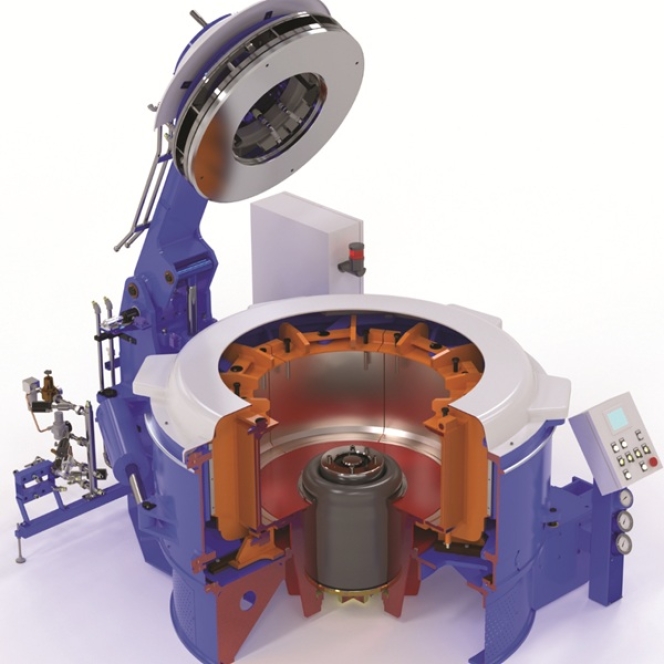
Aircraft tyre retreading may resemble truck tyre retreading on the factory floor, but the similarities end there. Stringent US Federal Aviation Administration (FAA) oversight, exhaustive inspection protocols and extensive documentation make it one of the most tightly regulated segments of the tyre industry. According to President of Central Marketing Inc., these rigorous requirements coupled with high upfront investment and the dominance of major tyre manufacturers have created a niche market where only a limited number of players can compete.
Tire Retread Information Bureau mentions that over 100,000 retreaded tyres are done annually in United States, while another report published by the United States International Trade Commission on retreaded tyres in 2012 stated approximately 80 percent of aircraft tyres in US are retreaded and that retreading saves commercial and military operators over USD 100 million annually.
Since publication of the report over a decade ago, the state of the tyre retreading industry remains quite optimistic. Market Research Future estimated that US aircraft tyre retreading market will reach USD 1.42 billion by 2035, up from USD 948.2 million in 2025.
However, aircraft tyre retreading demands for stricter regulatory oversight than conventional truck and bus tyre retreading.
 According to President Central Marketing Inc Edd Burleson, “FAA certification, rigorous inspections, extensive documentation and high entry barriers define the sector, where major tyre manufacturers dominate and independent retreaders serve mainly private aircraft operators.”
In a tete-a-tete with Tyre Trends, he delves into the dynamics of the aircraft retreading industry of United States and North America as his company has been a supplier of retreading machinery in these markets for over four decades.
“Although aircraft tyre retreading follows the hot retreading process, with many of the same steps seen in truck and bus radial retreading, the level of oversight is substantially higher. The process is fundamentally similar but is much more tightly controlled,” contended Burleson.
Everything is Federal Aviation Administration (FAA) certified. The inspection procedures are much stricter, there are more process controls, much more record-keeping and the Federal Aviation Administration oversees the entire process. The basic manufacturing process is similar, but the level of control and inspection is significantly higher.
He added that the dominance of major tyre manufacturers and strict regulatory requirements make it difficult for independent companies to enter the sector. And that’s because the smaller independent retreaders mainly service the private aircraft market rather than the major commercial airlines.
“Not everyone has the inspection capabilities or qualifications required to obtain an FAA license to retread aircraft tyres. It’s a speciality market and different from commercial truck tyre or OTR retreading,” he added.
Obtaining regulatory approval requires substantial investment before any licence is granted. A company will have to establish a plant, demonstrate its entire retreading process, undergo inspections and prove that it has the capability to perform aircraft tyre retreading.
“It’s not simply a matter of applying for a license and getting approval. You take on the risk of investing in the facility and processes before knowing whether you’ll actually be approved,” Burleson said.
In addition, entering the market isn’t easy because new plants will compete against major players like Goodyear, Michelin, Dunlop and Bridgestone. Hence, as an independent company, it’s generally conducive to enter the private aircraft market.
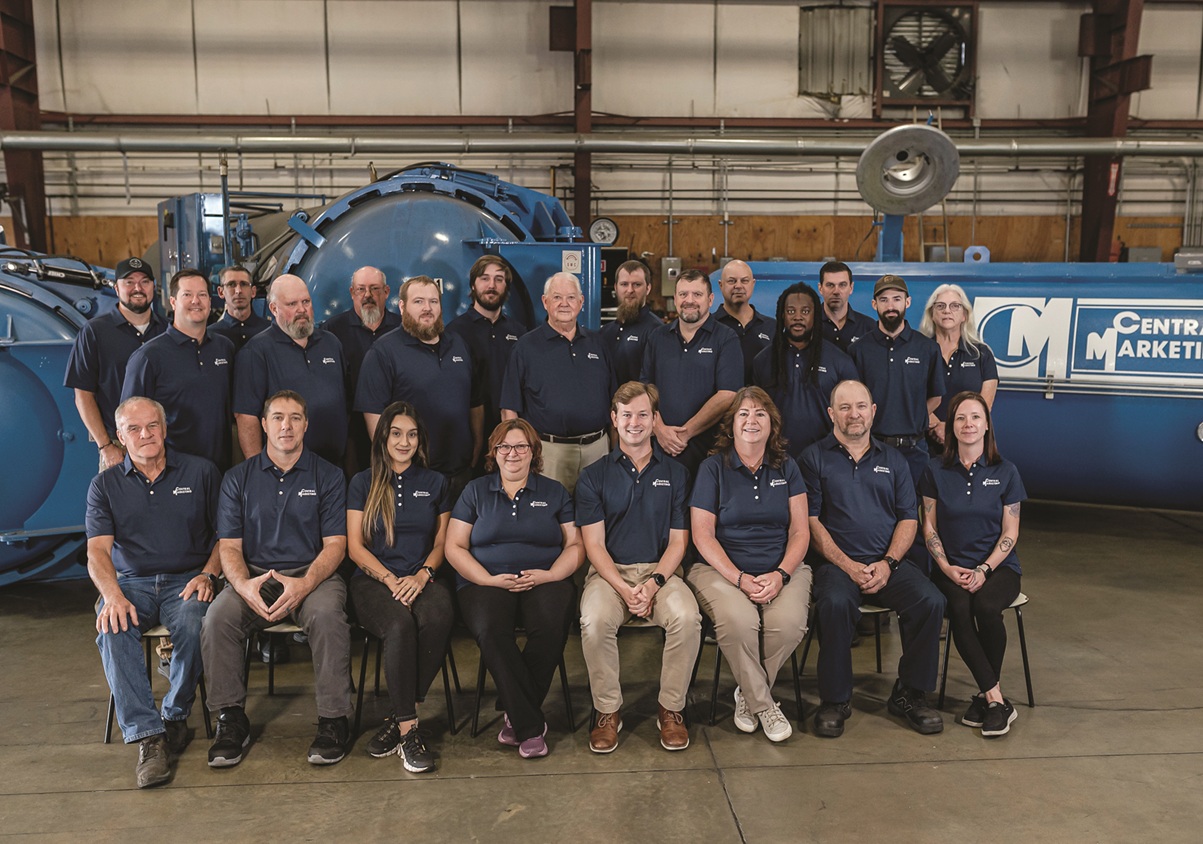 Burleson said the industry’s structure further limits competition because manufacturers sell tyre services rather than tyres themselves.
“The major players manufacture the new tyres and they’re not selling tyres but the service, most which is charged per cycle,” he said.
MARKET DYNAMICS
Aircraft tyre retreading remains a stable and highly specialised market. “The market across North America is well developed because airlines routinely retread their tyres as part of their operating model,” said Burleson.
The airlines themselves are responsible for maintaining the tyres including tyre pressure and general maintenance. The tyre company is responsible for supplying the tyres to the airlines and get paid on a per cycle basis. A cycle here means an entire take-off to landing cycle.
The number of times an aircraft tyre can be retreaded depends on the tyre size and aircraft type. “Some aircraft tyres can be retreaded two or three times, while others can be retreaded five or six times,” Burleson said.
Retreading significantly lowers operating costs for airlines by extending tyre life, he added. As a result, the cost per cycle comes down substantially. If airlines charged the same cost per cycle while using only new tyres, it would be three to four times more expensive.
The company supplies shearography inspection systems, repair machines, buffing machines, rubber extruders, laser engraving systems and curing presses. Its clientele includes Michelin, Bridgestone, Goodyear, Dunlop and one independent aircraft retreader, Wilkerson, in United States.
Besides, Central Marketing has been a servicing supplier to the tyre retreading industry as well as off-the-road, light truck, aircraft and the new tyre industries for 49 years. Its top-of-the-line computerised products have varying degrees of automation. Its base of operations is in Colonial Heights with a staff of 24 people.
Burleson described aircraft retreading as a stable market with limited growth because of the relatively small number of retreaders.
“The market is limited by the number of retreaders so it’s more of a stable market. Growth is typically around 3–5 percent annually. There’s no major boom like you’d see in an emerging market,” he said.
Unlike commercial truck tyre retreading, the aircraft sector in North America has not been affected by imports from Asian manufacturers.
“Bridgestone has one plant in US, Michelin has one, Goodyear has two and the total number of aircraft retreading plants isn’t very large,” Burleson said.
Outside United States, the market is even smaller.
“There’s a small aircraft retreader in Mexico and there isn’t any aircraft tyre retreading in Canada,” he said.
MAKING THE RETREADS
Aircraft retreading equipment differs from machinery used in commercial tyre retreading because aircraft tyres require greater precision during processing. The tyres are much more difficult to handle and buff.
Repairs are limited to very specific tolerances. Companies have to ensure their process doesn’t damage the body plies during buffing. There may be need to replace breaker belts and perform other specialised repairs.
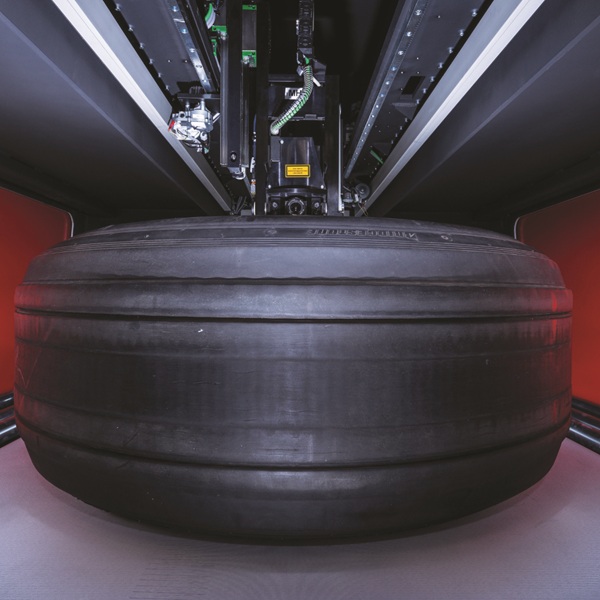
Each stage of production must comply with tightly controlled specifications. Every step of the process has to meet a specific specification.
“If the temperature drops by more than a set number of degrees during curing, then the tyre may no longer be acceptable. Aircraft retreading is governed by much stricter rules and regulations because of the nature of the application. You’re transporting people, so there can be absolutely no compromise on safety,” Burleson said.
Burleson identified shearography as the most significant technological advancement in aircraft tyre retreading.
“I would say the biggest advancement has been shearography. Another important development is laser engraving. Each time an aircraft tyre is retreaded, it’s assigned an ‘R level’ to ascertain the exact retread generation,” he said.
Laser engraving the sidewall makes record-keeping much more accurate compared with using stencils. Considerable progress has been made in buffing technology through computerised profiles too.
Automation is increasing in selected areas, although regulations limit the use of artificial intelligence as a trained human inspector must still verify and confirm the results.
SUSTAINABLE OPERATIONS
Aircraft retreading makes a significant contribution to sustainability by extending tyre life as each tyre is retreaded between three to six times.
The economics of cost savings and inexistence of Asian imports have also written an optimistic future for aircraft tyre retreading in US till now, but challenges are present for retreading machinery suppliers.
“We don’t make the machines ourselves but procure it from different countries for the US market. The challenge is providing equipment that meets our customers’ requirements and being able to service that equipment when it’s installed in their plants,” said Burleson.
However, he said that the broader retreading industry is undergoing consolidation. “In US, the East Coast is probably the largest market, followed by the West Coast, where the major population centres are,” he said.
Retreading plants are becoming larger in the TBR segment, processing higher volumes and adopting more automation. At the same time, smaller retreaders are finding it increasingly difficult to compete and many are going out of business.
Aircraft retreading is insulated from those market trends because of its unique business model.
Summing up the sector, Burleson reiterated that aircraft tyre retreading should not be viewed in the same way as commercial tyre retreading.
“The main thing people need to understand is that aircraft retreading is a speciality market. Although the process follows many of the same basic steps as commercial tyre retreading, it’s performed under much stricter controls because of the critical nature of its application. It’s not something that anyone can simply enter. It’s a highly specialised industry. Even though it’s still retreading, it shouldn’t be viewed in the same way as the normal commercial TBR market,” he noted.
Zeon Breaks Ground On Kawasaki Facility To Speed Lab-To-Mass-Production Scale-Up
- By TT News
- October 19, 2026
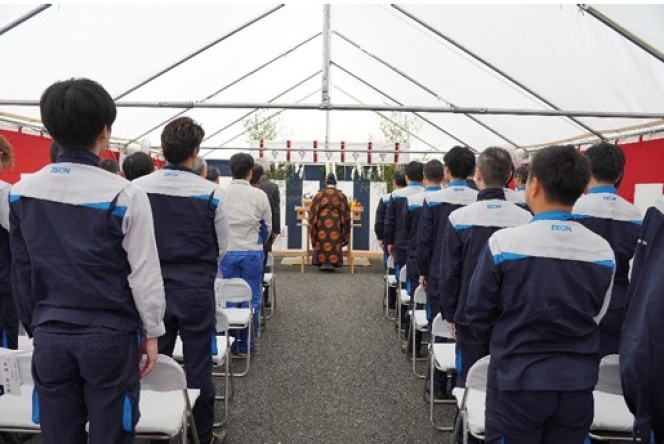
Zeon Corporation broke ground on a multi-product research and prototyping complex at the Kawasaki Innovation Frontier Port in Kawasaki City, Kanagawa Prefecture, on 16 October with a ceremony held beforehand to seek safety during construction. The company expects the complex to shorten the path from laboratory work to mass production for established and emerging businesses alike, making it central to its long-term growth strategy.
Set inside an existing building within the port's Research & Development Center area, the complex is slated to begin operating in January 2028. Its design aims to move products past the laboratory stage and into medium-scale sample output more quickly, clearing a bottleneck on the route to full-scale manufacturing.
Zeon's core production methods – polymerisation, hydrogenation, coagulation and drying – will be built into the complex, which is engineered to handle diverse manufacturing conditions and operating approaches. Beyond serving established and new businesses, the polymer design company envisions the site as a centre for technology development and a platform for rolling out new processes and operational, analytical, and measurement technologies within and beyond the company. It will eventually host development and prototyping work across a wide range of technologies, including contract prototypes commissioned by outside parties.
The Kawasaki Innovation Frontier Port is the umbrella name for the site combining the neighbouring Kawasaki Plant and Research & Development Center. The label underscores the location's role in breaking new ground by merging innovation, research and development and production and casts the Kawasaki waterfront as a port that propels innovation. Once a co-creative innovation facility begins operating in December 2026, the two sites will function as one continuous operation, turning out ever more sophisticated products and production methods and reinforcing their standing as a launchpad for technology.
Vipal Rubber Launches VT290 Tread For European Truck Market
- By TT Bureau
- October 13, 2026
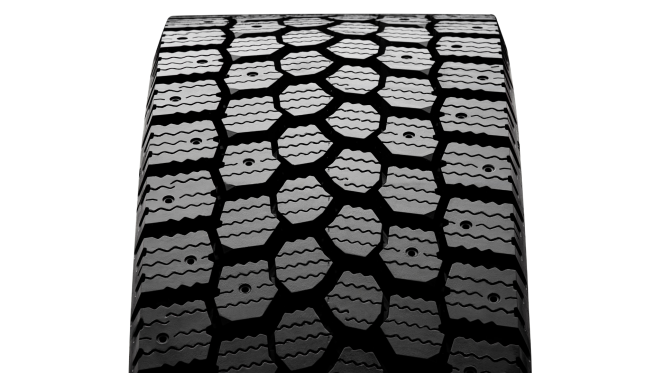
Vipal Rubber has launched the VT290, a tread designed for truck drive axles used on motorways and paved roads, targeting regional and long-distance transport operations in Europe.
The product is available in widths of 240mm, 250mm, 260mm, 270mm and 280mm. It is designed to provide traction and stability on dry and wet roads, as well as in demanding conditions involving snow.
Frederico Schmidt, General Manager of Vipal EMEA, said, “The launch of the VT290 reinforces Vipal’s ongoing commitment to offering technologically advanced solutions suited to the specific characteristics of European roads and climate.” “We want to further consolidate our presence in the region, delivering a high value-added product that combines innovation, operational efficiency and safety,” he added.
The VT290 carries the M+S marking and 3PMSF certification. Its design includes side sipes and grooves intended to help remove snow and mud from the tread, improving grip on slippery surfaces.
The tread pattern is also designed to distribute engine torque more evenly, helping to reduce uneven wear. Tie bars between the tread blocks add structural stability, supporting vehicle control during driving.
Fabrício Nedeff, Commercial Manager of Vipal EMEA, said, “With the VT290, weare responding directly to the real needs of fleet operators and truck drivers, combining performance, adherence and efficiency in different driving conditions. [RS2.1]In addition to expanding options for our customers, the product strengthens business opportunities for our partners in the region,”
Vipal said the launch would expand its offering for retreaders, distributors and fleet operators in the European market.
- Association of Natural Rubber Producing Countries
- ANRPC
- Monthly NR Statistical Report
- Natural Rubber
ANRPC Publishes Monthly NR Statistical Report For August 2026
- By TT News
- October 02, 2026
The Association of Natural Rubber Producing Countries (ANRPC) published its Monthly Natural Rubber Statistical Report for August 2026, noting firmer prices in several markets. Supply constraints, stable downstream demand and persistent geopolitical and macroeconomic uncertainty shaped the month. Renewed conflict and disruptions to major shipping routes added further pressure.
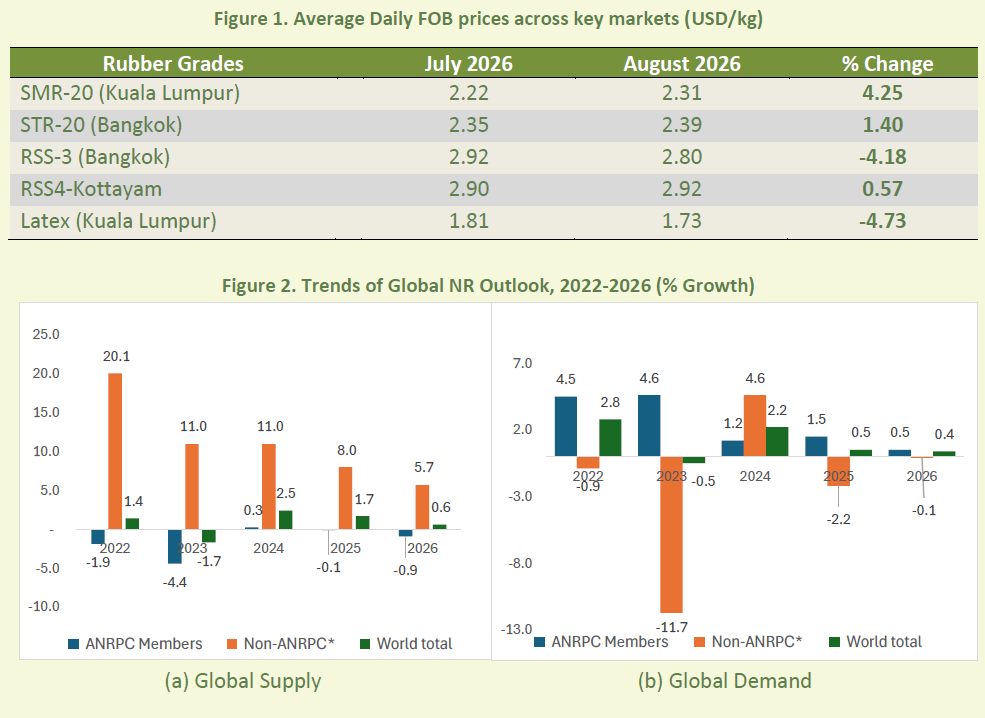
Physical prices for major grades moved in different directions. SMR-20 in Kuala Lumpur averaged USD 2.31 per kg, up 4.25 percent from July, while STR-20 in Bangkok rose 1.40 percent to USD 2.39 per kg. RSS-3 dropped 4.18 percent to USD 2.80 per kg, but RSS-4 in Kottayam gained 0.57 percent to USD 2.92 per kg. Latex-in-bulk fell 4.73 percent to USD 1.73 per kg. Brent crude averaged USD 91.08 per barrel, driven by concerns over possible restrictions on oil shipments through the Strait of Hormuz and wider Middle East instability, which raised energy supply risks and strengthened the oil market risk premium.
On trade, China's imports climbed 3.39 percent month-on-month, while India fell 10.18 percent and Malaysia dropped 8.24 percent; Viet Nam rose 5.08 percent. Exports advanced 5.63 percent in Viet Nam but declined in Thailand (-5.24 percent), Indonesia (-5.36 percent), Malaysia (-1.48 percent) and Cambodia (-1.88 percent).
Global production is projected to rise 0.6 percent to 15.039 million tons in 2026 from 14.952 million tonnes in 2025, after revisions to Thailand's 2025 output and updated 2026 estimates for Thailand, Malaysia and Indonesia. Weather, including erratic rainfall and drier Southeast Asian conditions, affected output. August 2026 production was estimated at 1.396 million tonnes, down 4.51 percent from 1.462 million tonnes a year earlier. Demand is forecast to grow 0.4 percent to 15.356 million tonnes in 2026 from 15.301 million tonnes, with the largest consumption gains expected in China, Malaysia and Cambodia. Prospects depend on vehicle sales, tyre production, shipping conditions and weather-related supply disruptions, while steady EV-linked demand supported modest growth led by China and India. The ringgit traded between RM4.02 per USD and RM4.09 per USD, and the baht between 32.68 and 33.34. The SHFE January 2027 contract averaged 18,109 CNY per tonne, up 7.78 percent month-on-month, while the SGX November 2026 contract averaged USD 2.24 per kg, up 4.32 percent.
Epsilon Carbon Advances Scope 3 Emissions Measurement Across Value Chain
- By TT News
- October 01, 2026

Epsilon Carbon Pvt. Ltd., a global speciality carbon and carbon black manufacturer, has broadened its emissions accounting to include value chain impacts beyond its direct operations. The move advances measurement and management of Scope 3 emissions across its supply and distribution network, according to the company.
The initiative spans Epsilon Carbon’s integrated carbon complex in Vijayanagar, Karnataka. That site has a production capacity of 500,000 tonnes per annum of speciality carbon and 215,000 TPA of carbon black. It combines carbon manufacturing with energy circularity efforts in one integrated ecosystem. The company assessed material Scope 3 categories under GHG Protocol guidelines.
Scope 3 emissions are indirect and arise from purchased goods and services, transportation, business activities and downstream product use where relevant. The assessment gives Epsilon Carbon clearer visibility into emissions outside its direct control and a foundation for spotting reduction opportunities. It builds on existing operational emissions and energy efficiency work.
The company previously reported a 98 percent Scope 2 reduction against its baseline year. A 17 MW captive power plant uses waste heat from carbon black operations, energy consumption intensity fell 6 percent from baseline, and 77 percent of energy needs came from waste heat recovery, avoiding over 89,000 tonnes of CO₂. Epsilon Carbon now emphasises supplier engagement, data transparency and circularity, aligning disclosures with global sustainability frameworks to track value chain emissions consistently and develop measurable reduction initiatives.
Vikram Handa, Managing Director, Epsilon Carbon, said, “Meaningful climate action requires us to look beyond the boundaries of our operations and understand the impact of the entire value chain. Scope 3 measurement gives us greater visibility into the emissions and enables deeper engagement with our partners and suppliers. Building this visibility will help us make more informed decisions as we scale our operations and advance our decarbonization plans.”



Comments (0)
ADD COMMENT