

- Birla Carbon
- Kennesaw State University
- Birla Institute of Technology and Science
- Birla Carbon India Study Abroad Program
Birla Carbon And KSU Launch Global Research Programme At BITS India
- By TT News
- January 27, 2026

Birla Carbon, a leading global manufacturer and supplier of high-quality carbon materials, and Kennesaw State University (KSU) have expanded their enduring partnership with the launch of Birla Carbon India Study Abroad Program in January 2026. This programme, backed by a USD 184,000 contribution from the carbon materials manufacturer, will send undergraduate students from KSU’s College of Science and Mathematics to India for collaborative research. Participants will first develop their projects during the spring semester at KSU before travelling to the Birla Institute of Technology and Science (BITS) in Goa for summer work alongside local faculty and peers.
This endeavour builds upon nearly a decade of collaboration, which since 2014 has funded research opportunities for over 110 KSU students as Birla Carbon Scholars. In its inaugural year, the programme will facilitate hands-on research for up to 12 students, marking a significant evolution in the longstanding alliance between the university and the global company. The initiative is designed to provide immersive, cross-cultural scientific training, equipping students with global perspectives and advanced research skills crucial for their future careers in science and technology.
Sharing his thoughts about the program, Terence Norman, HR Head, Americas, Birla Carbon, said, “Birla Carbon is now in its 15th year of partnership with Kennesaw State University overall, and over the years, we have seen phenomenal growth and development opportunities for the students here in the College of Science and Mathematics. Our ongoing commitment is driven by a genuine belief in making a positive impact not only for the students who participate in this programme but also for the impact their solutions can have across major industries and society at large. Fifteen years mark not just a partnership but a shared journey of growth and discovery. Birla Carbon’s purpose is to ‘Share the Strength’, and Kennesaw State gives us an opportunity to do that first-hand.”
Kadian Callahan, Associate Dean for Student Success and Community Engagement, KSU – College of Science and Mathematics, said, “We’re excited to partner with Birla Carbon to bring this opportunity to our students. The college’s focus is on providing quality undergraduate research experience to students, and this programme allows students to take their work beyond campus and into an international research setting. Students can begin their research at Kennesaw State and continue it at BITS in India, working closely with faculty and peers at both institutions. That continuity strengthens their projects and creates opportunities for shared publications with KSU and BITS faculty and students.”
- Birla Carbon
- Carbon Black
- Sustainable Carbonaceous Materials
- Sustainable Carbon Blacks
- International Rubber Conference
Birla Carbon To Showcase Electric Mobility-Focused Carbon Black Portfolio At IRC 2026
- By TT News
- October 28, 2026
Birla Carbon, a leading global supplier of carbon materials, will exhibit at the International Rubber Conference (IRC) 2026, scheduled for 2–6 November in Nagoya, Japan, at Booth B. The company aims to address application-specific demands arising from the shift towards electric mobility, which places greater emphasis on tyre wear and energy efficiency while requiring automotive rubber components to balance durability with ride comfort.
A Very High Structure (VHS) lineup awaits manufacturers of passenger car, light truck, truck and bus tyres. These grades were engineered to meet electrification requirements and tightening standards such as Euro 7, delivering gains in tread wear, energy efficiency and tyre longevity.
Sustainability also features prominently. The company's Continua Sustainable Carbonaceous Materials (SCM) and Sustainable Carbon Blacks (SCB) lines, which contain higher levels of recycled or bio-based material, are intended to help tyre makers pursue circularity targets. Their dependable quality and ability to be supplied at scale in large volumes make them viable for production use, and the Continua range carries ISCC PLUS certification.
Mechanical rubber goods round out the display. Grades aimed at bushings enhance mixing and dispersion, contributing to fatigue life and component durability, while formulations for mounts pair low hysteresis and low stiffness with reinforcement so that durable parts can be produced without sacrificing ride comfort. Drop-in grades for extrusion reduce defects, scrap and screen-pack changes while raising throughput and extending service life. Simulation and technical expertise help customers assess materials, and global production plus Asian capacity growth support long-term supply.
Amit Kumar, President – Asia, Birla Carbon, said, “Asia’s tyre and rubber manufacturers are shaping the next phase of mobility, and their material requirements are becoming increasingly stringent. As the clear leader in our industry, Birla Carbon aims to grow alongside our customers, combining application-focused innovation with dependable local supply. We see performance and circularity as priorities that must progress together. By expanding our capabilities in Asia and strengthening customer partnerships, we aim to help manufacturers meet evolving market needs and build greater long-term competitiveness.”
Zeon Breaks Ground On Kawasaki Facility To Speed Lab-To-Mass-Production Scale-Up
- By TT News
- October 19, 2026
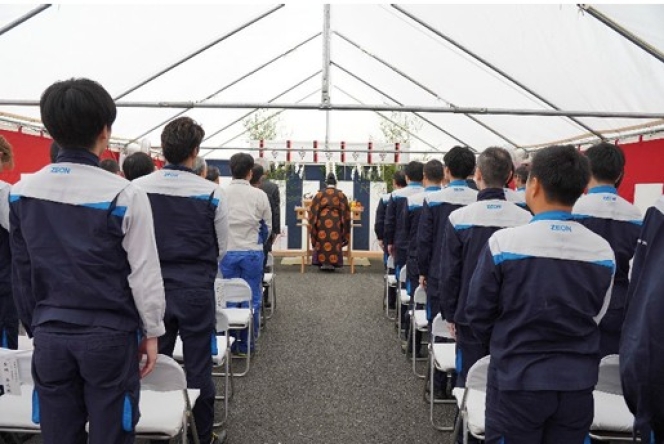
Zeon Corporation broke ground on a multi-product research and prototyping complex at the Kawasaki Innovation Frontier Port in Kawasaki City, Kanagawa Prefecture, on 16 October with a ceremony held beforehand to seek safety during construction. The company expects the complex to shorten the path from laboratory work to mass production for established and emerging businesses alike, making it central to its long-term growth strategy.
Set inside an existing building within the port's Research & Development Center area, the complex is slated to begin operating in January 2028. Its design aims to move products past the laboratory stage and into medium-scale sample output more quickly, clearing a bottleneck on the route to full-scale manufacturing.
Zeon's core production methods – polymerisation, hydrogenation, coagulation and drying – will be built into the complex, which is engineered to handle diverse manufacturing conditions and operating approaches. Beyond serving established and new businesses, the polymer design company envisions the site as a centre for technology development and a platform for rolling out new processes and operational, analytical, and measurement technologies within and beyond the company. It will eventually host development and prototyping work across a wide range of technologies, including contract prototypes commissioned by outside parties.
The Kawasaki Innovation Frontier Port is the umbrella name for the site combining the neighbouring Kawasaki Plant and Research & Development Center. The label underscores the location's role in breaking new ground by merging innovation, research and development and production and casts the Kawasaki waterfront as a port that propels innovation. Once a co-creative innovation facility begins operating in December 2026, the two sites will function as one continuous operation, turning out ever more sophisticated products and production methods and reinforcing their standing as a launchpad for technology.
Vipal Rubber Launches VT290 Tread For European Truck Market
- By TT Bureau
- October 13, 2026
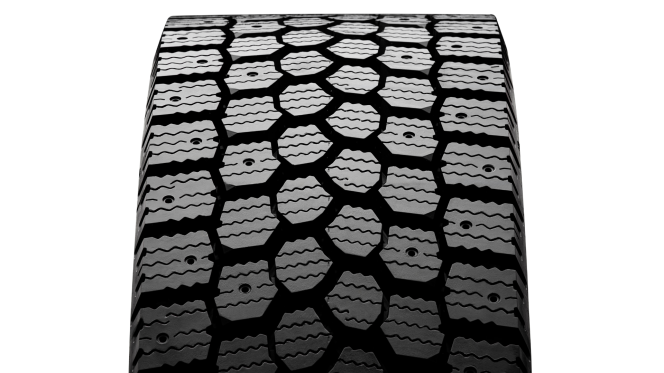
Vipal Rubber has launched the VT290, a tread designed for truck drive axles used on motorways and paved roads, targeting regional and long-distance transport operations in Europe.
The product is available in widths of 240mm, 250mm, 260mm, 270mm and 280mm. It is designed to provide traction and stability on dry and wet roads, as well as in demanding conditions involving snow.
Frederico Schmidt, General Manager of Vipal EMEA, said, “The launch of the VT290 reinforces Vipal’s ongoing commitment to offering technologically advanced solutions suited to the specific characteristics of European roads and climate.” “We want to further consolidate our presence in the region, delivering a high value-added product that combines innovation, operational efficiency and safety,” he added.
The VT290 carries the M+S marking and 3PMSF certification. Its design includes side sipes and grooves intended to help remove snow and mud from the tread, improving grip on slippery surfaces.
The tread pattern is also designed to distribute engine torque more evenly, helping to reduce uneven wear. Tie bars between the tread blocks add structural stability, supporting vehicle control during driving.
Fabrício Nedeff, Commercial Manager of Vipal EMEA, said, “With the VT290, weare responding directly to the real needs of fleet operators and truck drivers, combining performance, adherence and efficiency in different driving conditions. [RS2.1]In addition to expanding options for our customers, the product strengthens business opportunities for our partners in the region,”
Vipal said the launch would expand its offering for retreaders, distributors and fleet operators in the European market.
- Association of Natural Rubber Producing Countries
- ANRPC
- Monthly NR Statistical Report
- Natural Rubber
ANRPC Publishes Monthly NR Statistical Report For August 2026
- By TT News
- October 02, 2026
The Association of Natural Rubber Producing Countries (ANRPC) published its Monthly Natural Rubber Statistical Report for August 2026, noting firmer prices in several markets. Supply constraints, stable downstream demand and persistent geopolitical and macroeconomic uncertainty shaped the month. Renewed conflict and disruptions to major shipping routes added further pressure.
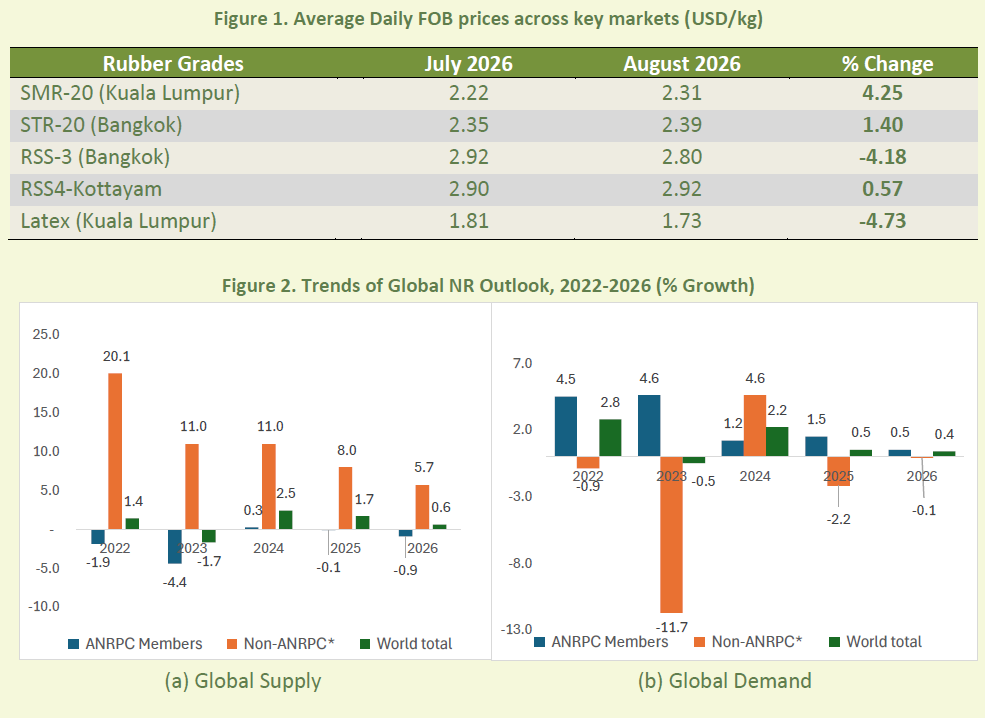
Physical prices for major grades moved in different directions. SMR-20 in Kuala Lumpur averaged USD 2.31 per kg, up 4.25 percent from July, while STR-20 in Bangkok rose 1.40 percent to USD 2.39 per kg. RSS-3 dropped 4.18 percent to USD 2.80 per kg, but RSS-4 in Kottayam gained 0.57 percent to USD 2.92 per kg. Latex-in-bulk fell 4.73 percent to USD 1.73 per kg. Brent crude averaged USD 91.08 per barrel, driven by concerns over possible restrictions on oil shipments through the Strait of Hormuz and wider Middle East instability, which raised energy supply risks and strengthened the oil market risk premium.
On trade, China's imports climbed 3.39 percent month-on-month, while India fell 10.18 percent and Malaysia dropped 8.24 percent; Viet Nam rose 5.08 percent. Exports advanced 5.63 percent in Viet Nam but declined in Thailand (-5.24 percent), Indonesia (-5.36 percent), Malaysia (-1.48 percent) and Cambodia (-1.88 percent).
Global production is projected to rise 0.6 percent to 15.039 million tons in 2026 from 14.952 million tonnes in 2025, after revisions to Thailand's 2025 output and updated 2026 estimates for Thailand, Malaysia and Indonesia. Weather, including erratic rainfall and drier Southeast Asian conditions, affected output. August 2026 production was estimated at 1.396 million tonnes, down 4.51 percent from 1.462 million tonnes a year earlier. Demand is forecast to grow 0.4 percent to 15.356 million tonnes in 2026 from 15.301 million tonnes, with the largest consumption gains expected in China, Malaysia and Cambodia. Prospects depend on vehicle sales, tyre production, shipping conditions and weather-related supply disruptions, while steady EV-linked demand supported modest growth led by China and India. The ringgit traded between RM4.02 per USD and RM4.09 per USD, and the baht between 32.68 and 33.34. The SHFE January 2027 contract averaged 18,109 CNY per tonne, up 7.78 percent month-on-month, while the SGX November 2026 contract averaged USD 2.24 per kg, up 4.32 percent.
Comments (0)
ADD COMMENT