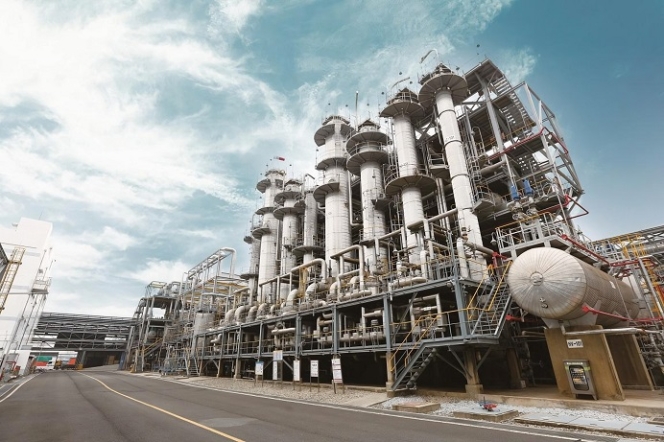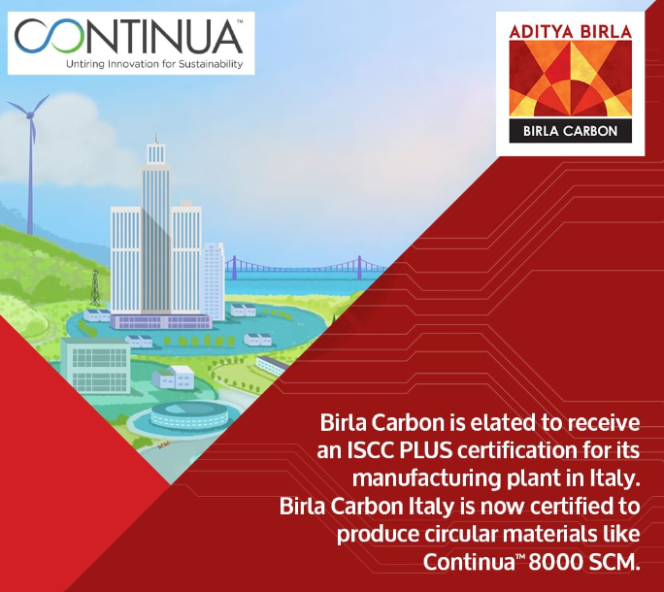
Birla Carbon’s plant in Italy received the ISCC PLUS certification from The International Sustainability and Carbon Certification (ISCC).
ISCC is a voluntary scheme applicable to the bio-economy and circular economy for various sectors. All kinds of biomass, waste and residues, non-biological renewables, and recycled carbon materials can be certified under ISCC PLUS.
Birla Carbon has an aspiration to achieve net zero carbon emissions by 2050 and the successful introduction of ContinuaTM Sustainable Carbonaceous Material (SCM).
Sharing his thoughts on the achievement, Dr Santrupt Misra, Group Director, Birla Carbon; Director, Chemicals & Director, Group H.R., Aditya Birla Group, said, “With an increase in interest and demand from customers for sustainable products, this first ISCC PLUS certification for Birla Carbon, gives us an opportunity to support our customers better and more particularly through our Continua product line.” He further added, “Aditya Birla Group’s focus on sustainability and circularity and its work toward a net zero carbon emissions world is made real through Birla Carbon’s dedication in providing advanced products to the industry, further fulfilling our commitment to sustainability and circularity.”
Commenting on this recognition, John Loudermilk, Chief Executive Officer, Birla Carbon, said, “This ISCC PLUS certification for our plant in Italy, supports the principles of environmentally, economically, and socially sustainable production, beginning with our Continua™ Sustainable Carbonaceous Material. It is our intention to adopt this important certification at all our manufacturing locations in the near future.” He further added, “Sustainability has always been core to who we are as a leader in our industry. Our sustainability efforts already led us to achieve the ‘Platinum’ rating by EcoVadis for sustainable business practices, and now, with the ISCC PLUS certification, we are well positioned to supply recognized sustainable materials to our customers globally.”
Tyre Recycling Reinvented
- By Gaurav Nandi
- December 18, 2025
Bolder Industries is positioning itself at the forefront of circular economy innovation with its next-generation Antwerp facility, promising to recycle 6.6 million tyres annually while slashing greenhouse gas emissions by over 80 percent. While the company has proven its technology in the US with BolderBlack and BolderOil, scaling operations to Europe will test both supply chain resilience and market adoption. Beyond environmental claims, the facility’s success will hinge on replicating consistent product quality at commercial volumes, navigating regulatory frameworks and maintaining customer confidence amid global demand for sustainable industrial materials.
Bolder Industries recently secured a EUR 32 million grant from the EU Innovation Fund and an additional EUR 2 million from the Flanders region to support its Antwerp facility, which will recycle over six million tyres annually.
Scheduled to begin operations by 2027, the plant will utilise wind power and on-site heat to produce sustainable materials like BolderBlack and BolderOil, significantly reducing greenhouse gas emissions. Construction is set to commence in 2026, marking a major step towards sustainable manufacturing in Europe.
The plant will serve as a cornerstone for Europe’s circular economy ambitions and strengthen the company’s position in the growing global market for sustainable industrial materials.
Speaking exclusively to Tyre Trends, Chief Executive Officer Tony Wibbeler shared a thorough insight into the company’s strategy and technology, reflecting the company’s readiness to scale proven solutions to commercial volumes.
“Bolder is beyond an ambitious idea. Since 2019, we have demonstrated years of commercial success with BolderBlack and BolderOil, which are now supplied across thousands of applications in tyres, rubber, plastics and coatings. Our US operations have proven our technology at scale and the Antwerp facility is not a pilot project; it is backed by the European Commission’s Innovation Fund through CINEA as part of the NextGen Thermal Tire Re-use (N2TR) project with full capacity targeted for spring 2027,” explained Wibbeler.
“We’ve built traceability and certification frameworks like ISCC Plus, ensuring customers receive validated, circular and consistent materials. We’re not proving the concept, we’re scaling a proven solution to meet accelerating global demand,” he added.
BolderBlack, the company’s flagship product, is already integrated into more than 3,000 global applications including tyres, manufactured rubber goods, inks, coatings and plastics. BolderOil complements this by serving high-value markets such as petrochemicals, solvents, carbon black feedstocks and sustainable fuels.
“We do not focus on what others are doing. Our steadfast focus is on delivering consistent, high-quality solutions to customers who demand reliability. Our technology has consistently delivered high-quality products for over five years, making us one of the few companies with a proven commercial-scale history,” Wibbeler noted.
The company sources its feedstock exclusively from post-consumer and post-industrial end-of-life tyres and scrap rubber obtained through partnerships in the US and Europe. “Because we are not tied to oil markets, our products are shielded from oil volatility and tariffs. That
stability enables predictable pricing, typically at a discount to virgin carbon black,” contended Wibbeler.
QUALITY STANDARDS
Meeting stringent tyre maker quality standards is a continuous process. Aside from traditional certifications like ISO 9001, the company has learned a tremendous amount from its customers. “While audits can be daunting, we embrace their experiences and utilise their suggestions to improve our manufacturing processes continually,” noted Wibbeler.
The Port of Antwerp facility is designed to recycle approximately 6.6 million tyres annually at full operation. The process achieves an over 80 percent reduction in greenhouse gas emissions and reduces water use by more than 90 percent compared to conventional carbon black production. This represents a major step forward from traditional tyre disposal methods such as landfilling and incineration, which are resource-intensive and environmentally harmful.
Strategically located on a 55,152-square-metre site within the NextGen District, the Antwerp facility will house four proprietary reactors and a state-of-the-art finishing line. The plant will be powered predominantly by renewable energy including wind power and recovered heat, underscoring the company’s commitment to environmental stewardship.
Complementing the Antwerp operation, Bolder’s US expansion in Terre Haute, Indiana, will recycle a comparable volume of tyres, producing 18,000 metric tonnes of BolderBlack and 21,000 metric tonnes of BolderOil.
“Together, these two facilities create a robust transatlantic supply network that guarantees customers consistent and reliable volumes,” Wibbeler highlighted.
CIRCULAR HUB
The Antwerp facility also contributes to regional economic growth, creating at least 50 new jobs in Flanders and reinforcing Antwerp’s standing as a circular economy hub. Cleaner production, strategic port access and integration within Europe’s largest petrochemical cluster further enhance the plant’s operational advantages.
The company’s resilience stems from multiple business safeguards. These include geographic diversification, alignment with ISCC Plus and European Union frameworks and securing commercial offtake agreements before capacity expansions.
The company recently secured a significant equity investment from Tiger Infrastructure Partners, a private equity firm with expertise in scaling infrastructure projects across the US and Europe, to support growth.
“Our customer base spans the largest tyre manufacturers globally and smaller players alike. This segmentation strategy places BolderBlack into thousands of products, from performance tyres to wetsuits, exemplifying our market reach,” Wibbeler affirmed.
While BolderBlack is already in mainstream production for some manufacturers, others remain in pilot phases. Multi-year offtake contracts ensure operational stability for existing and future capacities.
Regarding the pyrolysis oil produced in the recycling process, the company emphasises a commitment to true circularity. “Our primary markets for BolderOil are carbon black oil feedstock and petrochemicals, supporting circularity goals in tyre and rubber goods industries. We anticipate entering sustainable fuels markets in Europe, though nothing has been finalised currently,” stated the executive.
Addressing concerns around pyrolysis potentially delaying landfill issues, Wibbeler said, “That critique is both misinformed and shortsighted. Pyrolysis is just one step in our broader process. Our traceable tyre-to-tyre reuse model effectively solves the problem rather than delaying it.”
Bolder Industries is actively engaged in industry forums and circular economy initiatives, promoting sustainable materials and tyre recycling advancements, highlighting its leadership role beyond operational activity. The company has achieved multiple certifications and complies rigorously with environmental and quality standards and maintains a Silver EcoVadis rating, reflecting corporate responsibility.
The growing global recycled materials market further positions it to capture market share as industries elevate environmental compliance and sustainability.
Wibbeler concluded with an ambitious outlook, stating, “The industry faces many challenges ahead. Our aim for the next decade is to expand globally, deepen partnerships and deploy a range of technologies to deliver scalable, traceable circular solutions. That’s the role we are committed to playing.”
Reducing Ash Content In rCB
- By Gaurav Nandi
- December 18, 2025
Recovered carbon black is edging closer to mainstream adoption as ASTM International committee D36 on Recovered Carbon Black develops a new ash content standard, D8621. The test promises to slash analysis times from 18 hours to just a few, a change that could reshape productivity and quality control for tyre makers and rCB producers. Yet the push for faster monitoring also exposes a bigger challenge, as standardisation alone will not guarantee industry-wide adoption. With high capital investment, scaling hurdles and safety considerations, the new method sits at the intersection of technical progress, economic pressure and the tyre industry’s sustainability ambitions.
The ASTM International’s recovered carbon black (rCB) D36 committee developed and published a new standard called D8621, which will improve productivity of tyre makers and also enhance production process monitoring abilities.
Speaking exclusively to Tyre Trends, ASTM D36 Chair and Director of rCB at Circtec, Pieter Ter Haar, said, “The D1506 method was developed for regular carbon black, which typically has an ash content of <1 percent. rCB typically has an ash content between 15 and 30 percent.”
The new standard promises to cut testing times from 18 hours to just a few. Commenting on this, he said, “This rCB-specific test method requires less material, and by operating the furnace at a higher temperature, the rate-of-reaction is optimised for rCB, resulting in the significant reduction in time. Since ash content is one of the important product specifications, reducing the time to obtain results is of great help in quality control of the production process of rCB.”

“The main benefit is the significant reduced time required to obtain ash content information of the rCB sample from a tailor-made test method. The future bias and precision study will have to show if the method also has an improved standard deviation,” he added.
CONSENSUS BUILDING
The method’s creation reflects the convergence of some of the industry’s biggest players. “This standard was created by the globally leading rCB, carbon black and tyre manufacturers who come together in the committee. We will actively try to promote the use of this method going forward both for producers and users,” said Ter Haar.
He argued that the proposed standard could reshape the economics of rCB production, particularly in terms of reducing waste or lowering costs as more process control will typically result in less waste and a quicker ability to adjust feedstock ratio’s when changes need to be made.
“This new method will also help tyre manufacturers analyse rCB faster and this will, however, not likely play a role in competitiveness compared to virgin carbon black,” he stated.
According to Ter Haar, the temperature of the muffle furnace has increased from 550 degrees Celsius to 700 degrees Celsius, which is an important consideration for the manufacturer using this method when it comes to safe execution of this method. Besides, he wasn’t aware of any other potential risks or limitations that need to be considered.
Alluding to how critical is standardisation in gaining wider adoption of rCB within tyre production supply chains from Circtec’s perspective, Ter Haar explained, “Standardisation will not be the silver bullet for better understanding of rCB or overcoming the initial adoption phase of rCB in rubber compounds. However, when it comes to consistent supply of rCB, relevant rCB-specific specifications are crucial.”
SUSTAINABILITY PUSH
ASTM Standard D8621 fits neatly into the tyre industry’s strategic pivot towards greener materials. According to Ter Haar, the new standard is part of the wider industry development of the rCB producers and adaptation to the needs and requirements of the tyre industry for adoption of new raw materials for the construction of tyres.
He pointed to high levels of capital deployment, the emergence of reputable producers across global regions and platforms like ASTM as proof that rCB is on track to become a cornerstone of tyre sustainability.
“There are very few sustainable raw material options available for the tyre industry that seem to be developing into mature industries,” the spokesperson noted, stressing that rCB is now positioned as a key strategic material for fulfilling long-term sustainability and circularity objectives.
Circtec itself is pushing hard to lead the charge. Later this year, the company will open its third European factory in the Netherlands. The facility, built to a scale comparable with regular carbon black plants, is expected to convert around six percent of all waste tyres in Europe into sustainable products once it reaches full capacity.
“We will continue to focus on the global expansion of Circtec and the development of the sector when it comes to regulatory compliance, technical knowledge and producing high-quality rCB at large industrial scale,” he said.
INDUSTRY RECEPTION
The new standard has already won the backing of the tyre industry. “The tyre industry was an active participant in the development and approval process of this new standard,” Ter Haar emphasised.
The benefit is straightforward, which is more precise quality control. “Any time one of the raw material suppliers can improve their quality control, this is welcomed. The main objective of any new standard is that the test method is technically relevant and improves the ability to test rCB’s characteristics that actually correlate to in-rubber performance,” he explained.
For producers, the efficiency gains are significant. At Circtec’s Netherlands plant, for instance, output is expected to reach 10 tonnes of rCB per hour. At these production rates, quick quality control test methods are crucial.
While faster process monitoring will primarily benefit producers with scaled up production capacity, Ter Haar noted that the standard is not necessarily designed to spark innovation in rCB applications beyond tyres such as plastics or coatings.
Crucially, adopting the new standard won’t require expensive technical upgrades. “The benefit of this method and aim during the development is that for most producers or end-users, there would not be a need for any new investments in equipment. This method is based on the use of an affordable ashing muffle furnace with the ability to heat to 700 degrees Celsius,” he said.
ADOPTION DYNAMICS
ASTM standards remain voluntary, but Ter Haar expects uptake to be swift given the operational advantages. “This new standard is a tool to improve the speed of quality control. It is up to the individual parties to adopt this or any other ASTM method. Due to the clear advantages of this method, I would expect both producers and users to welcome using this test method moving forward,” Ter Haar said.
The development also represents a milestone in a broader strategic roadmap. The ASTM committee D36 on Recovered Carbon Black, formed eight years ago, initially issued guidance on which carbon black test methods could or should not be used.
“At the moment, most of the key product performance characteristics of rCB can be determined,” he observed, suggesting that D8621 could be a stepping stone towards a broader suite of rCB-specific standards on par with virgin carbon black testing.
As rCB moves into the mainstream, the combination of industrial-scale production, regulatory support and technical validation is setting the stage for what could become one of the tyre industry’s most significant sustainability transformations in decades.
- Global Platform For Sustainable Natural Rubber
- GPSNR
- Natural Rubber
- Sustainability
- Rubber Supply Chain
- Assurance System
- Circular Economy
- Responsible Sourcing
- Smallholders
- Supply Chain Transpa
GPSNR Marks Milestone At Seventh General Assembly
- By TT News
- December 17, 2025
Members of the Global Platform for Sustainable Natural Rubber gathered for the organisation’s seventh General Assembly, marking what it described as a pivotal year for accountability and member-led sustainability across the natural rubber value chain.
A key development in 2025 was the launch of GPSNR’s risk-based Assurance System, which sets sustainability expectations, introduces independent verification and aims to drive continuous improvement beyond regulatory compliance. The system was developed collaboratively over several years and is intended to provide a globally applicable framework for sustainability in the sector.
At the assembly, end-user companies reaffirmed their support for the Assurance System and agreed on a structured pathway towards full implementation within their category.
“This year marks a turning point for GPSNR,” said Stefano Savi, chief executive of GPSNR. “The Assurance System gives our members a shared and trusted foundation for demonstrating progress across the value chain.”
Members also reflected on the first year of the Shared Investment Mechanism, a model that allows manufacturers to share the costs of large-scale capacity-building projects. The initiative is intended to deliver long-term benefits for upstream participants, particularly smallholder producers.
“Sustainability cannot be achieved by one part of the value chain alone,” Savi said. “By investing together, our members are enabling more inclusive and impactful outcomes worldwide.”
Looking ahead to 2026, GPSNR said it would focus on supporting the implementation of the Assurance System through data collection, member learning programmes, and stakeholder dialogue, to ensure the framework reflects operational realities and different business models.
The assembly concluded with members reiterating their commitment to building more equitable, resilient and sustainable natural rubber supply chains.
- Tire Recycling Foundation
- Circle Of Change Awards
- Tyre Recycling
- End-Of-Life Tyres
- Circular Economy
- Sustainability
- Recycled Tyre Materials
- Tire Recycling Conference
- Value Chain Collaboration
- Innovation
Tire Recycling Foundation opens nominations for inaugural Circle of Change Awards
- By TT News
- December 16, 2025
The Tire Recycling Foundation has opened nominations for its first Circle of Change Awards, aimed at recognising organisations, teams and individuals advancing innovation and sustainability across the tyre recycling sector.
Nominations opened on 15 December and will be accepted until 8 February 2026. The awards will honour contributions spanning tyre recycling technologies, end-use market development and leadership in circular economy practices.
“The Circle of Change Awards will serve as a powerful way to recognise national visionaries and changemakers who have shaped the trajectory of the full tyre recycling value chain over the past two decades,” said Anne Forristall Luke, president of the Tire Recycling Foundation board. “We are thrilled to recognise trailblazers making a lasting impact on end-of-life tyre (ELT) recycling and the circular economy.”
Four award categories will be presented at the 10th Tire Recycling Conference, scheduled to take place in Denver, Colorado.
“By spotlighting the collective progress being made in tyre recycling, the Foundation hopes these inaugural awards will inspire and fuel accelerating momentum in exciting new markets for recycled tyres,” said Stephanie Mull, executive director of the Tire Recycling Foundation.
The Innovation in End-Use Technology Award will recognise technologies, products or processes that use recycled tyre rubber in new ways, with a focus on technological advancement, commercialisation and sustainability impact.
The Circular Economy Trailblazer Recognition, State Leadership in Tire Market Innovation category will honour state agencies or statewide programmes that demonstrate leadership and measurable impact in advancing tyre recycling within a circular economy framework.
The Market Development Excellence Award will recognise efforts to expand end-use markets for tyre-derived materials through education, policy, marketing or advocacy, with an emphasis on measurable market growth and long-term strategy.
The Value Chain Collaboration Award will acknowledge partnerships across the tyre recycling value chain that deliver measurable improvements in efficiency, economics or environmental performance.
The foundation said organisations and individuals that have made significant contributions to tyre recycling or developed innovative solutions for tyre-derived materials are encouraged to apply. Award recipients will be allowed to showcase their achievements and inspire further progress across the sector.

Comments (0)
ADD COMMENT