

Inside Henkel’s Quiet Revolution
- By Sharad Matade
- June 16, 2026
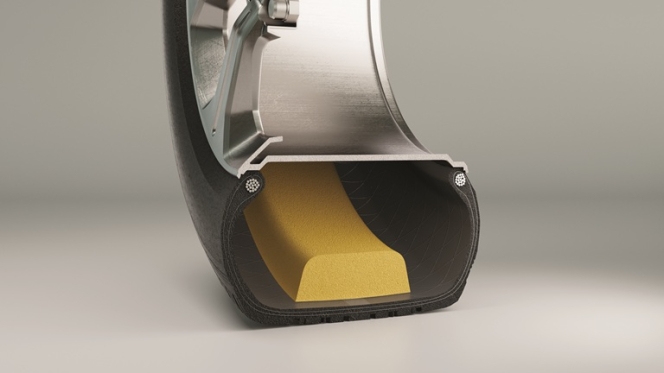
As modern automobiles evolve, especially electric vehicles, noise reduction has become essential across all segments, not just luxury models. With electric powertrains eliminating engine noise, road and tyre acoustics are now central to vehicle refinement. Henkel plays a key role in this shift, leveraging its materials science and adhesive technologies in automotive manufacturing. The company is now focused on transforming the increasingly important field of tyre acoustics through advances in chemistry, process engineering and strategy.
Dr Rainer Schönfeld, Head of Global Market Strategy for Henkel’s Automotive Components business, leads this initiative. He explains how the concept of placing foam inside a tyre has become a strategic technology in the electrification era, and how Henkel aims to redefine the process.
For over a decade, ‘silent tyres’ have featured in premium vehicles. These tyres use polyurethane foam inside the cavity to dampen resonance generated as the tyre rolls, often likened to a drum sound. As the tyre rotates, a standing wave forms within the cavity, typically between 200 and 250 hertz, and this energy travels through the chassis into the cabin, making it audible.
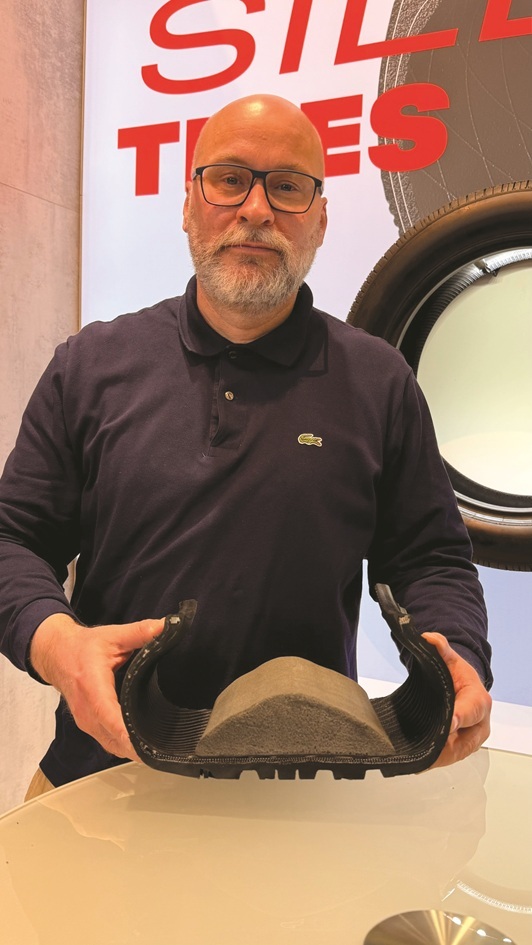 “In the early years, it was a very small business. For nearly eight years, there was limited traction. Over the last five years, however, we have seen significant growth,” Dr Schönfeld says.
The shift is closely tied to electric vehicles. Without the masking effect of an internal combustion engine, road noise becomes far more prominent, particularly at lower speeds. Foam-based solutions, Dr Schönfeld argues, address a problem that cannot be solved by tyre compounds alone.
“You can influence noise through the compound, but you will never reach the same level of effect as with foam. The cavity noise will always exist,” he says,
Laboratory tests show reductions of roughly 10 to 20 decibels at the critical frequency – enough to produce a noticeable improvement in cabin refinement.
However, the current manufacturing model for these tyres is inefficient. Foam is produced in blocks, cut to various sizes and shipped to tyre plants, where it is bonded inside the tyre with adhesives. While effective, this method adds significant complexity.
Manufacturers must manage dozens of foam variants across tyre sizes. Warehousing requirements expand, as foam – largely air – occupies significant volume. Internal logistics become cumbersome, with material repeatedly moved between storage and production lines. The cutting process generates waste, while bonding introduces additional quality control challenges.
“You are dealing with up to 10 or 20 different foam dimensions. And you are essentially storing and transporting air. That creates both cost and complexity,” Schönfeld notes.
It is this structural inefficiency that prompted Henkel to rethink the process from first principles. The result is its patented LOCTITE LASER-FIT process, a system that replaces pre-formed foam and adhesives with a fully integrated, three-step approach: cleaning the tyre, applying a liquid foam precursor and activating the structure through laser processing.
At its core, the innovation lies in applying a reactive liquid formulation directly into the tyre. The material expands and cures at ambient temperature, forming an acoustic foam in the place. The approach eliminates pre-cut foam patches, manual handling and the adhesive bonding stage altogether.
“The idea itself is quite obvious. But making it work reliably in a production environment is highly complex,” Dr Schönfeld says.
One of the central technical challenges relates to the nature of polyurethane foam. When it forms, it naturally develops a surface skin. While necessary during expansion, this skin reduces the acoustic effectiveness and the mechanical durability of the foam. Henkel’s process addresses this through an integrated laser step, developed with specialised partner 4Jet Laser System, which removes the surface layer and exposes the open-cell structure beneath.
Dr Schönfeld explains, “The acoustic performance depends on having an open-cell surface. The sound energy must be able to enter the foam and be dissipated.”
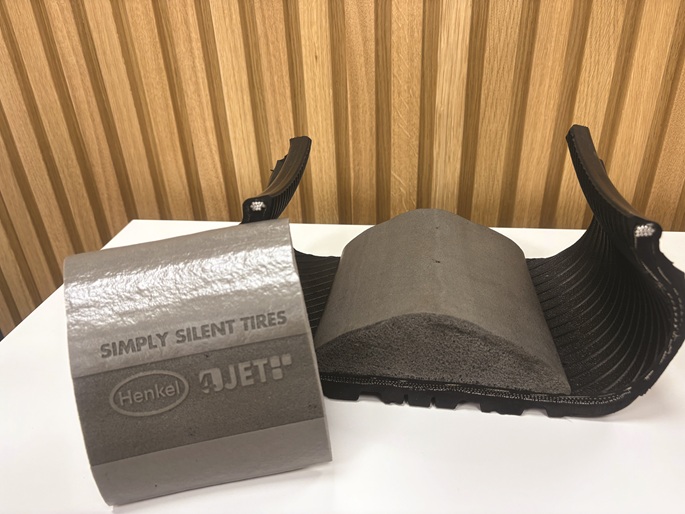
The process is both rapid and precise. The liquid precursor is applied within seconds, begins expanding almost immediately and completes foaming within roughly 30 seconds, with full curing achieved shortly thereafter. The tyre is rotated during application, using centrifugal force to distribute the material evenly and prevent sagging.
What distinguishes the system is not only its chemistry but also its adaptability. The application pattern can be adjusted dynamically for different tyre sizes and geometries without the need for retooling. This removes one of the most persistent constraints of the traditional model, where each tyre dimension requires a specific foam insert.
The implications extend well beyond process simplification. By eliminating pre-formed foam, manufacturers reduce material waste entirely. Storage requirements shrink, as liquid precursors occupy a fraction of the space required for foam blocks. Logistics become more efficient, while automation ensures consistent application quality.
“The whole system becomes simpler. You remove complexity, reduce waste and improve consistency at the same time,” Dr Schönfeld says.
As with any automotive innovation, however, trade-offs must be managed carefully. The addition of foam increases tyre weight by approximately 300 to 400 grammes – modest but not insignificant in a sector where efficiency gains are often incremental.
Thermal behaviour presents another consideration. Foam inherently provides some insulation, raising the risk of heat build-up under high-speed conditions. Dr Schönfeld emphasises that mitigating this effect was a central development requirement. “You have to ensure that the foam does not lead to critical temperature increases. The integrity of the tyre must never be compromised,” Dr Schönfeld adds.
Durability is equally demanding. The foam must withstand sustained mechanical stress over tens of thousands of kilometres without cracking or degrading. Early-stage materials exhibited such weaknesses, requiring significant refinement to achieve the necessary fatigue resistance.
The technology must also coexist with other evolving features of modern tyres. Sensors for monitoring pressure and temperature are increasingly standard, and integrating these components within foam-based systems remains an area of ongoing development. Similarly, compatibility with puncture sealants is being evaluated, although the foam itself – being open-cell – does not provide sealing capability.
From a market perspective, silent tyre technology has followed a familiar trajectory, beginning in luxury vehicles before gradually moving into premium and mid-range segments. Electric vehicles have accelerated this transition, as the absence of engine noise heightens the importance of road noise mitigation.
“In electric vehicles, the application rate is much higher. But we also see it moving into other segments over time,” Dr Schönfeld notes.
Adoption remains concentrated in original equipment markets, with limited penetration in the aftermarket. While replacement silent tyres are available, widespread retrofitting is constrained by economics, scale and regulatory requirements.
 Geographically, interest is broadly distributed. Dr Schönfeld points to engagement from tyre manufacturers across Europe, North America and Asia, with India emerging as a market of growing relevance. Road surface conditions, climatic factors and rapid infrastructure expansion create distinct acoustic challenges that may favour such solutions.
Perhaps the most consequential dimension of Henkel’s approach lies in sustainability. Conventional silent tyre designs face a critical limitation: recyclability. Certain adhesives used in bonding processes can interfere with tyre shredding, causing operational issues such as equipment clogging and even fire hazards. As a result, some recyclers exclude silent tyres altogether.
By eliminating adhesives from the process, Henkel’s system enables tyres to be processed through standard recycling streams. “Recyclability is becoming increasingly important. Our solution avoids the issues that exist with some traditional bonding systems,” Dr Schönfeld says.
This aligns with emerging regulatory frameworks, particularly in Europe, where stricter requirements around end-of-life tyre management are expected. Concepts such as digital product passports – capturing data on materials, usage and recyclability – are likely to become standard.
Henkel’s LOCTITE LASER-FIT process is currently undergoing validation with tyre manufacturers, with commercial deployment expected towards the latter part of the decade. “We are still in the optimisation phase. Full validation takes time, but the direction is clear,” Dr Schönfeld says.
In many respects, the evolution of silent tyres reflects a broader shift in automotive engineering. Performance is no longer defined solely by speed or efficiency; it increasingly encompasses refinement, comfort and sensory experience.
“It is about comfort. And comfort is becoming more important as vehicles evolve,” Dr Schönfeld reflects.
Vipal Rubber Launches VT290 Tread For European Truck Market
- By TT Bureau
- October 13, 2026
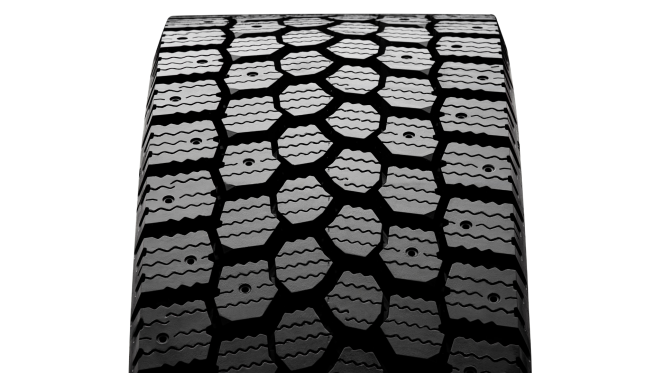
Vipal Rubber has launched the VT290, a tread designed for truck drive axles used on motorways and paved roads, targeting regional and long-distance transport operations in Europe.
The product is available in widths of 240mm, 250mm, 260mm, 270mm and 280mm. It is designed to provide traction and stability on dry and wet roads, as well as in demanding conditions involving snow.
Frederico Schmidt, General Manager of Vipal EMEA, said, “The launch of the VT290 reinforces Vipal’s ongoing commitment to offering technologically advanced solutions suited to the specific characteristics of European roads and climate.” “We want to further consolidate our presence in the region, delivering a high value-added product that combines innovation, operational efficiency and safety,” he added.
The VT290 carries the M+S marking and 3PMSF certification. Its design includes side sipes and grooves intended to help remove snow and mud from the tread, improving grip on slippery surfaces.
The tread pattern is also designed to distribute engine torque more evenly, helping to reduce uneven wear. Tie bars between the tread blocks add structural stability, supporting vehicle control during driving.
Fabrício Nedeff, Commercial Manager of Vipal EMEA, said, “With the VT290, weare responding directly to the real needs of fleet operators and truck drivers, combining performance, adherence and efficiency in different driving conditions. [RS2.1]In addition to expanding options for our customers, the product strengthens business opportunities for our partners in the region,”
Vipal said the launch would expand its offering for retreaders, distributors and fleet operators in the European market.
- Association of Natural Rubber Producing Countries
- ANRPC
- Monthly NR Statistical Report
- Natural Rubber
ANRPC Publishes Monthly NR Statistical Report For August 2026
- By TT News
- October 02, 2026
The Association of Natural Rubber Producing Countries (ANRPC) published its Monthly Natural Rubber Statistical Report for August 2026, noting firmer prices in several markets. Supply constraints, stable downstream demand and persistent geopolitical and macroeconomic uncertainty shaped the month. Renewed conflict and disruptions to major shipping routes added further pressure.
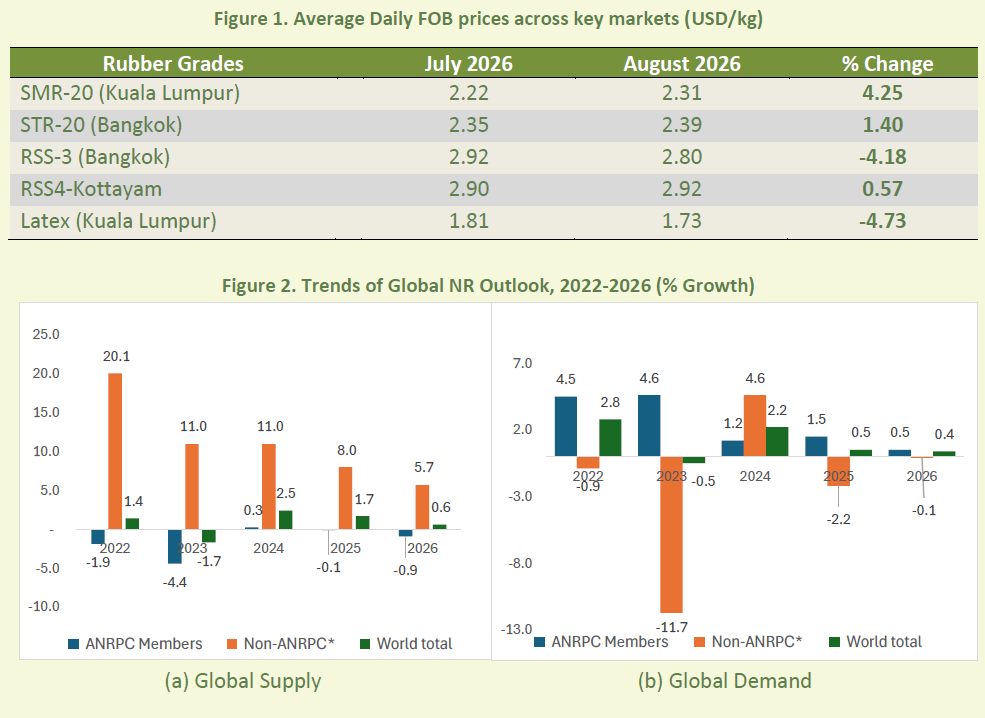
Physical prices for major grades moved in different directions. SMR-20 in Kuala Lumpur averaged USD 2.31 per kg, up 4.25 percent from July, while STR-20 in Bangkok rose 1.40 percent to USD 2.39 per kg. RSS-3 dropped 4.18 percent to USD 2.80 per kg, but RSS-4 in Kottayam gained 0.57 percent to USD 2.92 per kg. Latex-in-bulk fell 4.73 percent to USD 1.73 per kg. Brent crude averaged USD 91.08 per barrel, driven by concerns over possible restrictions on oil shipments through the Strait of Hormuz and wider Middle East instability, which raised energy supply risks and strengthened the oil market risk premium.
On trade, China's imports climbed 3.39 percent month-on-month, while India fell 10.18 percent and Malaysia dropped 8.24 percent; Viet Nam rose 5.08 percent. Exports advanced 5.63 percent in Viet Nam but declined in Thailand (-5.24 percent), Indonesia (-5.36 percent), Malaysia (-1.48 percent) and Cambodia (-1.88 percent).
Global production is projected to rise 0.6 percent to 15.039 million tons in 2026 from 14.952 million tonnes in 2025, after revisions to Thailand's 2025 output and updated 2026 estimates for Thailand, Malaysia and Indonesia. Weather, including erratic rainfall and drier Southeast Asian conditions, affected output. August 2026 production was estimated at 1.396 million tonnes, down 4.51 percent from 1.462 million tonnes a year earlier. Demand is forecast to grow 0.4 percent to 15.356 million tonnes in 2026 from 15.301 million tonnes, with the largest consumption gains expected in China, Malaysia and Cambodia. Prospects depend on vehicle sales, tyre production, shipping conditions and weather-related supply disruptions, while steady EV-linked demand supported modest growth led by China and India. The ringgit traded between RM4.02 per USD and RM4.09 per USD, and the baht between 32.68 and 33.34. The SHFE January 2027 contract averaged 18,109 CNY per tonne, up 7.78 percent month-on-month, while the SGX November 2026 contract averaged USD 2.24 per kg, up 4.32 percent.
Epsilon Carbon Advances Scope 3 Emissions Measurement Across Value Chain
- By TT News
- October 01, 2026
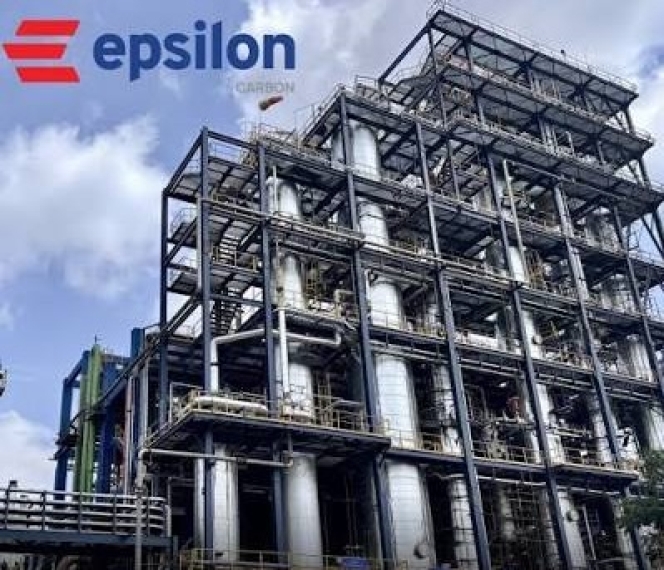
Epsilon Carbon Pvt. Ltd., a global speciality carbon and carbon black manufacturer, has broadened its emissions accounting to include value chain impacts beyond its direct operations. The move advances measurement and management of Scope 3 emissions across its supply and distribution network, according to the company.
The initiative spans Epsilon Carbon’s integrated carbon complex in Vijayanagar, Karnataka. That site has a production capacity of 500,000 tonnes per annum of speciality carbon and 215,000 TPA of carbon black. It combines carbon manufacturing with energy circularity efforts in one integrated ecosystem. The company assessed material Scope 3 categories under GHG Protocol guidelines.
Scope 3 emissions are indirect and arise from purchased goods and services, transportation, business activities and downstream product use where relevant. The assessment gives Epsilon Carbon clearer visibility into emissions outside its direct control and a foundation for spotting reduction opportunities. It builds on existing operational emissions and energy efficiency work.
The company previously reported a 98 percent Scope 2 reduction against its baseline year. A 17 MW captive power plant uses waste heat from carbon black operations, energy consumption intensity fell 6 percent from baseline, and 77 percent of energy needs came from waste heat recovery, avoiding over 89,000 tonnes of CO₂. Epsilon Carbon now emphasises supplier engagement, data transparency and circularity, aligning disclosures with global sustainability frameworks to track value chain emissions consistently and develop measurable reduction initiatives.
Vikram Handa, Managing Director, Epsilon Carbon, said, “Meaningful climate action requires us to look beyond the boundaries of our operations and understand the impact of the entire value chain. Scope 3 measurement gives us greater visibility into the emissions and enables deeper engagement with our partners and suppliers. Building this visibility will help us make more informed decisions as we scale our operations and advance our decarbonization plans.”
HS HYOSUNG To Expand Mexico Investments From 2027 Under New State Agreement
- By TT News
- September 30, 2026
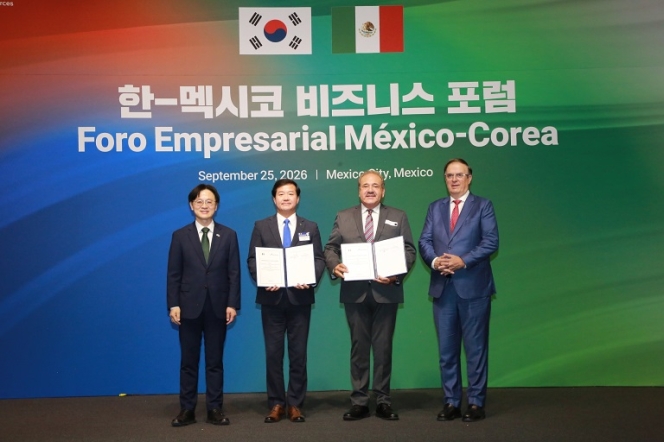
HS HYOSUNG has formalised a memorandum of understanding (MoU) with the State Government of San Luis Potosí, with the signing taking place at the World Trade Center Mexico City. The event formed part of the Korea-Mexico Business Forum, held alongside the Korean economic delegation's visit to Mexico.
Attending officials included Marcelo Ebrard, Mexico's Secretary of Economy, and Mario García Valdez, Secretary of Economic Development of San Luis Potosí. The two sides confirmed their shared resolve to back the company's local investment and regional growth. Separately, HS HYOSUNG's leadership met bilaterally with Secretary Ebrard to elaborate on its strategic vision and investment plans.
The agreement sets out a phased expansion of HS HYOSUNG's investments in San Luis Potosí beginning in 2027, with the goal of creating a major advanced materials production hub that bolsters supply for North American and wider global markets. The company's advanced materials span tyre cord, a flagship world-leading product, along with mobility, energy, aerospace and defence applications. Its North American operations, spanning Mexico and the United States, turn out tyre cord, airbag materials and mobility interior components for global leaders such as General Motors and Goodyear, underpinned by a highly dependable global supply chain.
Nak-yang Sung, CEO, HS HYOSUNG ADVANCED MATERIALS, said, “This investment goes beyond establishing a simple manufacturing base – it reflects our strategy to turn Mexico into a pivotal hub connecting North America with global supply networks. We are also committed to strengthening local supply chains and creating high-quality jobs to contribute directly to the region's industrial ecosystem.”

Comments (0)
ADD COMMENT