Natural Rubber Project Nears 200,000-Hectare Target In North-East India
- By TT News
- July 15, 2026
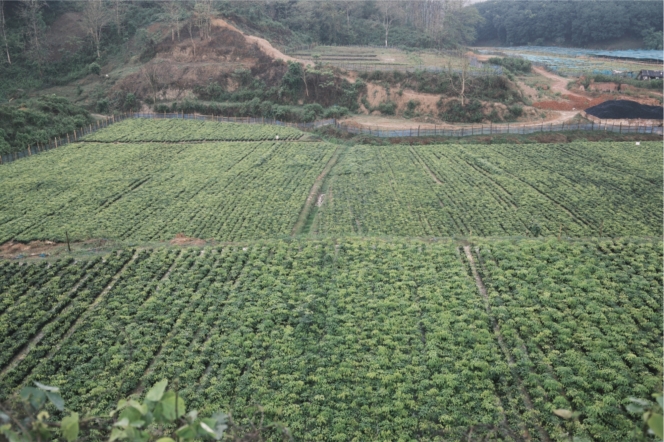
Natural Rubber (NR) plantations developed under Project INROAD (Indian Natural Rubber Operations for Assisted Development) have reached 179,376 hectares across north-east India after the completion of planting for the 2025-26 financial year, bringing the initiative close to its original target of 200,000 hectares.
Launched in the 2021-22 financial year, the project has established new NR plantations across 113 districts in the region over the past five years. According to the project partners, this represents the country's largest expansion of natural rubber plantations achieved within such a period.
Project INROAD is funded by tyre manufacturers Apollo Tyres, CEAT, JK Tyre and MRF, and is implemented by the Rubber Board of India. It is described as the first initiative of its kind in which the Indian tyre industry directly supports the development of rubber plantations.
"Despite several operational challenges including Covid-induced disruptions in the beginning, nearly 90% of the ambitious target of 2 lakh hectares of new plantation has been achieved under Project INROAD during the last five years. Beyond plantation expansion, the project has also made significant progress in strengthening local nurseries and building grower capacities — a testament to the collaborative efforts of the tyre industry and the Rubber Board," said Mohan Kurian, chairman of Project INROAD.
The project has distributed a record 83m quality planting materials during the five-year period. It has focused on supporting resource-constrained communities in the designated states, particularly small and marginal farmers, most of whom own less than one hectare of land. More than 200,000 beneficiaries have been supported through the initiative, with the project aiming to improve livelihoods and promote socio-economic development.
Project INROAD has also expanded nursery infrastructure across the region. More than 200 nurseries are supplying high-yielding planting materials to growers, while new and improved rubber clones suited to the north-east's agro-climatic conditions are being distributed through the programme.
"With plantations reaching a critical stage, the next component of the project — development of supporting infrastructure such as model smokehouses and dissemination of improved practices among rubber growers — is progressing well under the INROAD Skilling and Production Efficiency Enhancement Drive (iSPEED) initiative," Kurian added.
Under the iSPEED initiative, infrastructure development is intended to improve the quality of rubber produced by farmers through value addition at source. The programme also plans to roll out large-scale digital and in-person training for growers, supported by newly developed training materials that are ready for release.
Sustainability Without Compromise Still Sometime Away
- By Nilesh Wadhwa
- September 04, 2026
Sustainability has become critical for the tyre industry due to its heavy reliance on fossil-based raw materials, significant carbon footprint across the product lifecycle and the massive volume of end-of-life tyres generated annually. Shifting towards renewable, bio-based and recycled materials helps reduce greenhouse gas emissions, conserve resources, minimise microplastic pollution from tyre wear and address regulatory and consumer demands for greener mobility solutions. Without accelerated innovation, the industry risks falling short of global climate targets while facing supply chain vulnerabilities and reputational challenges.
The global tyre market is valued at around USD 290 billion in 2025 and is estimated to reach USD 299 billion in 2026 as per MarkNtel. It is projected to attain USD 387 billion by 2032, registering a CAGR of 4.39 percent during 2026–2032. Interestingly, the Passenger Car segment leads the global tyre market with approximately 42 percent of total demand. Radial tyres dominate the global tyre market with around 88 percent share. Furthermore, Asia-Pacific holds the largest regional share at approximately 37 percent.
In an exclusive interaction with Tyre Trends, C Harimohan, Head of Corporate R&D (Materials and Compounding) at Yokohama Off-Highway Tires (YOHT), shares his views on the tyre industry’s push towards true sustainability. He highlights the technical, economic and regulatory hurdles that lie ahead as the sector targets ambitious 2050 goals.
THE SUSTAINABILITY IMPERATIVE
It is no secret that the tyre industry is undergoing a profound shift, be it managing raw material supply chain, sustainability targets and geopolitical challenges, among others.
“See, I think we are undergoing a very special kind of scenario now,” Harimohan observes. While the core manufacturing process and raw material mixes have remained relatively stable, sustainability has moved from a ‘fashion word’ of a decade ago to a serious business priority.
“In the last two to three years, or let us say three to five years, we have started taking it more seriously because almost all the companies have declared that by 2050, 100 percent of the raw materials would be either renewable or recycled,” he says.
This target, however, comes with limited current visibility on delivery. Today, roughly 65 to 70 percent of tyre raw materials are derived from fossil sources, primarily crude oil.

“Around 30 percent only comes from the natural rubber; the remaining major part becomes a synthetic rubber, carbon black and almost all the chemicals which are derived from crude,” he explains. The central challenge is transforming these fossil-dependent components into renewable or recycled alternatives.
Recycling, though not new, presents its own limitations. “When you devulcanise the rubber, the kind of strength it has got originally, it is dropping drastically,” Harimohan notes.
“So it is not a 100 percent one-to-one substitution of the original compound or raw materials what you have. So you cannot go beyond a level,” he shares. This creates an inherent performance compromise that undermines the very idea of sustainability if safety and durability suffer.
BALANCING PERFORMANCE, QUALITY AND PRICE
The trade-off between sustainability, performance and cost emerges as one of the industry’s most pressing dilemmas. Harimohan poses the critical question, “What about trade-off between performance, quality as well as price? Because you could have the best recycled tyre, but if it does not perform as per consumer expectations or as per what is expected from its non-sustainable tyre or what people are used to, what are the challenges that have taken place?”
Even a near-100 percent sustainable tyre remains commercially unviable at present. “I can conceptually make a close to 100 percent, if not 100 percent, you can say a sustainable tyre which is produced from only renewable or recycled materials. But then it has to be at least three to four times the cost or the price would be three to four times what it is today. But then there has to be somebody who will pay for it,” he says.
Harimohan further explains that without external pressure, market adoption will be slow. “Unless and until it is enforced by a regulatory or by government, I do not think it is going to happen.”
He believes, “Even if we can market it as sustainable tyre, unless and until there is somebody who can pay for it, I think it is not going to happen.” Nevertheless, he remains optimistic about ongoing innovation.
“Most of us, almost all the R&Ds across the world are working towards it, how to make it more and more towards that 100 percent level, but at the same time without having a damage to the performance and almost at the same price you should be able to sell it,” says the executive. He anticipates meaningful progress over the next decade or two.
SUPPLY CHAIN PRESSURES AND THE ROAD AHEAD
Geopolitical tensions have added further complexity to an already intricate global supply chain. A single tyre incorporates ‘at least 60 to 70 different raw materials’ sourced from around the world. “All the geopolitical situations are affecting significantly on all the procurement, the supply chains are getting affected and it is affecting the whole production, supply of the tyre,” Harimohan confirms. “Tyre is no different. It is getting affected.”
On the question of segment-wise adoption, he sees OEM-driven momentum leading the way. “This is happening in almost across the segments, but I feel this is a bit more driven by the OEMs. So I think it may be the PCR segment which should be moving a little far ahead of others or even the two-wheeler would be going a little ahead of other segments,” he says, noting slower progress expected in off-highway and OTR applications.
Responding to a query on new trends in the industry, Harimohan acknowledges there lies huge potential for disruptive technologies. “I feel something will come to gradually replace the tyres. Like airless tyre could be one of the examples, there can be flat tracks coming,” he remarks.
Despite the industry’s traditional inertia, he believes change is inevitable, “Even though tyre is more of like a traditional and there is a lot of inertia to change, but I think going forward, there should be or there would be something which could potentially replace tyre all together. I mean, I think we should hope for that.”
The path to a fully sustainable tyre industry is neither simple nor short, but Harimohan’s insights reveal a sector actively confronting difficult trade-offs.
With continued R&D focus and potential regulatory support, the promise of high-performance, affordable and truly green tyres is still some decades away from becoming a reality.
- Association of Natural Rubber Producing Countries
- ANRPC
- Monthly NR Statistical Report
- Natural Rubber
ANRPC Publishes Monthly NR Statistical Report For July 2026
- By TT News
- September 02, 2026
The Association of Natural Rubber Producing Countries (ANRPC) has released its Monthly Natural Rubber Statistical Report for June 2026, documenting a period of price resilience within the sector. This stability persisted despite seasonal supply improvements and firm downstream demand, set against a backdrop of significant geopolitical friction and macroeconomic volatility. The month of July presented a starkly different energy landscape compared to June, as renewed regional conflicts and major shipping route disruptions replaced the brief period of stability following the provisional reopening of the Strait of Hormuz.
The escalation in Middle Eastern tensions exerted considerable upward pressure on global energy markets. Brent crude oil averaged approximately USD 83.76 per barrel in July, with the spot price surging to USD 96.95 per barrel by the end of the month. This sharp increase was primarily attributed to fears of potential restrictions on oil shipments through the strategic waterway, amplifying supply risks and embedding a higher risk premium within oil pricing structures.

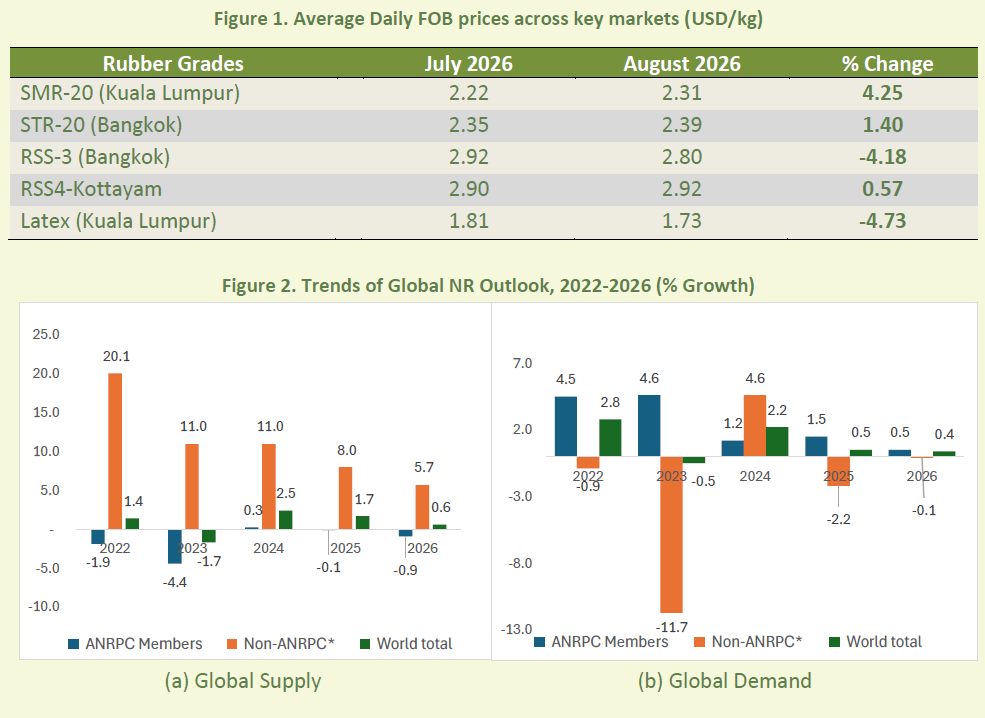
Physical natural rubber prices exhibited divergent trends across major grades during the month. The Kuala Lumpur market saw SMR-20 average USD 2.22 per kilogramme, representing a month-on-month decline, while STR-20 in Bangkok followed a similar downward trajectory. RSS-3 also registered a decrease, contrasting with RSS-4, which posted a notable gain. Latex-in-bulk prices softened over the same period. Trade flows showed mixed results, as Chinese imports contracted, while significant import growth was recorded for India, Viet Nam and Malaysia. On the export front, shipments from Thailand, Viet Nam and Malaysia advanced, whereas Cambodia and Indonesia experienced moderate declines.
For the full year 2026, the ANRPC projects global production to expand by over two percent to reach 15.279 million tonnes, driven primarily by anticipated increases in Thailand, China, India and Malaysia. However, on a monthly comparative basis, July 2026 production is estimated to be over five percent lower than the same month in the previous year, though seasonal recovery is expected in key producer nations. Global demand is forecast to grow modestly by 0.4 percent for the year, with consumption in July rising year-on-year, supported by robust tyre manufacturing and electric vehicle-related demand, as well as a strong manufacturing performance and record auto sales in India.
Currency valuations saw the Malaysian ringgit and Thai baht trade within defined ranges against the US dollar. Futures markets reflected the mixed sentiment, with the SHFE September 2026 contract averaging 16,802.61 CNY per tonne, while the SGX September 2026 contract averaged USD 2.14 per kilogramme, both registering month-on-month declines. The overall data suggests a market navigating the complex interplay of supply recovery, shifting trade dynamics and persistent geopolitical uncertainty.
Flexsys Unveils Next Phase In Quest To Replace Critical Tyre Additive 6PPD
- By TT News
- September 02, 2026
Flexsys, a prominent entity in material science and advanced tyre additives, has announced two significant advancements in its quest to develop a substitute for the chemical 6PPD. The company is progressing towards a new era in tyre manufacturing, having identified two primary molecular candidates that will undergo extensive evaluation. This development follows a prior announcement in November 2025, where Flexsys revealed it had created the first viable alternative to the established antidegradant.
The two finalist molecules have successfully passed rigorous internal and external testing, meeting stringent safety, performance and environmental standards. Significantly, neither compound belongs to the PPD chemical family, and crucially, they do not produce a quinone transformation product during usage. With the initial screening phase complete, Flexsys is now concentrating on expanded testing for these candidates, with the ultimate goal of selecting a definitive replacement for 6PPD in tyre production.
In a parallel effort to ensure environmental safety, Flexsys has formalised a Cooperative Research and Development Agreement with the U.S. Geological Survey. This collaboration is designed to independently and thoroughly assess the potential effects of the two molecules on aquatic ecosystems. Building upon a previous CRADA with the U.S. Department of Agriculture, this new agreement with the USGS represents a critical phase in determining the complete aquatic toxicity profile. The research will employ novel testing methodologies that extend beyond standard chemical registration requirements.
Under the agreement, scientists from the USGS Western Fisheries Research Center, alongside other USGS divisions, will study the molecules and their breakdown products. The focus will be on the impact on Pacific salmon and other aquatic species, utilising innovative cell-line research to pioneer new testing methods. This approach aims to create alternative assessment tools applicable to a wide range of chemicals. The CRADA formalises and expands upon preliminary testing that had already commenced at the research centre.
Flexsys acknowledged the support from the Economic Development Administration’s Tech Hubs Program, as a member of the Akron Sustainable Polymers Tech Hub. Concurrently, the company is optimising the process chemistry for both candidates to facilitate efficient, large-scale production. Both molecules utilise intermediate chemistry similar to that used for 6PPD, allowing the industry to leverage existing manufacturing assets. This strategic approach is expected to promote faster adoption and reduce overall investment costs while Flexsys continues its engagement with global regulatory agencies for commercial approval.
Carl Brech, Chief Executive Officer, Flexsys, said, “The tyre industry has been waiting for two things: a molecule that actually works and independent proof that it is safe. As of today, both are in hand or in motion. With tyre and environmental safety testing underway, the focus has shifted from finding a potential replacement to thorough validation, regulatory approval, scale-up and industry adoption.”
Neil Smith, Chief Technology and Sustainability Officer, said, “This marks a significant milestone for our team, and we’re pleased to announce we’ve narrowed our efforts to two final molecules that continue to meet our strict targets for in-rubber performance, scalability, toxicity profile and environmental sustainability. The selected alternative must be reliable and safe, not only today but for decades to come. USGS expertise provides independent evaluation with a level of rigour we could not execute on our own. We are proud to help pioneer novel toxicity-testing methods and eager to see the results.”
Michael Schmidt, Center Director, U.S. Geological Survey Western Fisheries Research Center, said, “USGS has spent the past five years studying the effects of 6PPD on aquatic species and developing innovative methods to screen the safety of potential alternatives. For nearly a century, the Western Fisheries Research Center has provided objective science to support management of aquatic species across the Western United States.”
- Central Marketing Inc
- Retread Information Bureau
- US Federal Aviation Administration
- FAA
- Edd Burleson
- Wilkerson
Aircraft Tyre Retreading A High-Stakes, High-Barrier Business
- By Gaurav Nandi
- September 02, 2026
Aircraft tyre retreading may resemble truck tyre retreading on the factory floor, but the similarities end there. Stringent US Federal Aviation Administration (FAA) oversight, exhaustive inspection protocols and extensive documentation make it one of the most tightly regulated segments of the tyre industry. According to President of Central Marketing Inc., these rigorous requirements coupled with high upfront investment and the dominance of major tyre manufacturers have created a niche market where only a limited number of players can compete.
Tire Retread Information Bureau mentions that over 100,000 retreaded tyres are done annually in United States, while another report published by the United States International Trade Commission on retreaded tyres in 2012 stated approximately 80 percent of aircraft tyres in US are retreaded and that retreading saves commercial and military operators over USD 100 million annually.
Since publication of the report over a decade ago, the state of the tyre retreading industry remains quite optimistic. Market Research Future estimated that US aircraft tyre retreading market will reach USD 1.42 billion by 2035, up from USD 948.2 million in 2025.
However, aircraft tyre retreading demands for stricter regulatory oversight than conventional truck and bus tyre retreading.
According to President Central Marketing Inc Edd Burleson, “FAA certification, rigorous inspections, extensive documentation and high entry barriers define the sector, where major tyre manufacturers dominate and independent retreaders serve mainly private aircraft operators.”
In a tete-a-tete with Tyre Trends, he delves into the dynamics of the aircraft retreading industry of United States and North America as his company has been a supplier of retreading machinery in these markets for over four decades.
“Although aircraft tyre retreading follows the hot retreading process, with many of the same steps seen in truck and bus radial retreading, the level of oversight is substantially higher. The process is fundamentally similar but is much more tightly controlled,” contended Burleson.
Everything is Federal Aviation Administration (FAA) certified. The inspection procedures are much stricter, there are more process controls, much more record-keeping and the Federal Aviation Administration oversees the entire process. The basic manufacturing process is similar, but the level of control and inspection is significantly higher.
He added that the dominance of major tyre manufacturers and strict regulatory requirements make it difficult for independent companies to enter the sector. And that’s because the smaller independent retreaders mainly service the private aircraft market rather than the major commercial airlines.
“Not everyone has the inspection capabilities or qualifications required to obtain an FAA license to retread aircraft tyres. It’s a speciality market and different from commercial truck tyre or OTR retreading,” he added.
Obtaining regulatory approval requires substantial investment before any licence is granted. A company will have to establish a plant, demonstrate its entire retreading process, undergo inspections and prove that it has the capability to perform aircraft tyre retreading.
“It’s not simply a matter of applying for a license and getting approval. You take on the risk of investing in the facility and processes before knowing whether you’ll actually be approved,” Burleson said.
In addition, entering the market isn’t easy because new plants will compete against major players like Goodyear, Michelin, Dunlop and Bridgestone. Hence, as an independent company, it’s generally conducive to enter the private aircraft market.
Burleson said the industry’s structure further limits competition because manufacturers sell tyre services rather than tyres themselves.
“The major players manufacture the new tyres and they’re not selling tyres but the service, most which is charged per cycle,” he said.
MARKET DYNAMICS
Aircraft tyre retreading remains a stable and highly specialised market. “The market across North America is well developed because airlines routinely retread their tyres as part of their operating model,” said Burleson.
The airlines themselves are responsible for maintaining the tyres including tyre pressure and general maintenance. The tyre company is responsible for supplying the tyres to the airlines and get paid on a per cycle basis. A cycle here means an entire take-off to landing cycle.
The number of times an aircraft tyre can be retreaded depends on the tyre size and aircraft type. “Some aircraft tyres can be retreaded two or three times, while others can be retreaded five or six times,” Burleson said.
Retreading significantly lowers operating costs for airlines by extending tyre life, he added. As a result, the cost per cycle comes down substantially. If airlines charged the same cost per cycle while using only new tyres, it would be three to four times more expensive.
The company supplies shearography inspection systems, repair machines, buffing machines, rubber extruders, laser engraving systems and curing presses. Its clientele includes Michelin, Bridgestone, Goodyear, Dunlop and one independent aircraft retreader, Wilkerson, in United States.
Besides, Central Marketing has been a servicing supplier to the tyre retreading industry as well as off-the-road, light truck, aircraft and the new tyre industries for 49 years. Its top-of-the-line computerised products have varying degrees of automation. Its base of operations is in Colonial Heights with a staff of 24 people.
Burleson described aircraft retreading as a stable market with limited growth because of the relatively small number of retreaders.
“The market is limited by the number of retreaders so it’s more of a stable market. Growth is typically around 3–5 percent annually. There’s no major boom like you’d see in an emerging market,” he said.
Unlike commercial truck tyre retreading, the aircraft sector in North America has not been affected by imports from Asian manufacturers.
“Bridgestone has one plant in US, Michelin has one, Goodyear has two and the total number of aircraft retreading plants isn’t very large,” Burleson said.
Outside United States, the market is even smaller.
“There’s a small aircraft retreader in Mexico and there isn’t any aircraft tyre retreading in Canada,” he said.
MAKING THE RETREADS
Aircraft retreading equipment differs from machinery used in commercial tyre retreading because aircraft tyres require greater precision during processing. The tyres are much more difficult to handle and buff.
Repairs are limited to very specific tolerances. Companies have to ensure their process doesn’t damage the body plies during buffing. There may be need to replace breaker belts and perform other specialised repairs.

Each stage of production must comply with tightly controlled specifications. Every step of the process has to meet a specific specification.
“If the temperature drops by more than a set number of degrees during curing, then the tyre may no longer be acceptable. Aircraft retreading is governed by much stricter rules and regulations because of the nature of the application. You’re transporting people, so there can be absolutely no compromise on safety,” Burleson said.
Burleson identified shearography as the most significant technological advancement in aircraft tyre retreading.
“I would say the biggest advancement has been shearography. Another important development is laser engraving. Each time an aircraft tyre is retreaded, it’s assigned an ‘R level’ to ascertain the exact retread generation,” he said.
Laser engraving the sidewall makes record-keeping much more accurate compared with using stencils. Considerable progress has been made in buffing technology through computerised profiles too.
Automation is increasing in selected areas, although regulations limit the use of artificial intelligence as a trained human inspector must still verify and confirm the results.
SUSTAINABLE OPERATIONS
Aircraft retreading makes a significant contribution to sustainability by extending tyre life as each tyre is retreaded between three to six times.
The economics of cost savings and inexistence of Asian imports have also written an optimistic future for aircraft tyre retreading in US till now, but challenges are present for retreading machinery suppliers.
“We don’t make the machines ourselves but procure it from different countries for the US market. The challenge is providing equipment that meets our customers’ requirements and being able to service that equipment when it’s installed in their plants,” said Burleson.
However, he said that the broader retreading industry is undergoing consolidation. “In US, the East Coast is probably the largest market, followed by the West Coast, where the major population centres are,” he said.
Retreading plants are becoming larger in the TBR segment, processing higher volumes and adopting more automation. At the same time, smaller retreaders are finding it increasingly difficult to compete and many are going out of business.
Aircraft retreading is insulated from those market trends because of its unique business model.
Summing up the sector, Burleson reiterated that aircraft tyre retreading should not be viewed in the same way as commercial tyre retreading.
“The main thing people need to understand is that aircraft retreading is a speciality market. Although the process follows many of the same basic steps as commercial tyre retreading, it’s performed under much stricter controls because of the critical nature of its application. It’s not something that anyone can simply enter. It’s a highly specialised industry. Even though it’s still retreading, it shouldn’t be viewed in the same way as the normal commercial TBR market,” he noted.


Comments (0)
ADD COMMENT