

Michelin Retains Crown as World's Most Valuable Tyre Brand
- By TT News
- May 09, 2025
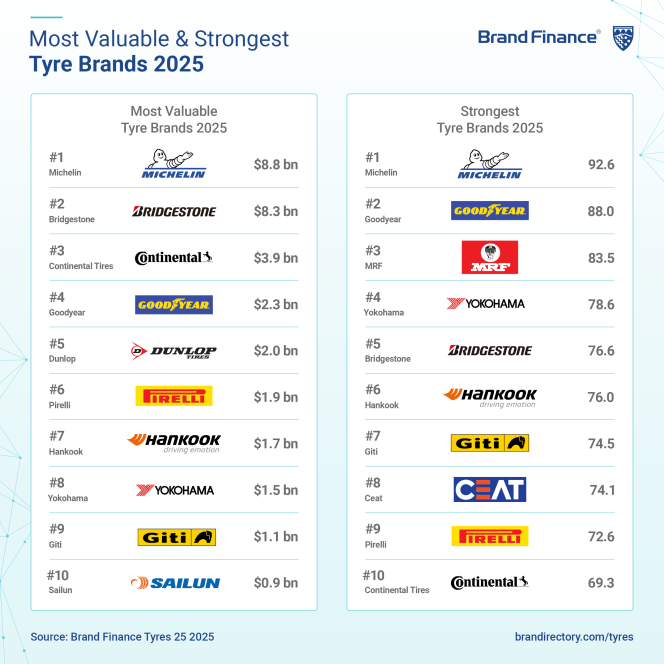
Michelin has secured its position as the world's most valuable tyre brand for the eighth consecutive year, according to the latest Brand Finance report.
The French manufacturer saw its brand value climb 11 percent to USD 8.8 billion, whilst also achieving the sector's highest Brand Strength Index score of 92.6 out of 100, placing it 15th amongst the strongest brands globally across all industries.
Brand Finance's research indicates Michelin enjoys exceptional familiarity and recommendation metrics across nearly all markets, underpinned by its reputation for quality, innovation and trust. Despite maintaining premium pricing—which can present challenges in price-sensitive segments where consumers struggle to identify the added value of high-end tyres—the brand continues to dominate on quality and reliability metrics.
Japanese firm Bridgestone maintained its second-place ranking with an 8 percent increase in brand value to USD 8.3 billion, bolstered by strong North American performance and ongoing investment in premium electric vehicle tyres.
Continental Tires rounded out the top three despite suffering the largest brand value decline among the top 10 contenders, falling 16 percent to USD 3.9 billion. The German manufacturer's drop reflects weaker 2024 revenue, persistently lower brand strength scores in the US market and a less optimistic outlook.
The combined brand value of the top 25 tyre brands rose 5 percent to USD 38.8 billion, outperforming the largely stagnant wider automotive sector. Industry players are heavily investing in innovations such as green tyre technology, smart RFID-enabled products and EV-specific offerings as vehicle electrification reshapes market demands.
"Tyre brands are driving growth by investing in innovation, digital integration, and EV readiness. Electrification is reshaping product demands, and international competition continues to intensify. Brands that adapt quickly to evolving technologies and shifting global markets are best positioned for future success," said Lorenzo Coruzzi, Director at Brand Finance.
Finnish manufacturer Nokian Tyres emerged as the ranking's fastest-growing brand with a remarkable 31 percent surge to USD 343 million. Within the top 10, Japan's Yokohama achieved the strongest growth, increasing 23 percent to USD1.5 billion, fuelled by record profitability, robust consumer tyre sales and effective pricing strategies.
China's Sailun broke into the top 10 for the first time, displacing Japan's Toyo Tires, which experienced a 4 percent decline to USD 852.1 million.
Kumho Tire's Road Venture MT71 Powers Drivers To Multiple 2026 Off-Road Racing Season Titles
- By TT News
- October 22, 2026
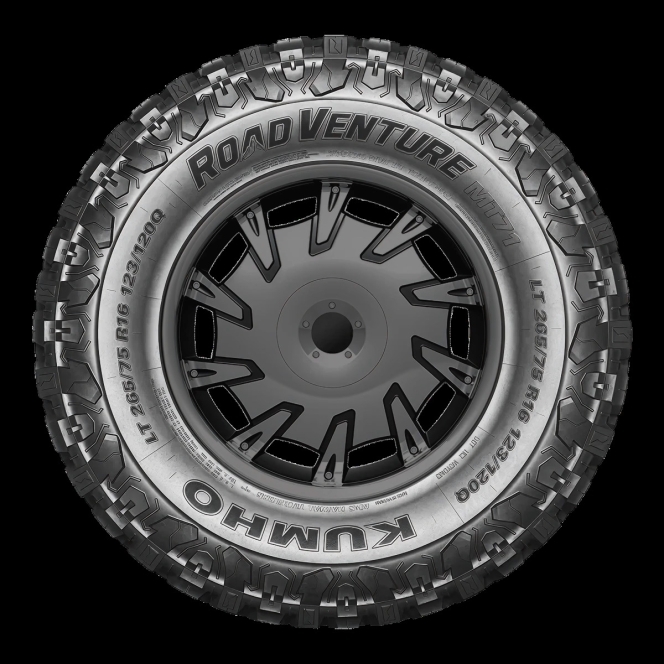
Kumho Tire USA has marked a successful return to off-road racing in the 2026 season, with its three sponsored drivers securing multiple class podium finishes. Mark Duval, Stephen ‘Woody’ Rose Jr and Eric Wikle all competed on KUMHO Road Venture MT71 mud-terrain tyres, which are engineered for the varied terrain and harsh conditions of competitive off-road courses.
Duval, driving the #4810 entry, claimed the 4800 Class title in the Valley Off Road Racing Association Season Championship after winning all four events in the series. He completed the campaign without a single puncture on his KUMHO tyres. Rose, in the #22 vehicle, earned the Ultra4 Western Regional Series Championship in the 4800 Class, recording one victory and two fourth-place finishes across four demanding races.

Eric Wikle, piloting the #406 entry, took first place in the Rock800 Legends class at the 2026 Casey Folks Vegas to Reno race. He navigated the rigorous 505-mile Nevada desert course, which was run in reverse for the first time in the event's history, with racers competing for the quickest time from Reno to Las Vegas.
The Road Venture MT71 features increased block stiffness for enhanced on- and off-road handling, a high-void tread pattern with a zig-zag and dual-pitch design for maximum off-road traction and mud and stone ejector bars between the shoulder lugs to prevent damage and aid self-cleaning. The drivers' results demonstrate Kumho Tire's commitment to high performance and durability across its Road Venture light truck and SUV tyre range.
Ed Cho, CEO, Kumho Tire USA, said, “We are extremely proud of the success of our drivers this season, which is a testament to the strength and performance of our Road Venture MT71 tyres. Key product insights gathered from these races will be integrated into the next generation of all-terrain tyres to ensure that racing-grade innovations reach everyday drivers.”
Tana Australia To Showcase Waste Solutions At Waste Expo Australia 2026
- By TT News
- October 22, 2026
Tana Australia, a subsidiary of Tana Oy, is set to exhibit at Waste Expo Australia 2026, scheduled for 28–29 October at the Melbourne Convention and Exhibition Centre. The event will gather professionals from the waste, recycling and resource recovery industries to share insights, examine emerging technologies, and discuss the future of sustainable materials management.
Attendees can visit stand E131 to meet the Tana Australia team, including Managing Director Joshua Feller, Sales Manager Andrew Browne, and Tana Oy's VP of Sales, Marketing & Channel Development Gerd Schreier. The company will showcase solid waste management solutions aimed at boosting operational efficiency, enhancing resource recovery and supporting landfill optimisation.

Tana Australia provides waste shredders, screens, landfill compactors and lifecycle services across Australia, all designed to maximise performance throughout each machine's lifetime.
- Alliance for the Future of Tires
- AZuR
- Tyre Circular Economy
- Tyre Recycling
- Innovation Award
- German Mobility Industry
AZuR Among Three Finalists For Innovation Award Of The German Mobility Industry 2026
- By TT News
- October 22, 2026

The Alliance for the Future of Tires (AZuR) is among three finalists for the Innovation Award of the German Mobility Industry 2026 in the Product/Project category. An expert jury spanning academia, specialist media and all sectors of the mobility industry nominated the cross-industry network for its holistic approach to the tire circular economy. Organised by the German Society for Traffic Sciences (DVWG), the award honours innovative, practical and transferable solutions for tomorrow's mobility. The winner will be announced at a ceremony on 17 November 2026 in Frankfurt's Paulskirche.
The network's goal is to keep tyres and their valuable raw materials in the economic cycle for as long as possible. AZuR connects companies from the tyre industry, tyre retail, remanufacturing and recycling with science and research and partners jointly develop and promote sustainable solutions along the entire tyre value chain. Priority goes to extending service life through proper maintenance, repair, retreading and refurbishing, with material recovery and reuse through recycling reserved for tyres that can no longer be used. Roughly 535,000 tonnes of used tyres arise in Germany alone each year, underscoring the importance of longer tyre life and intelligent use of existing resources.
The jury highlighted the finalists' systemic approach, recognising that innovation stems not only from new technologies but also from intelligently interconnecting existing solutions and actors. Joining AZuR in the final are BiciBus-Deutschland, which runs guided bike rides for schoolchildren, and radbox.nrw, a digital platform for safe bicycle parking. Beyond innovative character, the jury deemed it especially crucial that the nominated solutions are already successfully applied and transferable to other areas.
The finalist placement underscores the AZuR network's significance for a resource-efficient mobility economy, as converting linear value chains into closed material cycles demands collaboration among manufacturers, retailers, service providers, recycling companies, research institutions and users. AZuR links these stakeholders, fosters knowledge transfer, initiates research projects and pushes for wider practical use of sustainable tire solutions, so the nomination also honours its partners' shared commitment to longer tyre life, retrofitting and high-quality recycling. Awarded for the sixth time in 2026, the honour also includes a personality prize and a special Mobility Design award, with the ceremony held on the eve of the German Mobility Congress.
Prof Knut Ringat, Chairman of the Jury, said, “Innovation doesn’t always have to be the next big technology. All three finalists combine individual solutions into a system that makes mobility easier, more sustainable and more accessible – and that achieves more than the sum of its parts."
Prof Dr Jan Ninnemann, President of the DVWG and member of the jury, said, “All three finalists are already working in practice. We were also convinced that their approaches are not limited to a single location but can be adopted by other schools, municipalities or companies as well."
Anna-Maria Guth, Network Coordinator, AZuR, said, “The nomination is a great recognition for our entire network and shows that the tyre circular economy is an important driver of innovation for sustainable mobility. Together with our partners, we are committed to using tyres longer through remanufacturing, conserving valuable resources and closing the loop.”
- BKT
- PIRELLI
- JOINT VENTURE
- PASSENGER CAR TYRES
- PCR TYRES
- TYRE MANUFACTURING
- INDIAN TYRE INDUSTRY
- BALKRISHNA INDUSTRIES
- AUTOMOTIVE TYRES
- TYRE INDUSTRY NEWS
BKT, Pirelli plan 50:50 Indian Tyre Venture
- By Sharad Matade
- October 22, 2026
Partnership targets passenger car radial tyres, with new plant planned and joint venture agreement due by 2030.
Balkrishna Industries (BKT), the Indian maker of off-highway tyres, has agreed to establish a 50:50 joint venture with Italian tyre manufacturer Pirelli to manufacture passenger car tyres in India, as both companies seek to expand their presence in the market.
BKT and Pirelli signed a framework agreement on Thursday setting out the proposed venture’s structure and timelines, alongside separate agreements covering tyre manufacturing and technical support, according to a stock exchange filing by BKT.
The proposed joint venture will manufacture passenger car radial (PCR) tyres under the Pirelli and BKT brands and establish a new manufacturing plant in India. The partners intend to share the venture’s manufacturing capacity equally, with each nominating two directors to a four-member board and the chairmanship rotating between them.
The joint venture agreement is yet to be signed. The companies have agreed to incorporate the venture by December 31 2030, subject to the fulfilment or waiver of specified conditions.
Under an interim offtake agreement, BKT will manufacture Pirelli-branded passenger car tyres at its existing plant in Bhuj, Gujarat, using Pirelli’s specifications and know-how. Pirelli and its affiliates will purchase the tyres, with pricing based on actual raw material costs plus conversion costs. Payments will be made in rupees for domestic supplies and euros for exports.
The agreement includes a minimum annual purchasing commitment from Pirelli, matched by a corresponding capacity commitment from BKT. The arrangement is expected to remain in force until the joint venture becomes operational and can meet Pirelli’s demand. Otherwise, it will continue until December 31 2031, subject to a possible extension by mutual agreement.
The partnership also provides for Pirelli to supply technical support for testing BKT-branded tyres, including products for sport utility vehicles, passenger cars and two-wheelers. The services will use Pirelli’s testing facilities outside India, with BKT paying fees in euros under an agreed pricing schedule.
For Pirelli, which the filing says currently has a commercial presence in India, the venture represents a step towards strengthening its position in a market with growing demand for higher-value tyres. The company reported consolidated revenue of approximately €6.78bn for the year ended December 2025.
For BKT, the agreement offers a route into the passenger car tyre segment beyond its established business, potentially opening opportunities in domestic and international markets.
The agreements also contain restrictions on competing arrangements. While the framework agreement remains in force, neither company may enter a joint venture or similar arrangement with a third party in India to manufacture car, light truck, motorcycle or bicycle tyres, although wholly owned plants are excluded. Under the offtake agreement, BKT cannot manufacture comparable or competing passenger car tyres for third parties, but remains free to develop and sell its own BKT-branded products.
The proposed joint venture’s completion remains subject to the conditions specified in the agreements. The companies have not disclosed a financial value for the transaction or the proposed plant’s investment cost in the filing.

Comments (0)
ADD COMMENT