

A Chinese Tyre Maker’s European Powerplay
- By Sharad Matade and Gaurav Nandi
- December 10, 2025
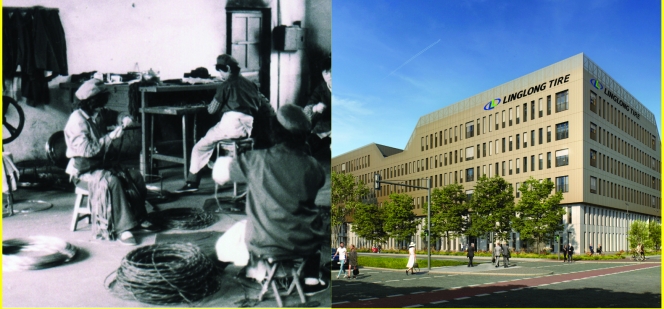
Once dismissed for quality concerns, Chinese tyre makers are steadily challenging legacy brands through localisation, OE wins and performance-driven branding. At the forefront is Linglong Tire, which is fast becoming a strategic force in Europe. From securing OE fitments with Stellantis, Volkswagen, Renault Group to launching a high-tech plant in Serbia, Linglong is leveraging smart manufacturing, targeted dealer engagement and sports sponsorships to elevate its brand. While most view OE as a branding tool with thin margins, Linglong claims real profitability, underpinned by market knowledge and pricing precision. Its lean model, combined with bold ambitions, signals a new chapter in global tyre competition.
A common perception associated with Chinese goods that still lingers across economies is ‘inferior quality’. The same fate had befallen Chinese tyres but is gradually changing. Today, Chinese brands are very competitive with global brands including the big names.
Speaking to Tyre Trends, Linglong Tire Head of Marketing Wolf Fuder said, “Our technology is now on par with established brands in Europe. However, branding is a different story. We have several tools and strategies. First and foremost is tyre quality. We’re constantly working on it. We have three main strategies to demonstrate the performance and quality of our tyres. The first is investment in original equipment. Being an OE supplier for brands like Fiat or Volkswagen or Renault Group serves as a clear proof of performance.”
OE fitment plays a critical role. The company began with spare tyres but has since made significant progress with OEM partnerships. While OE brings brand credibility, Fuder acknowledges that real profitability lies in the replacement market.
 “The second strategy is rigorous testing. We work hard to get our products included in prominent magazines in Germany, Northern Europe, UK etc. Sometimes we invite testers to observe our testing processes. We’ve received strong results from the Rubber and High-Tech Centre, which we show to both our dealers and customers as proof of performance of our tyres,” he added.
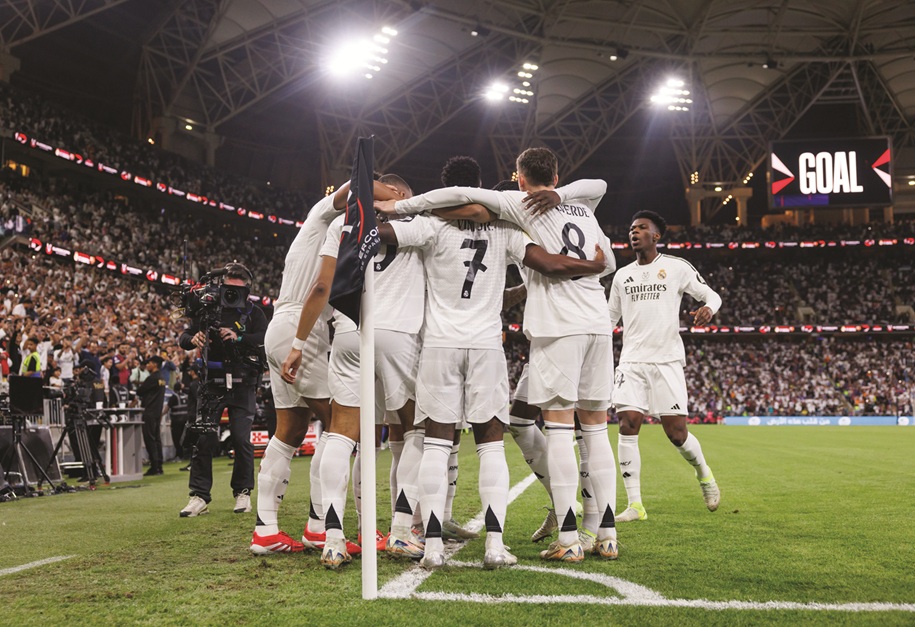
The executive noted that different customised strategies are deployed across markets. In Europe, it offers a 30-day money-back guarantee. “We have partnered with major football clubs like Real Madrid and Chelsea to feature our logo. Football is a key long-term branding tool for us. Our goal is to have one strong club partnership in each European country. We’ve already partnered with Wolfsburg (partnership not extended yet) in Germany and we’re looking for similar opportunities in Italy and France,” noted Fuder.
 Beyond sports sponsorships, it invests in advertising and trade fairs. “While branding is certainly about reaching the end user, it’s actually even more important to win over the dealer. In Germany, and across much of Europe, dealers are the real decision-makers in 80–85 percent of purchases. They’re the key link between the tyre and the consumer,” contented Fuder.
As Linglong Tire deepens its European presence, the company’s strategy is increasingly anchored by its manufacturing facility in Serbia. When asked about the company’s performance in the region post-Serbia plant inauguration, Fuder noted that the transition is still underway as ramping up the factory to its full capacity of 14 million passenger car radial (PCR) tyres per year takes time.
Despite that, he expressed satisfaction with the plant’s current progress and emphasised that the facility now supplies tyres to its European dealer network alongside existing exports from China. While imports from China continue, the long-term goal is to gradually shift the supply focus towards European production, making Serbia the primary hub for the region.
The localisation strategy also aligns with its ambition to expand volumes and competitiveness in Europe. In terms of production mix, Fuder confirmed that the Serbian plant manufactures a full range of tyre sizes, from 13 and 14 inches all the way up to larger sizes like 21 and 22 inches.
Notably, while certain older tread patterns continue to be produced in China, newer lines such are exclusively manufactured in Serbia.
To strengthen its presence there, Linglong Tire is launching marketing campaigns in Italy and the UK, expanding its social media footprint in Europe and preparing localised websites in six key markets including Germany, UK, Spain, Italy, France and Serbia.
7+5 STRATEGY
Linglong Tire’s long-term ‘7+5’ global strategy is a framework guiding the company’s international growth trajectory. It represents the vision to operate seven manufacturing plants in China and five international plants across strategic global locations.
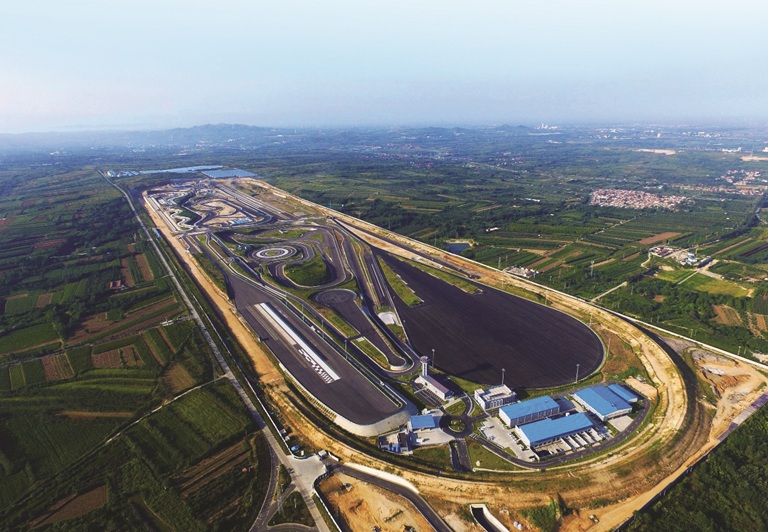
(Linglong’s Thailand facility, part of the company’s international expansion strategy)
Currently, Linglong Tire’s international footprint includes operational facilities in Thailand and Serbia with a third under development in Brazil. Two more international sites are yet to be finalised.
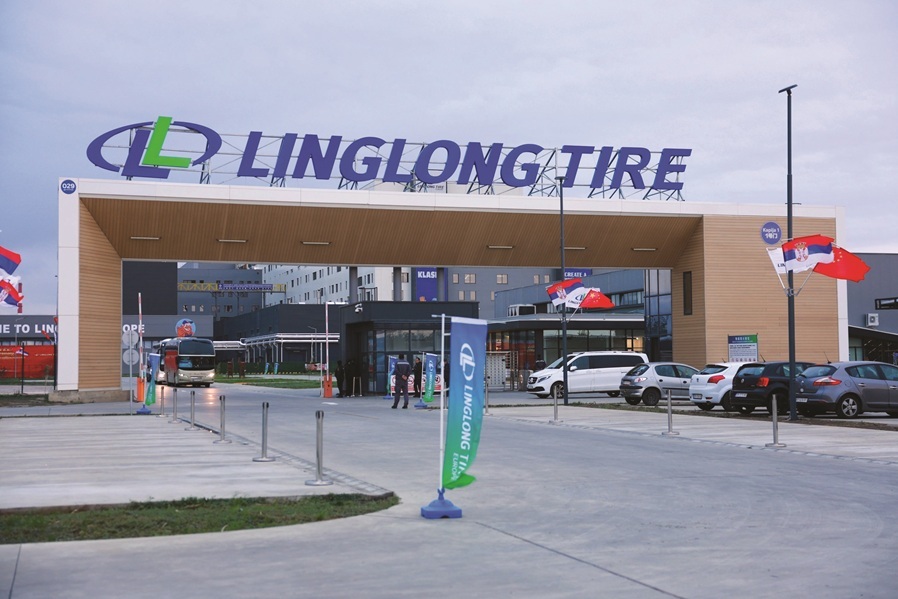 Linglong Tire describes its Serbia facility as a ‘smart factory’ equipped with state-of-the-art machinery and designed for eco-efficiency and automation. “Our newer factories in China are also smart but Serbia features the most advanced setup,” explained Fuder.
The facility initially focuses on PCR tyres. In phase-two, production is expanding to include TBR and OTR tyres for agriculture and mining. These were previously made in China but are now shifting to Serbia.
This diversification also helps Linglong Tire avoid global tariffs, particularly in TBR and possibly in the near future in PCR as well, which has been impacted by import duties. “We had set up our Thailand plant earlier to avoid duties. Now, TBR tyres are exclusively produced in Serbia for Europe,” the executive said.
He also highlighted the plant’s 94/100 sustainability score, citing efforts across the supply chain, sustainable materials etc.
Answering why the company selected Serbia for its plant, Fuder explained, “Serbia is very well-connected to China and offers attractive incentives. These include subsidies, affordable land and economic advantages related to labour and operations.”
“The country’s appeal is evident as other tyre manufacturers also explore the region. While some competitors are evaluating sites in Poland or Romania, we secured the Serbia deal nearly six years ago, well before current market shifts,” he added.
Linglong Tire is actively working to expand its presence in Europe through a focused strategy combining dealer partnerships, OE fitment and targeted aftermarket engagement. Currently, the company operates with a relatively small European sales team, which it plans to scale up.
Rather than disclosing an exact dealer count, Fuder emphasised the company’s reliance on key wholesalers across Europe to maximise reach. In countries like Germany, where there are over 4,000 tyre dealers, wholesalers are seen as the most effective distribution route today, especially when supported by local warehousing.
MARKET INTEGRATION
Penetrating the OEM tyre supply chain has always been challenging, given the stringent validation and approval timelines. Traditionally, tyre development took several months, but as the automotive development cycle is accelerating, tyre manufacturers are under pressure to deliver faster without compromising performance.
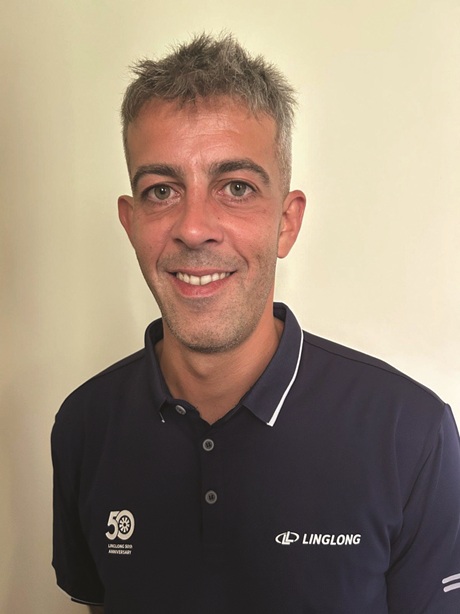 “Today, companies like Renault are using virtual development loops followed by physical testing, reducing total car development time to under two years. This means tyre development must be completed within 12 to 14 months,” noted Enrico Staffini, the company’s Deputy Director Europe OE Sales.
The key challenge now lies in balancing performance requirements, particularly around rolling resistance, which is critical to meeting emission targets. “OEMs are no longer asking for just A-class tyres. They want A+ and A++ in rolling resistance, which directly impacts wet grip and wear life. There’s no breakthrough material yet that solves all these trade-offs, so we’re constantly optimising within limits,” he added.
Homologation requirements are prioritising rolling resistance, pass-by noise and mileage – metrics that all tyre makers must hit to stay competitive. Linglong Tire has been able to break into this tough segment in part due to its experienced team and its Serbian plant.
“I’ve been doing OE development for over 10 years and we started building this up at Linglong with early SKUs. Then came a turning point, when OEMs needed to cut costs and opened a door for us. Now, Stellantis, Renault and Ford are key OEM partners for us including Volkswagen,” said Staffini.
The industry itself is evolving. In the past, OEMs relied on just three or four tyre suppliers. But economic pressures are forcing change. OEMs now work with up to 12 suppliers, including brands like Kumho, Nexen, Falken, Apollo, Giti, ZC Rubber, Sentury, CEAT and Linglong.
As premium brands exit smaller tyre segments and OEMs expand their supplier base, agile and cost-effective manufacturers like Linglong Tire are seizing the opportunity to scale faster in Europe’s OEM ecosystem.
Another perception about the OE market is of low-margin. But Staffini strongly disagrees with that notion, pointing to recent developments in the company’s European operations as proof.
The company has strategically hired experienced specialists who are well-versed in pricing dynamics, supply chain management and competitive positioning. This expertise allows it to avoid aggressive undercutting.
For Linglong Tire, OE fitment is a crucial tool for building brand visibility in Europe. Unlike established players like Michelin, it benefits from the ‘pull effect’ when consumers see its tyres on new vehicles, helping drive replacement sales in a market where dealer influence is limited.
Sustainability is now a core requirement from OEMs and the company is undergoing independent assessments covering green materials, emissions, labour rights and production ethics.
It is also producing EV tyres in Serbia, but the ICE segment remains dominant due to slow EV adoption caused by high infrastructure costs. It is also expanding in TBR and agricultural tyres, starting to work with OEM like CNH and already supplying trailer tyres to Krone, while other trailer manufacturers are in the pipeline.
MARKET INFLUENCES
In light of ongoing global trade tensions and fluctuating tariffs, Chinese tyre manufacturers are increasingly realising the need to localise production rather than rely solely on exports.
In response to global anti-dumping tariffs, Linglong is also shifting its OE production for PCR and TBR tyres from China to Serbia. This move is not only meant to serve the European market but also offers flexibility to export to tariff-heavy markets like Brazil and US, where shipping from China is no longer commercially viable.
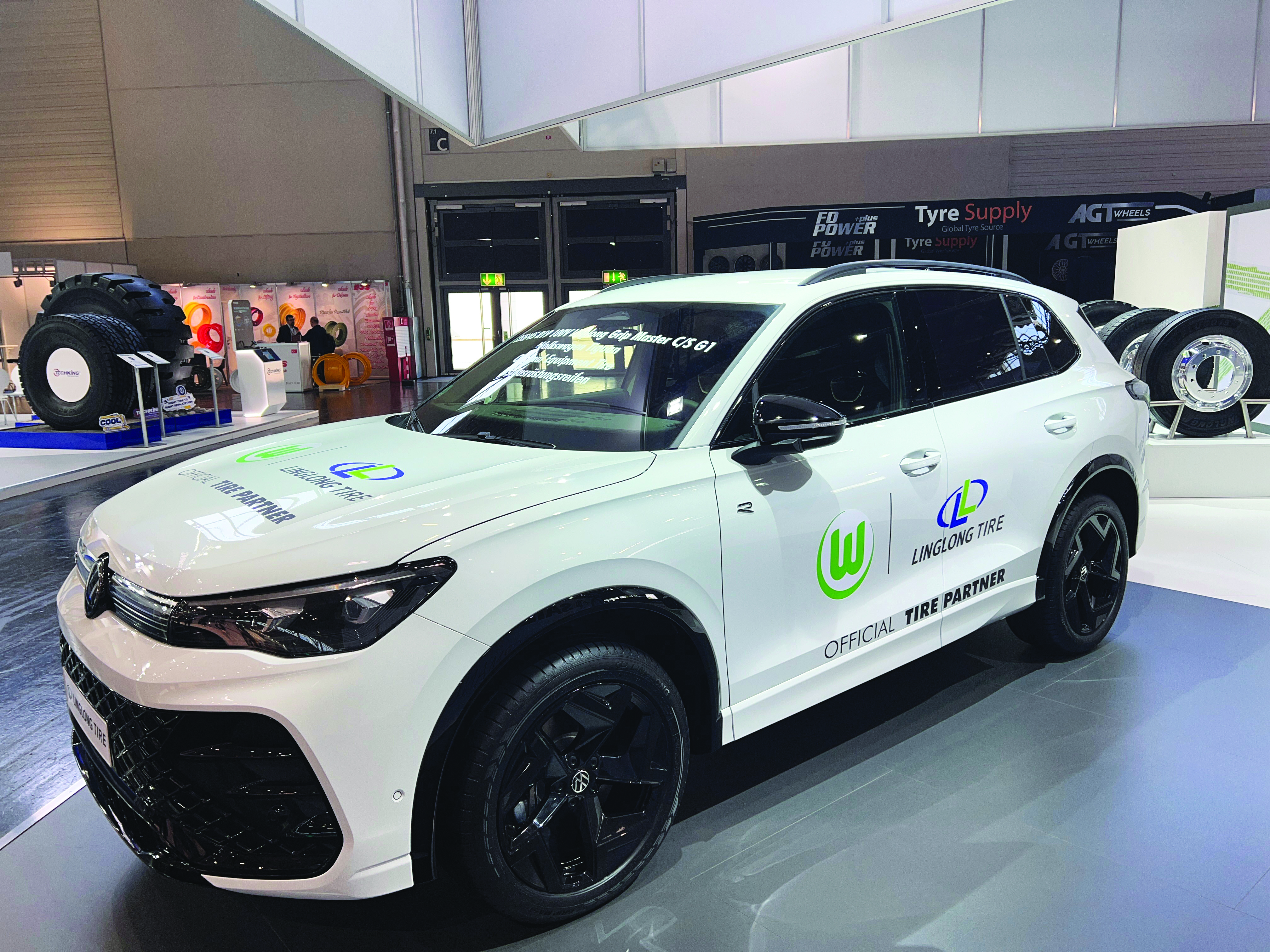 Being the first Chinese tyre manufacturer with a plant in Europe positions Linglong Tire strategically, giving it regulatory agility, tariff advantages and proximity to OEM customers in a fast-evolving global market.
“There’s already ongoing debate in Europe about PCR tyre tariffs and the situation is even more unpredictable in the US. While US tariff policies on Chinese goods have yet to reach an affirmative structure, European Union is seen as more stable,” said Fuder.
Besides the tariffs, major tyre manufacturers in Europe are exiting the small-size tyre segment and instead focusing on larger, high-margin products. This has come as a boon-in-disguise for Chinese tyre makers.
“Premium brands are stepping away from small-size tyres because the margins don’t suit their high-cost structures. But those same tyres are still profitable for us. We’re growing in both market share and profitability and doing so quite comfortably,” noted Staffini.
“Big companies are realising they’re too complex with too many departments and overheads. Now everyone wants to become as lean as the Koreans,” he added, citing Goodyear’s recent large-scale restructuring in Europe.
This industry transition is also redefining distribution and manufacturing. As tyre makers cut direct ties with retailers due to high servicing costs, wholesalers are increasingly taking over logistics and customer interface roles.
“Setting up a plant in Europe is capital-intensive and many do it to serve OEMs. But OEM business is brutally expensive. Total tyre development costs can range from EUR 300,000 to EUR 1 million for regular cars (high-end cars, like Porsche or others, can be easily more), depending on specifications and performance requirements. You also need specialised technology, engineers, testing facilities and logistics,” said Staffini.
In this high-cost, high-pressure environment, Linglong Tire’s lean approach and focus on both small and large tyre segments is giving it a competitive edge.
Furthermore. with the upcoming Euro 7 regulations, OE tyre suppliers like Linglong Tire face new performance demands. These targets are becoming increasingly stringent, requiring not just material innovation but end-to-end process optimisation.
The manufacturer’s Serbia plant gives the company a structural advantage. However, Staffini stressed that automation alone isn’t enough. Stabilising production, especially at a new site, takes time. Transferring moulds from China to Serbia, for example, isn’t a plug-and-play task. It requires fine-tuning and iterative testing to ensure performance consistency and final approval from OEM customers.
SEGMENTATION
Linglong Tire sees the OTR tyre market in Europe as fairly stable with the agriculture segment slightly down by around four percent in early 2025. Historically, the market has fluctuated, and while forecasts indicate slow growth over the next 4–5 years, it’s not expected to expand rapidly.
Another major trend is the shift from tier-I (premium) brands to tier-II and tier-III. Sales of mid-range and budget tyres are increasing, while premium brands like Continental are pulling back from the market. This shift is driven by both economic pressures and improved quality of Chinese and Indian tyres, which now offer better cost-per-hour and competitive performance.
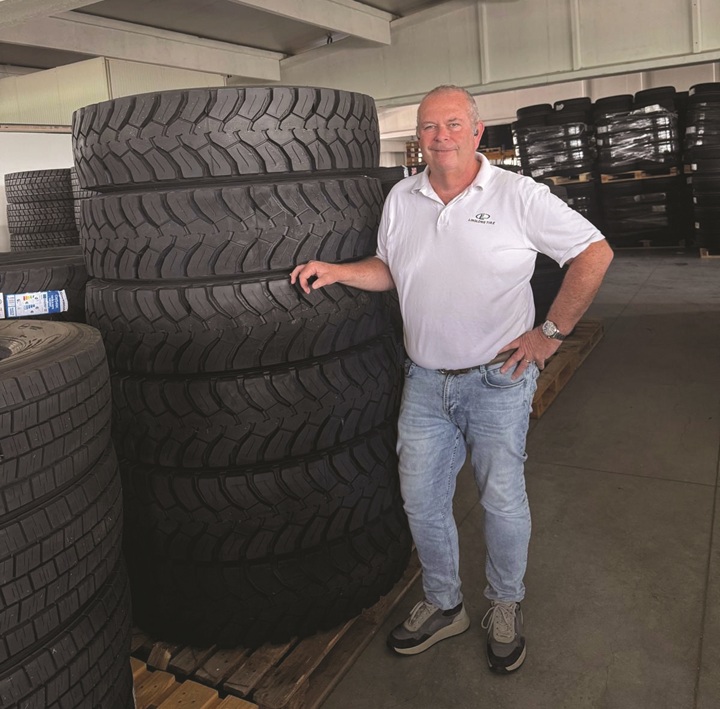
According to the company’s Director Sales and Marketing of Specialty Tire Europe, Jean Paul Spijker, “Chinese brands are gaining trust, moving beyond the outdated perception of inconsistent quality. Today, many customers recognise that while we may not be Michelin or Bridgestone, our products are reliable and good. Brand reputation still matters, but price and quality balance are reshaping the market.”
However, establishing a strong brand presence in speciality tyres such as agriculture and mining requires a fundamentally different approach than in the passenger car radial segment. While PCR marketing focuses on safety, affordability and broad consumer appeal, speciality tyres are all about deep product knowledge and real-world application expertise.
Linglong Tire’s views this as a space for specialists, not just salespeople. “You need experienced professionals who understand technical specifications like load index, terrain behaviour, compound variation and air pressure optimisation,” noted Spijker, who has around 34 years in the tyre industry.
“Unlike the PCR business, where a competitive price and solid safety pitch may close the deal, speciality segments demand consultative selling and engineering credibility. However, one of our key concerns is the loss of industry expertise as younger professionals increasingly prefer to work with car or truck tyres, which are perceived as easier to sell and manage. Today’s generation leans on AI or online searches for answers. But in speciality tyres, you need to understand things like soil compaction, flotation effects and compound flexibility based on pressure and terrain; these can’t just be looked up. They require hands-on experience,” noted Spijker.
To signal its confidence and maturity in the agricultural segment, the company has become the first Chinese manufacturer to offer a 10-year warranty on radial agriculture tyres.
Moreover, the company’s entry into Europe’s speciality tyre segment is driven by experienced hires as building a younger talent pipeline is tough.
While Linglong still imports speciality tyres from China, it plans to begin production in Serbia soon. “Europe’s market is different from India or China. Bigger machines, more SKUs and higher expectations categorise the market. We’re also expanding our very high flexion range to meet OEM demands,” added Spijker.
“Now, with experts in place, we’re focusing on quality and margin. With Serbian production, stronger VF range and growing brand trust, we aim to be a key player in Europe’s speciality market,” contended Spijker.
Grismer Tire & Auto Service Appoints New CEO And CFO
- By TT News
- September 28, 2026
Grismer Tire & Auto Service, a tyre and automotive service centre operator backed by CenterOak Partners LLC, has named Chris Blanchette as Chief Executive Officer and Mark Hedstrom as Chief Financial Officer. The announcement marks a significant leadership transition for the portfolio company.
Blanchette arrives with over two decades of senior leadership experience in multi-site consumer services, specialising in operations, strategy and business development. He most recently served as Chief Executive Officer of Service Minds, a residential electrical, plumbing and HVAC services provider. His background also includes serving as Chief Operating Officer of QAS, which operates Valvoline Instant Oil Change locations, along with senior operational positions at Advance Auto Parts, Bridgestone Retail Operations and Best Buy.
Hedstrom brings more than three decades of finance expertise to his new role. He previously held the Chief Financial Officer position at W.S. Connelly & Co., a multi-regional specialty distributor, and has also served as Chief Financial Officer for several private equity-backed consumer and distribution companies.
Eric Holter, Managing Director, CenterOak, said, “Chris Blanchette brings highly relevant leadership experience in the automotive aftermarket. He has led complex, multi-location organisations and understands how to translate operational discipline into sustainable growth. Together, Chris and Mark add important depth to Grismer’s leadership team as the Company pursues expansion in existing and new markets.”
Blanchette said, “Grismer’s 90-year history and the trust it has earned with customers set the Company apart. I am excited to join a business with such a strong legacy and see significant
- International Rubber Conference
- Society Of Rubber Science And Technology Japan
- James Busfield
- Nobuyuki Tamura
- Bridgestone Corporation
- Japan Rubber Manufacturers Association
- Aichi International Exhibition Center
- Aichi Sky Expo
Japan To Host International Rubber Conference After Decade-Long Gap
- By TT News
- September 25, 2026
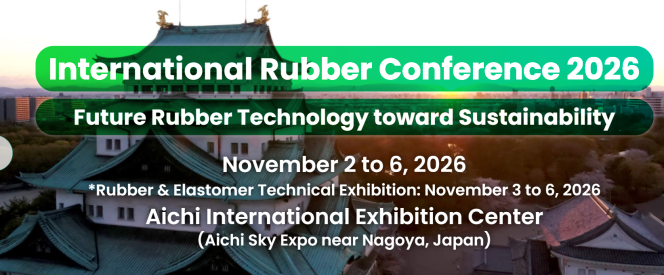
The International Rubber Conference (IRC) will return to Japan in November for the first time in a decade, with more than 271 technical presentations and over 117 exhibitors expected to take part.
The event, known as IRC 2026 Aichi, will be hosted by the Society of Rubber Science and Technology, Japan, alongside the Rubber & Elastomer Technical Exhibition in Aichi. It is scheduled to run from 2nd to 6th November, with the exhibition opening a day later and continuing until 6th November .
Held at the Aichi International Exhibition Center, also known as Aichi Sky Expo, the venue is located near Chubu Centrair International Airport and can be reached from Nagoya Station in about 28 minutes by train.
The conference programme will feature more than 271 presentations spanning rubber science, technology and industrial applications. Participants include James Busfield of Queen Mary University of London and Nobuyuki Tamura of Bridgestone Corporation, who also chairs the Japan Rubber Manufacturers Association. More than 400 delegates have already registered.
Running alongside the conference, the Rubber & Elastomer Technical Exhibition will host more than 117 exhibitors, ranging from raw material suppliers and machinery manufacturers to tyre makers and testing-equipment providers. The exhibition will be open to visitors free of charge.
The International Rubber Conference, first held in 1966, rotates annually across global host cities. The last event in Japan took place in Kitakyushu in 2016, with subsequent editions held in Haikou, Istanbul and Bangkok.
Pirelli Board Approves EUR 1 Billion US Investment Plan And Organisational Restructuring
- By TT News
- September 23, 2026
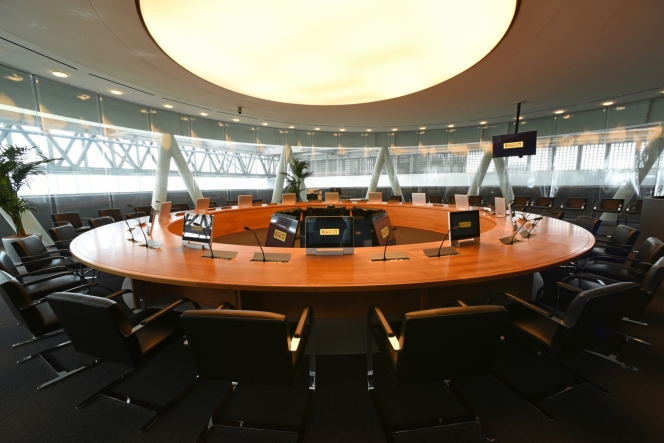
Italian tyre major Pirelli has announced a multi-year investment plan worth approximately EUR 1 billion (USD 1.2 billion) to expand its manufacturing facility in Rome, Georgia in the United States. The motion passed by majority vote, with board members Zhang Haitao, Xi Xiaohong and Wang Kun voting against the proposal.
The capital expenditure program, scheduled to begin in 2027 and will go through 2033, aims to expand annual production capacity at the Georgia site to six million tyres and create approximately 1,000 jobs.
The United States represents the largest market for high-value tyres globally, accounting for roughly 40 percent of global volumes. The project will be carried out in two phases without altering Pirelli's financial targets for 2026.
Phase one of the expansion will introduce modular robotised production systems based on Pirelli's Modular Integrated Robotised System technology, scaling annual output to three million tyres starting in 2028.
In phase two, the company will begin construction of an automated production facility to add three million units of annual capacity. The expanded plant will produce connected tyre systems, including Cyber Tyre technology, following market authorisation granted by the US Bureau of Industry and Security under Italy’s 2026 Golden Power Decree.
Alongside the investment decision, the board approved an organisational restructuring resulting in the immediate elimination of the Corporate General Management function. As part of the changes, Corporate General Manager Francesco Tanzi will step down from his executive role, maintaining an employment relationship through 31 December 2026 to facilitate the leadership transition.
Under the terms approved by the board and the Remuneration Committee, Tanzi will receive a severance payment equivalent to 13 months’ remuneration, payable by February 2027, alongside accrued rights under existing short-term and long-term incentive plans. He has agreed to a two-year non-compete covenant covering Pirelli's primary operating regions in exchange for 130 percent of his gross annual salary, paid in eight quarterly instalments. Following the end of his employment, Tanzi will provide advisory services under a two-year consultancy contract with an annual fee of EUR 350,000, plus non-monetary benefits valued at EUR 45,000.
Bridgestone Appoints Stefano Sanchini As President Of Europe Sales
- By TT News
- September 19, 2026
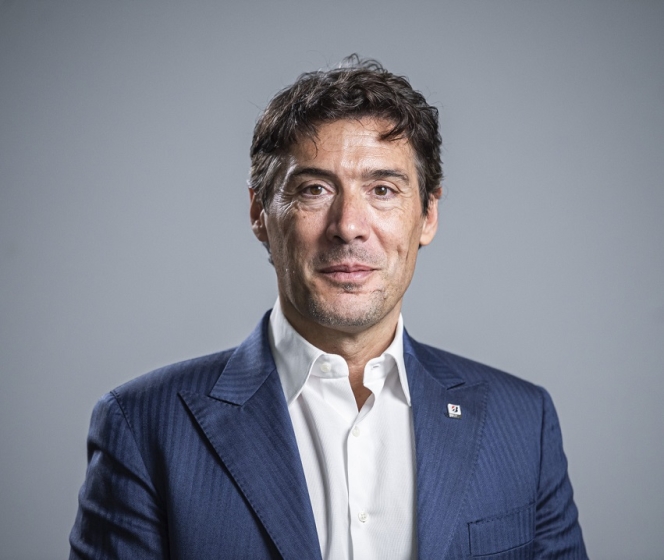
Bridgestone has announced a European leadership appointment aimed at sharpening customer focus, streamlining engagement across product groups and supporting its ongoing growth plans. Stefano Sanchini will become President, Europe Sales, effective 1 October 2026, leading the company’s European sales organisation across both Consumer and Commercial segments.
The expanded role unites sales activities spanning passenger car, truck and bus, agriculture, off-the-road, motorcycle and original equipment. Sanchini brings over 20 years of international leadership experience in the automotive and tyre sectors, with a career covering Europe, Middle East, Africa and India. Since joining Bridgestone in 2017, he has held several senior positions, including Managing Director of Bridgestone India.
Most recently, as Vice President for Consumer Replacement in Europe, he helped strengthen customer engagement, commercial performance, profitability and regional market growth. Bridgestone said the appointment underscores its commitment to customer relationships, commercial execution and simpler cross-market operations. Sanchini will pursue sustainable growth while developing capabilities and partnerships supporting the company’s long-term European strategy.
Mete Ekin, Group President EMEA, said, "Our customers increasingly operate across multiple product categories and expect a consistent experience wherever they engage with Bridgestone. By bringing our sales activities together under one European structure, we are creating a simpler, more connected organisation that will help us respond faster, collaborate more effectively and continue building strong partnerships with our customers."

Comments (0)
ADD COMMENT