

- United Nations Economic Commission for Europe
- UNECE
- Jean Rodriquez
- Working Party on Noise and Tyres
- GRBP
Global Tyre Standards
- By Gaurav Nandi
- December 08, 2025
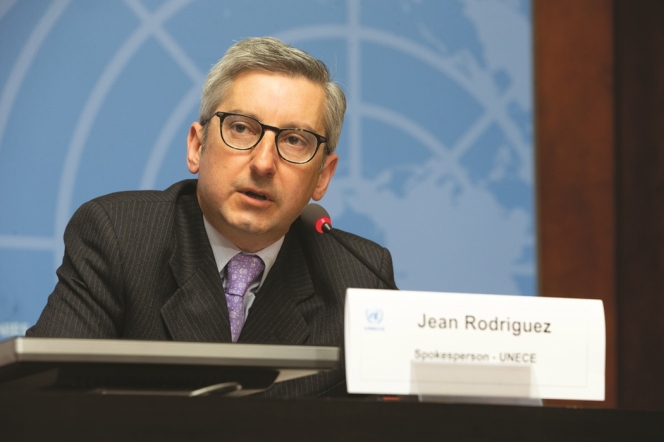
In a discussion with Tyre Trends, Chief of the United Nations Economic Commission for Europe (UNECE) Information Unit Jean Rodriguez detailed how the Working Party on Noise and Tyres (GRBP) is driving international regulations on tyre safety, noise and sustainability. From pioneering micro-plastic emission measurement to strengthening wet-grip requirements and updating studded and retreaded tyre rules, Rodriguez emphasised UNECE’s role in shaping a harmonised global framework that balances consumer safety with environmental protection.
What is the role of the Working Party on Noise and Tyres (GRBP) within UNECE?
As one of the six subsidiary bodies of the World Forum for Harmonisation of Vehicle Regulations, hosted by UNECE, the Working Party on Noise and Tyres continues to spearhead globally harmonised standards through UN Regulation No. 117, covering tyre rolling resistance, noise, wet grip and, with recent developments, abrasion measures. These UN Regulations form the backbone of safety and environmental tyre specifications adopted by numerous countries and a substantial share of tyre producers globally.
What were the key regulatory changes between 2022 and 2025?
In early 2024, the Working Party adopted the first-ever methodology to measure particle emissions from tyres, critical for tracking micro-plastic emissions via two protocols including real-world 8,000 kilometres convoy tests and 5,000 kilometres rolling-drum lab tests. These are slated for integration into a new UN Regulation by September 2025 for passenger tyres, expanding into heavier vehicle categories (C2, C3) into 2026 and 2027.
Once in force, these regulations will contribute to significantly reducing micro-plastic pollution. In 2016, tyre abrasion was estimated to represent 78 percent of the 1.3 million metric tonnes of microplastics entering the ocean.
The UNECE methodology to measure particle emissions from tyres will become the reference methodology of the Euro 7 proposal of the European Union. Moreover, EU tyre regulation and labelling covering noise, wet grip, rolling resistance and environmental transparency build directly on UNECE’s standards.
How has UNECE addressed tyre safety at legal minimum tread depth?
GRBP introduced requirements ensuring that tyres at the legal minimum tread depth (1.6 millimetres) retain a minimum wet-grip level relative to new tyres. This is a shift towards safety and sustainability by permitting consumers to drive worn tyres safely, potentially reducing waste. It obliges manufacturers to design tread compounds and patterns that preserve wet performance over the tyre’s life, not just when new.
What regulations were introduced for studded tyres in 2022?
In September 2022, a new UN Regulation to cover performance requirements and marking of studded tyres entered into force to increase road safety by introducing harmonised snow grip requirements for studded tyres. It simplified the legislative situation in several countries that allowed the usage of studded tyres on public roads, introduced strict requirements and procedures for testing their snow grip and allowed consumers to benefit from more coherent winter tyre markings.
What additional areas has UNECE been working on to align safety and environmental goals?
By refining noise standards, updating testing protocols and promoting tyre lifecycle efficiency, UNECE is steadily shaping regulations to match environmental and safety objectives. This includes work on enhanced noise testing for tyres (UN Regulation No. 117) and motorcycles (UN Regulation No. 41) and vehicle alert systems (UN Regulation No. 138/51)
How does UNECE ensure global relevance, transparency and participation in its work?
All this work in setting technical specifications testifies to UNECE’s high relevance in providing a global harmonisation framework. Its expanding scope, especially in environmental dimensions such as micro-plastic emissions, is helping it maintain policy leadership and normative force, shaping tyre safety, noise and environmental performance worldwide.
A very important aspect of UNECE work is that it prevents fragmentation of the tyre regulatory landscape. GRBP is open to governmental experts from any member country of the United Nations and to any regional economic integration organisation set up by member countries of the United Nations including experts of governmental organisations and non-governmental organisations (NGOs).
UNECE provides secretarial support to WP.29 and its working parties, facilitating negotiations between contracting parties to the 1958, 1997 and 1998 agreements. More than 100 experts participate in the sessions of GRBP and all documents considered by GRBP are available in the public domain.
What are UNECE’s priorities going forward to support safety and the circular economy?
Leveraging its technical authority and norm-setting capacities, UNECE is uniquely positioned to foster a globally harmonised tyre labelling framework that covers rolling resistance, wet grip and, for the first time, tyre abrasion. This framework promotes consistency, environmental protection, consumer transparency and ultimately supports worldwide regulatory alignment.
At its session in September 2025, GRBP will consider the proposal for a new UN Regulation on the uniform provisions concerning the approval of tyres with regard to abrasion performance.
UNECE is also updating UN Regulations no. 108 (passenger car/towed vehicle Retreaded tyres), 109 (commercial vehicle retreaded tyres) and 172 (snow performance of retreaded tyres) to ensure retreaded tyres meet the same safety standards as new tyres, even in challenging winter conditions but in a way that makes regulatory processes smoother and more conducive to circular economy practices.
Grismer Tire & Auto Service Appoints New CEO And CFO
- By TT News
- September 28, 2026
Grismer Tire & Auto Service, a tyre and automotive service centre operator backed by CenterOak Partners LLC, has named Chris Blanchette as Chief Executive Officer and Mark Hedstrom as Chief Financial Officer. The announcement marks a significant leadership transition for the portfolio company.
Blanchette arrives with over two decades of senior leadership experience in multi-site consumer services, specialising in operations, strategy and business development. He most recently served as Chief Executive Officer of Service Minds, a residential electrical, plumbing and HVAC services provider. His background also includes serving as Chief Operating Officer of QAS, which operates Valvoline Instant Oil Change locations, along with senior operational positions at Advance Auto Parts, Bridgestone Retail Operations and Best Buy.
Hedstrom brings more than three decades of finance expertise to his new role. He previously held the Chief Financial Officer position at W.S. Connelly & Co., a multi-regional specialty distributor, and has also served as Chief Financial Officer for several private equity-backed consumer and distribution companies.
Eric Holter, Managing Director, CenterOak, said, “Chris Blanchette brings highly relevant leadership experience in the automotive aftermarket. He has led complex, multi-location organisations and understands how to translate operational discipline into sustainable growth. Together, Chris and Mark add important depth to Grismer’s leadership team as the Company pursues expansion in existing and new markets.”
Blanchette said, “Grismer’s 90-year history and the trust it has earned with customers set the Company apart. I am excited to join a business with such a strong legacy and see significant
- International Rubber Conference
- Society Of Rubber Science And Technology Japan
- James Busfield
- Nobuyuki Tamura
- Bridgestone Corporation
- Japan Rubber Manufacturers Association
- Aichi International Exhibition Center
- Aichi Sky Expo
Japan To Host International Rubber Conference After Decade-Long Gap
- By TT News
- September 25, 2026
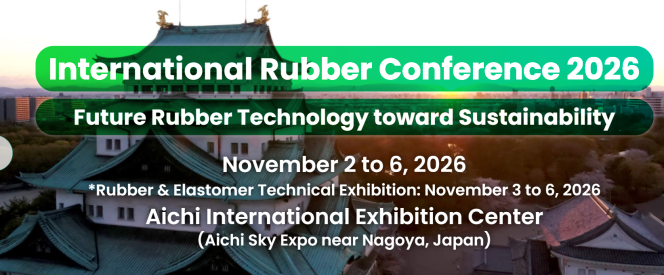
The International Rubber Conference (IRC) will return to Japan in November for the first time in a decade, with more than 271 technical presentations and over 117 exhibitors expected to take part.
The event, known as IRC 2026 Aichi, will be hosted by the Society of Rubber Science and Technology, Japan, alongside the Rubber & Elastomer Technical Exhibition in Aichi. It is scheduled to run from 2nd to 6th November, with the exhibition opening a day later and continuing until 6th November .
Held at the Aichi International Exhibition Center, also known as Aichi Sky Expo, the venue is located near Chubu Centrair International Airport and can be reached from Nagoya Station in about 28 minutes by train.
The conference programme will feature more than 271 presentations spanning rubber science, technology and industrial applications. Participants include James Busfield of Queen Mary University of London and Nobuyuki Tamura of Bridgestone Corporation, who also chairs the Japan Rubber Manufacturers Association. More than 400 delegates have already registered.
Running alongside the conference, the Rubber & Elastomer Technical Exhibition will host more than 117 exhibitors, ranging from raw material suppliers and machinery manufacturers to tyre makers and testing-equipment providers. The exhibition will be open to visitors free of charge.
The International Rubber Conference, first held in 1966, rotates annually across global host cities. The last event in Japan took place in Kitakyushu in 2016, with subsequent editions held in Haikou, Istanbul and Bangkok.
Pirelli Board Approves EUR 1 Billion US Investment Plan And Organisational Restructuring
- By TT News
- September 23, 2026
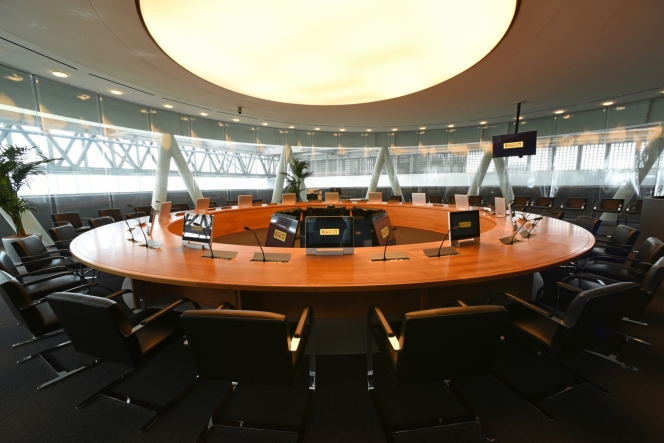
Italian tyre major Pirelli has announced a multi-year investment plan worth approximately EUR 1 billion (USD 1.2 billion) to expand its manufacturing facility in Rome, Georgia in the United States. The motion passed by majority vote, with board members Zhang Haitao, Xi Xiaohong and Wang Kun voting against the proposal.
The capital expenditure program, scheduled to begin in 2027 and will go through 2033, aims to expand annual production capacity at the Georgia site to six million tyres and create approximately 1,000 jobs.
The United States represents the largest market for high-value tyres globally, accounting for roughly 40 percent of global volumes. The project will be carried out in two phases without altering Pirelli's financial targets for 2026.
Phase one of the expansion will introduce modular robotised production systems based on Pirelli's Modular Integrated Robotised System technology, scaling annual output to three million tyres starting in 2028.
In phase two, the company will begin construction of an automated production facility to add three million units of annual capacity. The expanded plant will produce connected tyre systems, including Cyber Tyre technology, following market authorisation granted by the US Bureau of Industry and Security under Italy’s 2026 Golden Power Decree.
Alongside the investment decision, the board approved an organisational restructuring resulting in the immediate elimination of the Corporate General Management function. As part of the changes, Corporate General Manager Francesco Tanzi will step down from his executive role, maintaining an employment relationship through 31 December 2026 to facilitate the leadership transition.
Under the terms approved by the board and the Remuneration Committee, Tanzi will receive a severance payment equivalent to 13 months’ remuneration, payable by February 2027, alongside accrued rights under existing short-term and long-term incentive plans. He has agreed to a two-year non-compete covenant covering Pirelli's primary operating regions in exchange for 130 percent of his gross annual salary, paid in eight quarterly instalments. Following the end of his employment, Tanzi will provide advisory services under a two-year consultancy contract with an annual fee of EUR 350,000, plus non-monetary benefits valued at EUR 45,000.
Bridgestone Appoints Stefano Sanchini As President Of Europe Sales
- By TT News
- September 19, 2026

Bridgestone has announced a European leadership appointment aimed at sharpening customer focus, streamlining engagement across product groups and supporting its ongoing growth plans. Stefano Sanchini will become President, Europe Sales, effective 1 October 2026, leading the company’s European sales organisation across both Consumer and Commercial segments.
The expanded role unites sales activities spanning passenger car, truck and bus, agriculture, off-the-road, motorcycle and original equipment. Sanchini brings over 20 years of international leadership experience in the automotive and tyre sectors, with a career covering Europe, Middle East, Africa and India. Since joining Bridgestone in 2017, he has held several senior positions, including Managing Director of Bridgestone India.
Most recently, as Vice President for Consumer Replacement in Europe, he helped strengthen customer engagement, commercial performance, profitability and regional market growth. Bridgestone said the appointment underscores its commitment to customer relationships, commercial execution and simpler cross-market operations. Sanchini will pursue sustainable growth while developing capabilities and partnerships supporting the company’s long-term European strategy.
Mete Ekin, Group President EMEA, said, "Our customers increasingly operate across multiple product categories and expect a consistent experience wherever they engage with Bridgestone. By bringing our sales activities together under one European structure, we are creating a simpler, more connected organisation that will help us respond faster, collaborate more effectively and continue building strong partnerships with our customers."

Comments (0)
ADD COMMENT