

- Michelin
- Primacy 5
- Shantanu Deshpande
- Michelin India
- Applus+ IDIADA
- Turanza
- UltraContact UC6
- BluEarth
- Yokohama
- Continental
- Bridgestone
Made In India, Built For Premium
- By Sharad Matade
- August 13, 2026
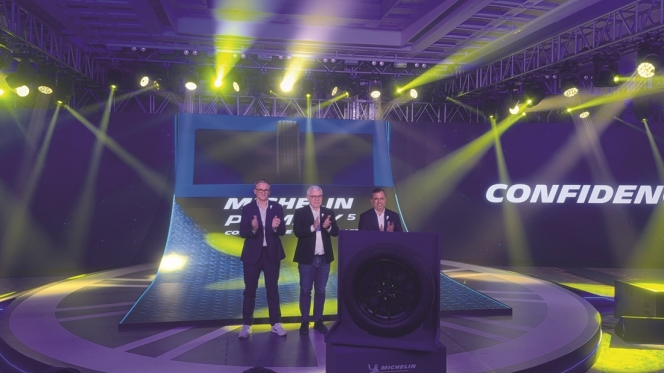
The launch of the Made-in-India MICHELIN Primacy 5, the company’s first locally manufactured passenger car tyre, is not simply another product introduction. It is the cornerstone of a broader strategy that spans premium mobility, advanced manufacturing, artificial intelligence, customer experience and global supply chains. As India’s automotive market shifts towards larger, safer and more premium vehicles, Michelin believes the country is ready for technology-led tyres manufactured closer to home.
For much of the past decade, Michelin’s India story has largely revolved around truck and bus radial tyres. The French tyre maker built a modern manufacturing facility in Chennai, supplied premium commercial vehicle tyres to both domestic and export markets, expanded its engineering, research & development and digital capabilities in Pune and patiently built its brand in a market where price traditionally outweighed premium performance.
But now, Michelin believes the timing is right to make its biggest play yet in India’s passenger vehicle market.
The company has launched the MICHELIN Primacy 5, the first passenger car tyre manufactured by Michelin in India, ending years of reliance on imports for one of its most important premium product lines. This new launch represents more than localisation. It reflects Michelin’s confidence that India is entering a new phase of automotive consumption – one where buyers increasingly prioritise safety, comfort and long-term ownership value over the lowest purchase price.
Speaking at the launch in Chennai, Shantanu Deshpande, Managing Director, Michelin India, described the milestone as the culmination of a strategic shift announced just 18 months earlier.
“Just about a year and a half ago, we stood here and announced that we were going to start manufacturing passenger car tyres. It’s no more a promise. It is actually happening. The tyres are being manufactured as we speak now in our factory,” said Deshpande.
The passenger car production line was commissioned in just 12 months, supported by 50,000 hours of employee training and equipped with Michelin’s latest manufacturing technologies. But the investment is less about expanding capacity than positioning Michelin for what it sees as the next chapter of India’s automotive evolution.
RAPIDLY CHANGING PASSENGER CAR SEGMENT
The central premise behind Michelin’s strategy is straightforward: India is no longer simply a small-car market.
For years, hatchbacks dominated domestic passenger vehicle sales, shaping not only vehicle development but also tyre demand. That landscape has changed dramatically as rising incomes, improved highways and changing consumer aspirations have driven buyers towards larger vehicles.
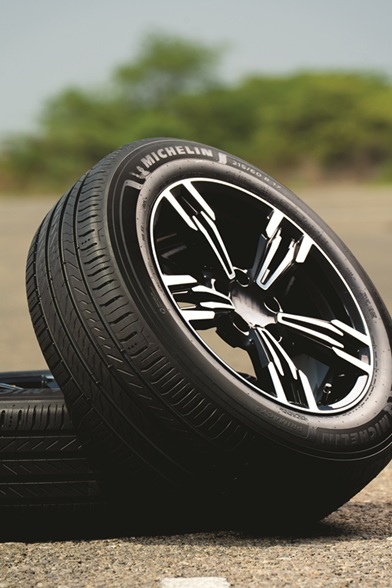 Deshpande believes this transformation is reshaping consumer expectations. “Generally speaking, India is not a country now which is looking for cheap products. It is not limited only to automobiles. You see premiumisation happening across technology, real estate, lifestyle, and it is equally applicable to mobility,” explained Deshpande.
He argues that better road infrastructure has fundamentally altered how Indians use their cars. Explaining it further, Deshpande said, “Cars are no longer just something parked in the garage during the week and taken out over weekends. Families are travelling longer distances at higher speeds, and consumers are looking for bigger cars, comfortable cars and safer cars.”
The numbers support that view.
SUVs, crossovers and MPVs accounted for just over one-fifth of passenger vehicle sales in 2010. By 2025, they represented more than half of new vehicle sales, while annual volumes in the segment have expanded to roughly 1.5 million units. Michelin believes that trend will continue, creating sustained demand for premium tyres in the 16-inch and above category.
That explains why the Chennai plant will manufacture tyres ranging from 16 to 22 inches – sizes increasingly fitted to SUVs and premium sedans rather than traditional entry-level hatchbacks. “Our chosen segment is 16 inches and above. That is where we see the strongest growth,” Deshpande said.
Unlike domestic tyre manufacturers that compete across virtually every price segment, Michelin is deliberately narrowing its focus.
Rather than chasing volume at the lower end of the market, it wants to dominate the premium replacement segment, where technological differentiation and brand equity command stronger pricing power.
SAFETY AS A VALUE PROPOSITION
Launching another premium tyre in India would have been difficult if Michelin relied solely on brand reputation. Instead, the company is attempting to build its value proposition around measurable safety performance.
The Primacy 5 has been tested in India by independent testing agency Applus+ IDIADA against competing premium products from its immediate peers on Indian roads.
According to Michelin, the tyre stops up to eight metres shorter than competing tyres in wet braking tests when new and up to nine metres shorter when worn. It also delivers a four-metre advantage in dry braking while offering an eight percent improvement in longevity over its predecessor, the Primacy 4ST.
For Deshpande, these figures translate into a much broader consumer message. “Eight metres is probably as long as a city bus. That difference, when you’re driving in wet conditions, is the difference between being safe and being involved in an accident,” explained Deshpande.
More importantly, Michelin emphasises that the braking advantage remains even after the tyre has worn. “The confidence is not only when you buy a new tyre. The confidence lasts for the entire life of the tyre. That is what the consumer wants,” added Deshpande.
This lifecycle approach has become a defining characteristic of Michelin’s premium positioning globally, but it is particularly relevant in India, where tyres are often used until the legal wear limit or beyond.
The Primacy 5 delivers a claimed 6.5 percent improvement in rolling resistance compared with the Primacy 4ST, helping reduce fuel consumption in internal combustion vehicles while extending driving range in electric vehicles. Michelin also claims a nine percent improvement in ride comfort through a redesigned tread pattern aimed at reducing road noise.
BENCHMARKING AGAINST THE BEST
Michelin is positioning the Primacy 5 at the top end of India’s replacement tyre market, and its performance claims have been measured against what it considers the strongest competitors in the segment.
Rather than comparing the tyre with mid-market products, the company benchmarked the Primacy 5 against flagship offerings from its immediate peers.
“We picked the top-of-the-line products,” Deshpande said.
The comparison included Bridgestone’s Turanza range, Continental’s UltraContact UC6 and Yokohama’s BluEarth series – products that define the premium replacement segment. By evaluating the Primacy 5 against competitors’ best offerings, Michelin believes it provides consumers with a more meaningful assessment of performance, particularly in safety, comfort and longevity.
For Michelin, the objective is not simply to participate in the premium category but to establish itself as the benchmark against which other premium tyres are measured.
AN EV STRATEGY WITHOUT BUILDING AN EV TYRE
Another notable aspect of Michelin’s positioning is its approach to electric vehicles.
Unlike several competitors that market dedicated EV tyre ranges, Michelin is promoting the Primacy 5 as a platform equally suited to internal combustion engine, hybrid and battery-electric vehicles.
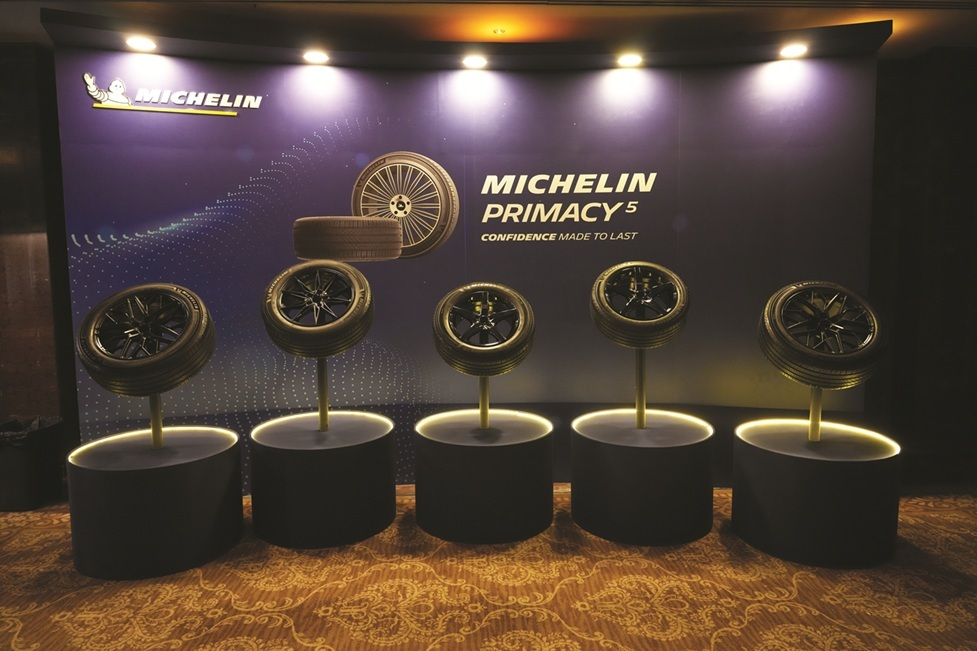
The tyre has been engineered to manage the additional weight and higher torque associated with electric vehicles while reducing rolling resistance to improve driving range.
Deshpande summarised the positioning succinctly: “Our products are good for ICE and great for EV.”
Rather than creating separate product families, Michelin appears to believe that mainstream premium tyres will increasingly serve multiple powertrain technologies as the market evolves.
That approach may prove particularly relevant in India, where consumers continue to choose between petrol, diesel, hybrid and electric vehicles across the same model lines.
LOCAL MANUFACTURING GOES BEYOND IMPORT SUBSTITUTION
For Michelin, manufacturing passenger car tyres in India is not simply about reducing imports. It reflects the company’s broader ‘local to local’ strategy – producing closer to customers while maintaining global technology and quality standards.
The Chennai facility now houses one of Michelin’s most advanced passenger car production lines, featuring extensive automation and robotics. Questions inevitably arose about whether tyres manufactured in India would differ from those produced in Europe.
Deshpande dismissed the suggestion. “The fact that we have been exporting our truck tyres made in Chennai to North American markets, European markets and African markets is testimony that a Michelin tyre of the same quality standards which is made outside India can be made in India,” said Deshpande.
The only changes, the Michelin India executive said, involve reinforcing the tyre for Indian road conditions while maintaining the same global performance standards.
WHY MICHELIN SKIPPED PRIMACY 4
The launch also prompted questions about Michelin’s product strategy.
Why introduce the Primacy 5 as the first locally manufactured passenger car tyre instead of producing the outgoing Primacy 4? Deshpande said the answer was straightforward.
“The Primacy 4 is a tyre line which is getting succeeded by Primacy 5. We are selling Primacy 4 right now because we wanted to manufacture Primacy 5 in India. Now that we are launching Primacy 5, over time, through a phase-in and phase-out process, we’ll discontinue Primacy 4 and have only Primacy 5,” stated Deshpande.
PREPARING FOR THE AI CONSUMER
Michelin also sees artificial intelligence reshaping how tyres are marketed. According to Deshpande, the battle for consumer attention is moving beyond Google.
“The research online is now changing. It is not just websites or Google. People are searching through AI,” he said. That requires manufacturers to rethink how information is published.
“It is very important that you are engaging on the right forums where this information is crawled by AI agents. Platforms talking objectively about tyres and vehicles need to have the right content available so that whenever a consumer researches, that information is captured and presented,” added Deshpande.
BUILDING A GLOBAL SUPPLY CHAIN FROM INDIA
Michelin’s ambitions in India extend well beyond manufacturing finished tyres.
Alongside expanding local production, the company is actively identifying Indian suppliers that can become part of Michelin’s global procurement network. Deshpande explained that Michelin categorises its raw materials into three broad groups. Certain strategic components and proprietary compounds continue to be produced internally to safeguard intellectual property, while natural rubber remains an area where India still depends heavily on imports because domestic production cannot fully meet industry demand.
The larger opportunity, however, lies in industrial raw materials such as chemicals, carbon black and other tyre manufacturing inputs.
“Our focus is to procure more of these raw materials locally in India but also identify suppliers who can become part of Michelin’s global supply chain,” Deshpande said.
Bridgestone Appoints Stefano Sanchini As President Of Europe Sales
- By TT News
- September 19, 2026
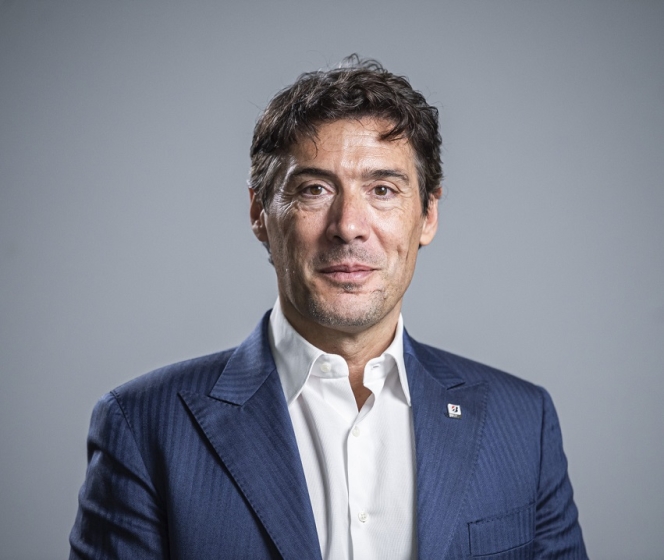
Bridgestone has announced a European leadership appointment aimed at sharpening customer focus, streamlining engagement across product groups and supporting its ongoing growth plans. Stefano Sanchini will become President, Europe Sales, effective 1 October 2026, leading the company’s European sales organisation across both Consumer and Commercial segments.
The expanded role unites sales activities spanning passenger car, truck and bus, agriculture, off-the-road, motorcycle and original equipment. Sanchini brings over 20 years of international leadership experience in the automotive and tyre sectors, with a career covering Europe, Middle East, Africa and India. Since joining Bridgestone in 2017, he has held several senior positions, including Managing Director of Bridgestone India.
Most recently, as Vice President for Consumer Replacement in Europe, he helped strengthen customer engagement, commercial performance, profitability and regional market growth. Bridgestone said the appointment underscores its commitment to customer relationships, commercial execution and simpler cross-market operations. Sanchini will pursue sustainable growth while developing capabilities and partnerships supporting the company’s long-term European strategy.
Mete Ekin, Group President EMEA, said, "Our customers increasingly operate across multiple product categories and expect a consistent experience wherever they engage with Bridgestone. By bringing our sales activities together under one European structure, we are creating a simpler, more connected organisation that will help us respond faster, collaborate more effectively and continue building strong partnerships with our customers."
Yokohama Europe Appoints Giuseppe La Iacona To Lead Southern Operations
- By TT News
- September 18, 2026
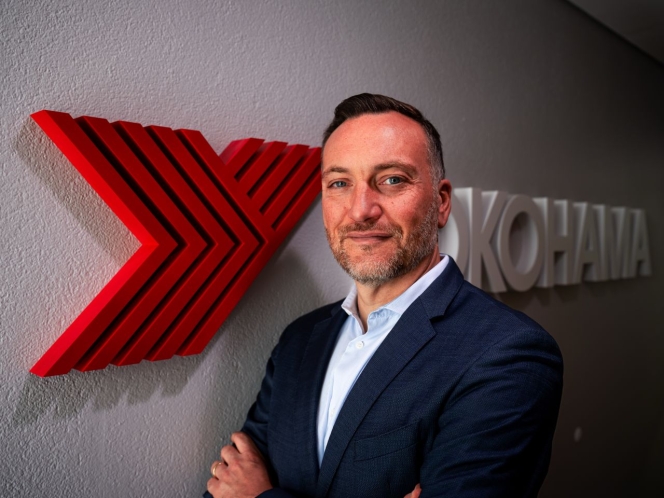
Yokohama Europe has appointed Giuseppe La Iacona to a series of senior leadership roles as the company seeks to strengthen its position across the region.
La Iacona joined the business on September 15 and will assume responsibility for supporting growth and organisational consolidation in the European market.
He brings more than 20 years’ experience in the tyre industry, spanning sales, marketing, business development, country management and international customer relations. He has held senior roles across several European markets, developing experience in managing local dynamics while driving cross-border business expansion.
Reporting to Takashi Maki, La Iacona has been appointed General Manager for southern Europe, where he will lead a newly created regional cluster covering Italy and France. The role is intended to improve coordination and operational synergies between the two markets.
He will also serve as Chief Executive of Yokohama Italia, with overall responsibility for the Italian subsidiary, alongside taking on the role of head of international customers. In that capacity, he will oversee the management and development of clients operating across multiple European markets, with the aim of creating a more consistent commercial approach and strengthening collaboration between subsidiaries.
His remit includes improving organisational alignment and fostering closer cooperation between markets and customers as the company expands its European operations.
“I am very pleased to welcome Giuseppe to YOKOHAMA Europe at an important stage in our development,” said Maki. “His extensive international experience, deep knowledge of the tyre industry and ability to work across different markets will be valuable assets as we continue to strengthen our European organisation and pursue sustainable growth.”
La Iacona said: “I am excited to join YOKOHAMA Europe and to contribute to the company’s next phase of growth in Europe. YOKOHAMA has a strong heritage, a distinctive brand and significant opportunities across the European market. I look forward to working closely with our teams, customers and partners across countries to further develop the business and strengthen our presence in the region.”
Özka Tyre Appoints Mehmet Yüksel As New Chief Operating Officer
- By TT News
- September 18, 2026
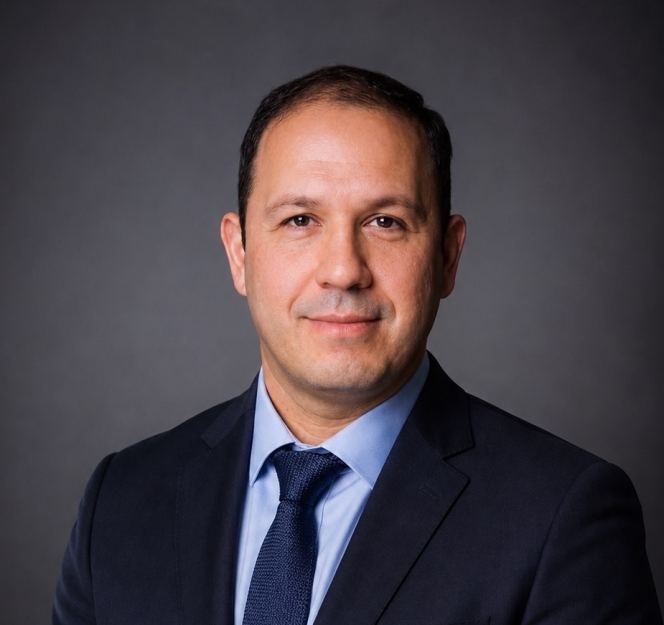
Özka Tyre, a prominent Turkish manufacturer of tyres for agricultural and construction equipment, has reinforced its leadership team as part of a broader push towards global expansion and technological modernisation in production. The company has appointed Mehmet Yüksel as its new Chief Operating Officer, bringing aboard an executive with extensive senior experience from Goodyear’s Luxembourg-based international organisation.
In his new role, Yüksel will oversee functions central to Özka’s production and operational strength. His responsibilities encompass production, quality, research and development, planning, investment and projects, electricity and maintenance, occupational safety and quality management systems, positioning him to steer critical areas of the company’s industrial performance.
Driven by investments and a focus on advancing its manufacturing strength, Özka continuously monitors shifts in the worldwide tire sector, particularly technological progress in Europe, and uses those insights to shape its future production infrastructure. As new investments prepare to elevate its output capacity and technical systems, the firm is simultaneously bolstering its organisational framework to sustain that transformation.
Cabot Names Steve Delahunt As Interim CFO
- By TT News
- September 16, 2026
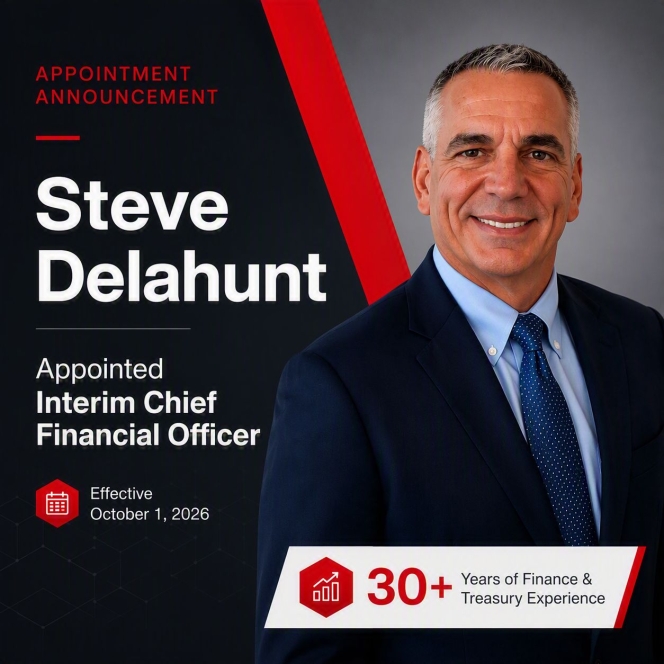
Cabot Corporation has named Steve Delahunt, currently Vice President and Corporate Treasurer, to assume the Chief Financial Officer role on an interim basis starting 1 October 2026. He will hold the position while Cabot continues searching for a permanent finance chief.
The interim appointment follows the previously disclosed leadership transition in which Erica McLaughlin, Executive Vice President, Chief Financial Officer and Head of Corporate Strategy, will become President and Chief Executive Officer on the same date. McLaughlin succeeds Sean Keohane and will relinquish her CFO duties at that time.
Delahunt brings over three decades of finance and treasury experience, including nine years leading Cabot's investor relations function through January 2026. As Corporate Treasurer, he oversees global treasury operations, capital markets strategy, liquidity management, banking relationships, risk management and pension investments. He has been central to Cabot's capital allocation, financing, investor engagement and strategic growth initiatives, as well as strengthened shareholder relations during his investor relations tenure.
McLaughlin said, “Steve is a highly respected finance leader with deep knowledge of our business, strong relationships across our global organisation and a proven track record of disciplined financial leadership. As we continue executing our strategy and building on our strong financial position, Steve’s experience, judgment and understanding of our business make him exceptionally well suited to lead our finance organisation while the Company conducts its search for our next Chief Financial Officer.”

Comments (0)
ADD COMMENT