

Recircle Awards 2025 Now Opens Up For Nominations, Winners To Be Announced On 22 May 2025
- By TT News
- October 10, 2024
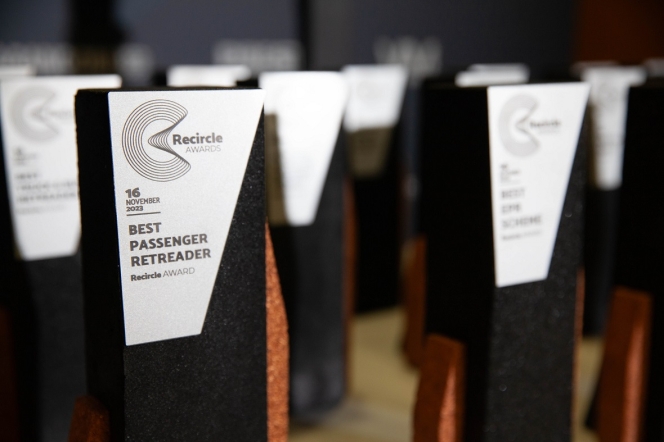
Retreading Business and Tyre & Rubber Recycling magazines, the organisers of the Recircle Awards, have announced the launch of 2025 Recircle Awards. In its fourth edition, the event will see a total of 22 awards covering a wide range of categories from across the tyre industry.
This is part of its endevaour to undertake a number of new initiatives to drive inclusivity and engagement across the tyre retreading and tyre recycling sectors as it seeks to evolve and expand its position as the key industry awards event recognising sustainability in the tyre industry.
The awards will culminate in a ceremony to be held next May during Autopromotec 2025 in Bologna, Italy.
David Wilson, Publisher of Retreading Business and Tyre & Rubber Recycling, said, “2025 marks the fourth edition of the Recircle Awards, and we are delighted to able to announce our continued co-operation with Autopromotec. We look forward to being able to host an enhanced ceremony in Bologna next May, and we thank Renzo Servadei and his team for their valued support in helping us to expand the influence of the Recircle Awards as the key awards event recognising the valuable contribution made by the tyre retreading and recycling sectors to the circular economy and to the sustainability of the tyre industry as a whole.
“We are constantly looking for ways to increase the scope of the Awards and to drive engagement from companies from across the industry both large and small, and in analysing feedback from the market, we identified the need to alter the weighting of the voting process in order to gain the optimum balance between the opinions of our expert judges and engagement from the wider market. As a result, 65 percent of the voting strength in the 2025 awards will now be allocated to the views expressed by our independent Nominations Committee.
“We have also increased the robustness of the nominations and voting process by asking shortlisted nominees to submit a written case in support of their nomination which can be analysed by the Committee, as well as increasing the amount of information required to be input by the voting public in order to minimise the risk of frivolous and/or organised mass voting.
“We are constantly looking at ways to improve the awards and we hope that these changes will represent a positive development as we strive to expand the profile and credibility of the Awards on a global level. We look forward to next year’s Awards ceremony with anticipation.”
The first 18 awards categories for the 2025 Recircle Awards include:
- Lifetime Achievement Award in the Tyre Retreading Sector
- Lifetime Achievement Award in the Tyre Recycling Sector
- Retreader of the Year Award
- Tyre Recycler of the Year Award
- Best Retreading Industry Innovation
- Best Tyre Recycling Innovation
- Employee of the Year
- Best Company Director
- Spirit of Retreading Award
- Circular Economy Award
- Best Tread Rubber Supplier
- Best Retreading Equipment Supplier
- Best Retreading Accessory and Consumables Supplier
- Best Tyre Recycling Industry Supplier
- Women’s Award for the Tyre Retreading Sector
- Women’s Award for the Tyre Recycling Sector
- Best Tyre Recycling Research Project
- Business Breakthrough Award
A further four categories will be announced on Monday, 10 February, 2025.
The nominations for the Recircle Awards are now open and can be made through the official voting/nominations platform on the Recircle Awards website.
The shortlist will be announced in a virtual Nominations Ceremony on Monday, 20 January, 2025, will once again be selected by a specially constituted Nominations Committee of 15 people, consisting of the respective editors of Retreading Business and Tyre & Rubber Recycling plus a further 13 individuals from the global tyre retreading and recycling industries selected according to their independent status and their acknowledged expertise within their respective fields.
The voting for the 2025 Recircle Awards will open as soon as the shortlists are announced and will run until Friday, 14 March, 2025. The Awards Ceremony will take place on Thursday 22 May, 2025, during Autopromotec 2025 in Bologna.
Inside CEAT’S Factories Of The Future: A Conversation With Jayasankar Kuruppal
- By Sharad Matade
- October 09, 2026

When the World Economic Forum inducted CEAT’s Chennai facility into its Global Lighthouse Network in January 2025, it made the Indian tyre-maker the first tyre brand in the world to hold two such honours – Chennai following in the footsteps of the company’s Halol plant. Add to that CEAT’s Deming Grand Prize, awarded by the Union of Japanese Scientists and Engineers for sustained excellence in Total Quality Management, and the company finds itself in rarefied company: one of only a handful of manufacturers worldwide, and the only tyre brand to hold both distinctions.
Behind these accolades sits a quieter, harder story – one of culture change, shop-floor scepticism and years of disciplined, incremental investment in artificial intelligence, the Industrial Internet of Things and automation. In an interview with Tyre Trends, Jayasankar Kuruppal, Senior Vice President, Manufacturing at CEAT, spoke on what these recognitions actually mean on the factory floor, and where the company believes manufacturing is headed next.
AWARDS AS A BY-PRODUCT, NOT THE GOAL
CEAT’s Chennai plant has posted striking numbers since its digital transformation began: a 54 percent improvement in dispatch turnaround, a 25 percent uplift in labour productivity, an 18 percent reduction in cycle times, a 31 percent improvement in operating cost and a 47 percent cut in Scope 1 and 2 emissions. Yet Kuruppal is quick to reframe the narrative around these achievements.
“The awards are lagging indicators, not the goal. What actually matters is what they force us to build: a common language for problem-solving across every plant, real-time visibility into quality and efficiencies and a workforce that trusts data over gut-feel,” Kuruppal said.
“That discipline shows up directly in the numbers – tighter process capability, better efficiencies and faster changeovers leading to shorter lead times. There is a commercial dividend too: global OEMs increasingly audit manufacturing maturity, and being part of the WEF Global Lighthouse Network gives us instant credibility in those conversations,” he added.
WHAT’S REALLY DRIVING THE INVESTMENT
CEAT has been pouring capital into AI, IIoT and automation across its plants. Is this cost pressure, premiumisation or a simple need to stay globally competitive? Kuruppal’s answer suggests it is all three, each playing a distinct role.
Kuruppal explained, “Quality, cost and efficiency is what gets the funding approved. Premiumisation is what’s shaping which lines we automate or upgrade first – you cannot hold the tolerances a premium radial demands with manual, operator-dependent processes.” According to him, global competitiveness, meanwhile, sets the ambition. “We’re not benchmarking ourselves against the best tyre plant in India anymore – we’re benchmarking against the best factories in any industry,” he added.
Asked to rank the three forces, he summarised neatly: competitiveness sets the ambition, premiumisation sets the sequencing and cost discipline keeps the whole effort honest.
REPLICATING HALOL AT CHENNAI: CULTURE OVER CODE
Chennai’s transformation built directly on lessons learned at Halol, the world’s first tyre facility inducted into the Lighthouse Network. And when asked what proved hardest to replicate, the technology, the culture or getting the underlying processes right, Kuruppal said, “Technology was actually the easiest part to copy. A use case that works at Halol can be re-deployed at Chennai in weeks.”
But the real difficulty, as per Kuruppal, was culture, people and change management. At Halol, habits such as daily data reviews, operator ownership of quality metrics and a managerial focus on coaching rather than firefighting were built steadily over several years. Chennai, by contrast, has had to replicate that trajectory on a compressed timeline, with a workforce encountering these practices for the first time.
“We had to resist the temptation to just parachute in dashboards and call it digital. We spent real time getting the underlying process standardisation right first, because AI on top of an unstable process just gives you a faster route to the wrong answer,” Kuruppal said.





Comments (0)
ADD COMMENT