

- Model Solution
- Hankook
- Hycore
- AI-Based Robotic Mobility
- Robotic Mobility
- Artificial Intelligence
- Robotics
- Autonomous Electric Wheelchairs
Hankook Subsidiary Model Solution Partners With Hycore For AI-Based Robotic Mobility
- By TT News
- September 12, 2024

Model Solution, a total hardware platform company and subsidiary of Hankook Group, has signed a memorandum of understanding (MOU) with Hycore Co Ltd, a Korea-based company specialising in AI mobility, with a focus on prototyping and mass production of AI-based robotic mobility.
As per the agreement, the two companies decided to work together to develop AI-based robotic mobility that can be applied broadly across a range of industries, including logistics, short-term mobility solutions, as in the event of a quarantine, and autonomous electric wheelchairs for those with mobility disabilities. Model Solution will leverage its advanced hardware manufacturing technology to create prototypes and will play a key role in the entire mass production process, whereas Hycore will take the responsibility for product design and field testing.
Hycore creates personal mobility solutions, such as LiDAR-based autonomous electric wheelchairs, using proprietary technology in synthetic motor control and AI-based autonomous driving. The company also sponsors a number of sporting events run by the Korean Paralympic Committee, which furthers the growth of sports for individuals with disabilities.
Model Solution seeks to expedite the development of goods that combine the technologies and know-how of both businesses. It is anticipated that this partnership would greatly increase its competitiveness on a worldwide scale in the AI robot mobility space, a crucial area of the business going forward.
Byung-il Woo, CEO, Model Solution, said, “We are honoured to sign the MOU at the historic site of the Paris 2024 Paralympic Games. We are committed to enhancing social value across various fields, including improving convenience for individuals with mobility impairments through the development and mass production of products utilising Model Solution’s innovative technology.”
Dong-hyun Park, CEO, Hycore, added, “We hope this agreement will provide an opportunity for both companies to collaborate on developing future technologies. We’re striving to become a company that realises technologies essential to every individual.”
Michelin Connected Fleet And Doran Launch Integrated Tyre Management System
- By TT News
- September 09, 2026
Michelin Connected Fleet, a subsidiary of Michelin North America, has entered into a collaboration with Doran to integrate the latter’s tyre pressure monitoring hardware with its own Smart Predictive Tire solution. This combined offering is now accessible through the Platform Science Virtual Vehicle Marketplace, marking the first retail platform to host the integrated system.
The partnership merges Doran’s commercial tyre pressure and temperature monitors with Michelin’s predictive analytics software, creating a unified tyre management ecosystem. By fusing real-time sensor data with connected vehicle intelligence, the solution aims to enhance fleet visibility into tyre health, thereby enabling more informed maintenance scheduling and operational strategy. This development follows Michelin Connected Fleet’s recent launch of Smart Predictive Tire on the same marketplace, now broadening access to a fully bundled hardware-software package.
Utilising advanced data analytics, Smart Predictive Tire identifies emerging tyre issues through pressure and temperature readings, allowing fleets to pre-empt costly roadside failures and minimise unplanned downtime. Doran’s sensors supply the critical digital inputs that feed this predictive model, delivering comprehensive tyre oversight. The joint effort underscores both companies’ dedication to progressing connected fleet capabilities via synergistic hardware, software and data integration.
Willem Moore, President, Michelin Connected Fleet, said, "Doran provides the signal, and our Michelin Smart Leak algorithm helps translate tyre data into actionable insights that support informed maintenance decisions. By providing visibility into potential tyre conditions, fleets can evaluate issues sooner and take appropriate action based on their operational needs. Our focus is on delivering information that helps fleets manage their tyre assets more effectively and helps to support safe, efficient operations.”
Jim Samocki, President, Doran, said, “Fleets do not just need more data. They need accurate and reliable information that they can trust to reduce tyre-related repair and maintenance costs, improve uptime and keep vehicles operating safely. By combining Doran’s proven TPMS technology with Michelin’s Smart Predictive Tire solution, fleets can move beyond simply reacting to tyre issues and take a more proactive approach to tyre maintenance.”
Vicissitudes Of Mexican Retreading
- By Gaurav Nandi
- September 09, 2026

As freight operators across Mexico race to cut operating costs and meet increasingly stringent sustainability targets, tyre retreading is emerging as a critical tool for extending tyre life and reducing fleet expenses. Yet the industry’s growth is being tested by the influx of low-cost disposable imports, an expanding informal market and lingering misconceptions about retread safety. Against this backdrop, Renovacion Suarod is investing in advanced diagnostics, automation and lifecycle tyre management to position itself at the forefront of Mexico’s evolving retreading industry.
Mexican tyre retreader Renovacion Suarod is betting that rising demand for lower operating costs, improved fleet efficiency and corporate sustainability will accelerate the adoption of premium retreaded tyres even as the industry grapples with low-quality imports and the need to educate customers about the safety and performance of modern retreading technologies.
Speaking to Tyre Trends, Salvador Espinosa Perez, spokesperson and executive representative at Renovacion Suarod, characterised Mexico’s tyre retreading industry as entering a period of greater maturity and heightened competition.

“On one side, commercial fleet operators are facing increasing pressure to reduce operating expenses while meeting corporate sustainability targets. Those trends have renewed interest in tyre retreading as fleets seek to maximise tyre life and reduce environmental impacts,” he stated.
At the same time, the industry continues to face structural challenges.
One of the most significant concerns, according to Espinosa, is competition from the informal sector, where quality standards may not always match those of established retreaders.
Another challenge comes from increasing imports of inexpensive tyres that are often manufactured for single-use applications and lack the structural integrity required for multiple retreading cycles.
“The formal market in Mexico is resilient and moving steadily towards complete technical professionalisation,” Espinosa said.
The company, an authorised retreader for Industrias de Hule Galgo, has more than five decades of experience, investments in advanced manufacturing technology and digital inspection systems that have positioned it as a long-term partner for commercial fleet operators rather than simply a tyre supplier.
“Our history is synonymous with evolution, consistency and leadership in the Mexican market,” said the executive.
DEMAND DRIVERS
Espinosa identified three primary factors supporting demand for retreaded commercial tyres in Mexico.
The first is the growing adoption of circular economy principles. Companies across multiple industries are increasingly seeking measurable ways to reduce environmental footprint. Retreading extends the useful life of tyre casings, reducing waste generation and lowering raw material consumption compared with manufacturing new tyres.
The second driver is cost efficiency. “Commercial tyres represent one of the largest operating expenses for transportation fleets. By extending casing life through multiple retreading cycles, fleet operators can significantly reduce their total cost of ownership, making retreading an increasingly attractive financial proposition,” divulged Espinosa.
The third driver is the rapid growth of nearshoring. As manufacturing investment and cross-border freight activity continue expanding across North America, trucking fleets require highly reliable tyre solutions that maximise vehicle uptime and minimise interruptions along transport routes.
According to him, these factors collectively are reshaping purchasing decisions throughout Mexico’s commercial transportation sector.
RETREADING FOCUS
Founded more than 50 years ago, the company was established with the objective of providing a sustainable and efficient mobility solution for Mexico’s transport sector. Over the decades, it has expanded its operations by investing in modern production technology, implementing stringent quality-control procedures and developing services tailored to the operational demands of Mexico’s commercial transport industry.
According to Espinosa, these investments have enabled the company to build long-term relationships with some of the country’s largest fleet operators.
“Today, we are not merely a supplier but an indispensable strategic partner for transport operators,” he said.
Renovacion Suarod specialises primarily in retreading commercial tyres used in heavy-duty freight transportation, passenger transport fleets and off-the-road (OTR) applications.
The company uses the cold retreading or precured process, which Espinosa described as the benchmark for high-performance commercial fleets.
Unlike processes that require rebuilding an entire tyre, cold retreading preserves the structural integrity of the original tyre casing while replacing only the worn tread. A pre-vulcanised tread is applied to the inspected casing before being cured in an autoclave under carefully controlled pressure and temperature.
According to the him, the process allows the retreaded tyre to deliver mileage comparable to that of a new tyre while maximising the value of the original casing.
The company’s primary production facility is located in Metepec in the State of Mexico, a location that Espinosa says provides efficient access to the country’s major logistics corridors.
He added that the location enables faster response times and more efficient deliveries to customers throughout central Mexico and other regions.
The Metepec plant is equipped with modern production equipment and infrastructure capable of processing substantial monthly tyre volumes. It also maintains sufficient operational flexibility to accommodate increases in demand from major corporate fleets without sacrificing technical precision or product quality.
BEYOND RETREADING
Renovacion Suarod attributes much of its competitive position to its status as an authorised retreader for Industrias de Hule Galgo.
The partnership allows the company to use rubber compounds specifically formulated to perform under Mexico’s diverse road and operating conditions.
Espinosa said the company has shifted from offering conventional retreading services to providing complete tyre lifecycle management.
Rather than selling a single retread, the objective is to maximise the economic value of every casing throughout its usable life while delivering the lowest possible cost-per-kilometre for fleet operators.
Commercial fleet operators are also becoming increasingly sophisticated in how they evaluate tyre performance. According to Espinosa, purchasing decisions are no longer based simply on obtaining the lowest acquisition price.
Operators also demand greater predictability in maintenance planning. Rather than reacting to tyre failures, fleet managers want to know precisely when maintenance will be required in order to avoid unplanned roadside breakdowns and improve operational efficiency.
Fuel economy has likewise become a growing priority. “Fleet operators increasingly expect retreaded tyres to meet low rolling resistance requirements that contribute to lower fuel consumption and reduced operating expenses,” noted Espinosa.
INNOVATION GIVES QUALITY
Innovation remains central to improving retread performance, according to Espinosa. The company continues developing tread patterns and rubber compounds designed to dissipate heat more effectively, reduce irregular tread wear and improve traction on wet road surfaces.
Process innovation has also become an important focus. Renovacion Suarod has invested in increasingly precise vulcanisation procedures to ensure consistent product quality throughout the retreading process.
In addition, the company employs advanced bonding cushion technologies designed to strengthen adhesion between the casing and the replacement tread.
According to Espinosa, these technologies are intended to eliminate the risk of tread separation while improving long-term reliability.
Digitalisation is also becoming an increasingly important component of tyre inspection, retreading and fleet management.
Espinosa said the transformation begins before production even starts. At the company’s Metepec facility, every tyre casing undergoes a comprehensive digital inspection to determine whether it is suitable for retreading.
The company uses advanced inspection equipment and specialised software capable of performing predictive diagnostics before the casing enters the buffing or vulcanisation stages.
These technologies identify internal defects including micro-separations that cannot be detected through conventional visual inspection.
The resulting structural data is then linked with fleet operating requirements, allowing technicians to determine whether a casing can safely continue through the retreading process.
According to Espinosa, the objective is to deliver retreaded tyres that eliminate roadside failures by ensuring only structurally sound casings enter production.
STANDING ISSUE
Among the industry’s biggest concerns is the growing presence of imported single-use or disposable tyres. According to Espinosa, many of these products lack the internal structural characteristics required for safe retreading.
Because they cannot undergo multiple service cycles, they ultimately increase the volume of waste tyres entering disposal systems while limiting the environmental benefits associated with the circular economy.
Another major obstacle is public perception. Espinosa said the industry must continue educating fleet operators and the broader market to dispel longstanding misconceptions that retreaded tyres are inherently less safe than new products.
He argued that premium tyre casings retreaded under strict manufacturing standards can achieve safety and performance levels comparable to new tyres.
The challenge, he said, is replacing outdated assumptions with measurable technical data demonstrating the reliability of professionally retreaded products.
EXPANSION THROUGH AUTOMATION
Looking ahead, Renovacion Suarod plans to expand its manufacturing capabilities while further integrating automation throughout its operations.
The company intends to increase operational capacity and deploy additional technologies that improve the precision of casing diagnostics.
It also plans to strengthen relationships with commercial fleets pursuing ‘zero carbon’ initiatives, reflecting the growing importance of sustainability within the transportation industry.
Espinosa said the long-term objective is to reinforce the company’s reputation as a provider of technologically advanced retreading solutions while maintaining high levels of reliability across Mexico’s road transport network.
For Renovacion Suarod, the future of tyre retreading lies at the intersection of economic efficiency, technological innovation and environmental responsibility.
As commercial fleets increasingly seek to reduce operating costs while meeting sustainability objectives, the company believes modern retreading has evolved into a strategic fleet management tool rather than simply a maintenance service.
“We are driven by the technical expertise and commitment to sustainability that define us. We do more than just retread tyres; we extend the return on your investment and safeguard the future of mobility in Mexico,” Espinosa said.
HF Group Expands Global Manufacturing Footprint With Major Investment In INDIA
- By Sharad Matade
- August 24, 2026
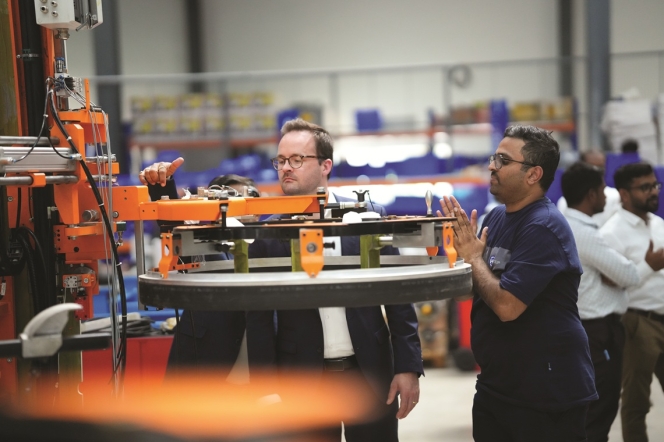
The German headquarter engineering group unveils an ambitious localisation strategy, expands its manufacturing footprint and commits EUR 20 million to a next-generation factory as India’s tyre industry enters a new growth phase.
“The Indian rubber industry is entering a transformation phase. HF, with this investment, will be well placed to support that transformation and to support our customers,” Wilson said.
The current expansion represents the next step in a broader long-term strategy. HF GROUP plans to invest approximately EUR 20 million in a digitally enabled manufacturing facility that will become an integral part of its global production network.
Rather than simply exporting European technology into India, HF is increasingly designing, manufacturing, rebuilding and servicing equipment within the country while folding its Indian operations into its worldwide manufacturing network.
AN ENGINEERING LEGACY SINCE 1848
Few companies serving the tyre industry can match HF GROUP’s history. Founded in 1848, the international engineering group has grown into one of the world’s leading suppliers of equipment for rubber and plastics processing, specialising in mixing technology, tyre curing systems, automation and downstream manufacturing.
The group today employs nearly 1,890 people across 15 international locations, including plants, engineering centres, sales organisations and service facilities across Europe, North America and Asia. Its principal manufacturing sites remain in Germany, Italy, UK, Slovakia and Croatia, supported by service centres in US, France, China, Singapore, Thailand, Malaysia and now an expanding Indian base. Wilson noted that HF generated roughly EUR 400 million in revenue during 2025, a reflection of its global reach in a highly specialised industrial sector.
Unlike many multinationals, HF answers to an ownership structure built for patient capital rather than short-term returns. The company sits within the Possehl Group, an entrepreneurial group wholly owned by the charitable Possehl foundation based in Lübeck, Germany. “Dividend payments also support philanthropic projects that help the city and the people of Lübeck and the northern part of Germany. This allows us a lot of freedom to invest in the future of HF,” Wilson explained. Increasingly, that freedom is being channelled towards India.
MORE THAN A MARKET
For decades, multinational equipment makers treated India chiefly as an export destination. HF has deliberately chosen a long-term localisation strategy focused on engineering, manufacturing, service and product lifecycle support within India.
Wilson returned repeatedly to one theme: creating customer value rather than simply selling machines. “Our objective is to be the technological leader in the market. But not only the technological leader – a leader that creates value for our customers, because without customers, there is no HF,” he said. That philosophy underpins the company’s four core values – experience, innovation, commitment and partnership – extended, Wilson argued, well beyond supplier relationships. “We hold customer engagement very early in our R&D and innovation process, to make sure we create that value when we go to market with a new product or service,” the CEO added.
FROM INDUS UTH TO HF INDIA
HF’s Indian story predates the latest announcement by three decades. Its roots trace to 1995, when Indus Uth was founded as an Indo-German venture serving India’s expanding rubber-processing industry, initially refurbishing imported European machinery. The business broadened steadily: India’s first stock blender arrived in 1998, its first batch-off unit in 2000, and its first K-Series intermeshing mixer in 2003. As demand grew, the operation relocated in 2007 to a larger facility in Nelamangala, near Bengaluru.
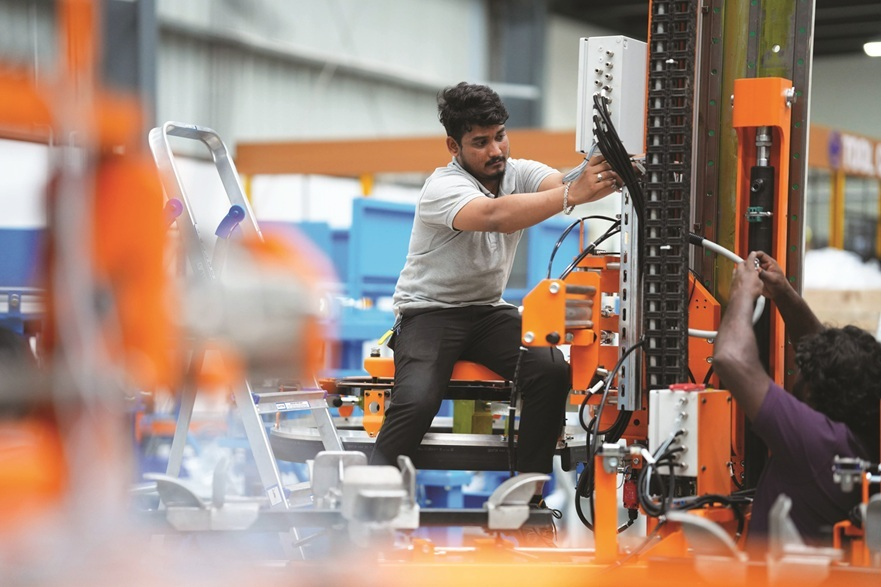
The pivotal moment came in 2011, when HF GROUP entered the business through a joint venture, bringing proprietary European mixing technology and global manufacturing standards. “We started our first activity directly in India in 2011, in a joint venture with Indus. Over the years, we further developed the company, and in 2024, we completed the full acquisition. We now own 100 percent of the facility and renamed it HF Machinery India,” Wilson recalled. Full ownership changed the pace of investment. “Now we can move much faster in the Indian market because we have full control over the entity,” he added.
LOCALISATION BECOMES THE STRATEGY
The most significant shift in HF India’s evolution has been its move from importer and refurbisher to manufacturer of rubber-processing machinery built largely on Indian soil. The company calls this ‘glocalisation’ – combining European engineering standards with Indian manufacturing agility and cost competitiveness while also cutting currency exposure and shortening delivery times for customers.
“The Indian economy is going into a take-off decade. The economy runs on tyres. The growth we see is in double digits annually to 2030 and beyond. That was the purpose of acquiring 100 percent of our Indian subsidiary – it allows us to invest further, expand local manufacturing and deliver world-class solutions,” Wilson said.
Technological milestones have followed steadily: the Indo-German hybrid K100 intermeshing mixer in 2014; locally manufactured hydraulic hopper systems for BANBURY mixers and India’s first 100-inch rubber-processing mill, among the largest available anywhere. Since 2020, HF has redesigned its Rubmix K-Series with Mark 5 technology, lifting productivity by roughly 15 percent and extending its range from a compact 20-litre unit to a forthcoming 203-litre model. The iconic 11D BANBURY mixer, once supplied from Farrel in UK, is now built entirely in India, including its chamber components and rotor technology – complemented by the larger F270 and F305 BANBURY range, which pairs locally made structures with proprietary European rotor geometries. “The unique rotor technology still comes from our OEM in Europe, which differentiates HF from the competition,” Wilson noted.
HF India’s product line now spans a bigger part of the rubber-mixing process: the Rubmix K-Series from the compact K2 through the K6; tangential BANBURY mixers and two-roll mills from 36 to 100 inches, complete with stock blenders and PLC-based automation. The company has also entered tyre-curing equipment for the first time, with curing presses built to HF’s Hamburg design – mechanical bodies from Croatia, assembly and automation completed in India – initially in 46-, 48- and 52-inch configurations, with truck-tyre presses to follow. Every press, Wilson stressed, meets the same European safety standards as those built in Europe.
FROM EQUIPMENT SUPPLIER TO LIFECYCLE PARTNER
Perhaps the most striking shift in HF India’s strategy is its move from selling machinery to supporting customers across the entire operating life of their equipment. “We like to use the phrase ‘holding the customer’s hand’. We’re not just here to sell hardware. We want to support you with process optimisation and performance enhancement going forward,” Wilson said.
That philosophy has built an extensive service business spanning technical support, repairs and modernisation, operator training and spares management – including rotor refurbishment, chamber rebuilding, gearbox overhauls, control-system upgrades and energy-efficiency improvements. For customers, the logic is straightforward: extend equipment life and reduce downtime without the capital cost of full replacement.
SUSTAINABILITY AS COMMERCIAL STRATEGY
Sustainability has become one of HF’s principal differentiators, not merely a compliance box to tick. Most of the group’s major European plants have achieved EcoVadis Gold ratings, and its principal facilities are targeting carbon-neutral manufacturing by 2040. More significant is the 35 percent of R&D spend now directed towards technologies that cut customers’ energy use and emissions. “Our target is to support our customers with solutions that reduce their CO₂ footprint,” Wilson said.
That agenda extends into the circular economy through the group’s acquisition of UK-based WF Recycle-Tech, whose patented two-stage pyrolysis process converts end-of-life tyres into reusable raw materials. “We have our first successes and intend to focus on growing this activity,” Wilson said, “because it has a clear link to sustainability and to solving the problem of end-of-life tyres.”
INVESTING EUR 20 MILLION IN INDIA’S MANUFACTURING FUTURE
The next phase of HF India’s expansion will be its boldest yet: a greenfield campus spanning 10 acres and roughly 200,000 square feet, built around Industry 4.0 principles with digital manufacturing, automated production and integrated engineering under one roof. Rather than a satellite supporting European factories, the plant is designed as a fully-fledged manufacturing hub serving Indian customers.
The commitment reflects broader change across the global tyre-equipment industry, as international suppliers localise engineering, production and service to stay competitive in one of the world’s fastest-growing automotive markets. For HF, that is no longer a regional tactic but a central plank of global strategy.
Wilson was careful, however, to temper celebration with realism. “We are all very proud of today’s achievement,” he told employees at the inauguration. “But the real work starts now. We have to ramp up this activity and make sure we deliver first-class quality to our customers.” The company is planning to build the new facility by 2028.
For a company founded in the middle of the 19th century, that sentiment captures HF’s calculated investment: that the next chapter of global tyre manufacturing will increasingly be written in Asia – and that India, in particular, is where HF GROUP intends to help write it.
The Economy Runs On Tyres
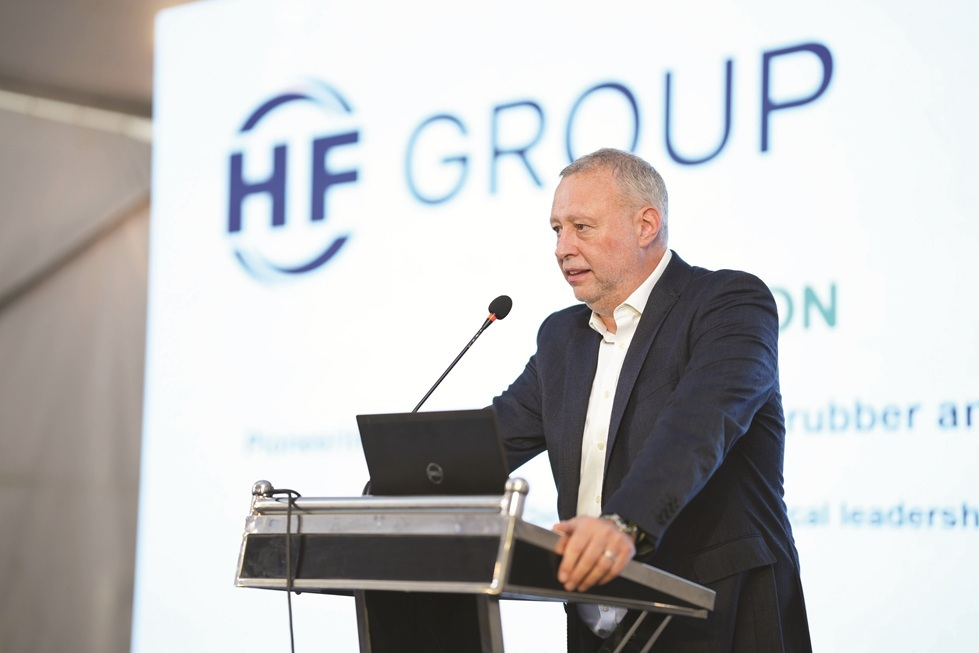
HF GROUP CEO On India’s Strategic Role In HF’s Global Growth
At the inauguration of HF India’s new Bengaluru facility, CEO Ian Wilson sat down to discuss the strategic case for India, the pressures reshaping the curing-press market, and how HF plans to defend its leadership as the Indian tyre industry accelerates.
Congratulations on the new unit. In your view, what makes India a strategic location for HF Group right now?
India is entering a phase of transformation in the rubber industry, where we see double-digit CAGR growth and huge potential to capture capacity expansion – both in greenfield projects and in modernisation of existing, brownfield plants.
To stay competitive in both mixing and curing, we need to keep innovating, but we also need to focus on cost optimisation. Manufacturing in India allows us to become even closer to our customers while improving competitiveness, responsiveness and local value creation. Local production also simplifies commercial transactions by allowing contracts in local currency, thus reducing unnecessary administrative complexity for customers.
Nearly every major tyre manufacturer in India has announced a large expansion this year. Where does HF fit into that growth story?
I think it’s clear from a market perspective – we’re number one in mixing, and I say that not from ego but because it’s a proven fact, both in market share and in innovation. We do much more than a basic mixer; we offer full solutions including automation, which not all our competitors do in one package. We’ve also invested heavily, every year for the past 16 years, into improving our mixer’s performance, and that’s paying off now.
Why India specifically, given how competitive the landscape has become?
Our competitors on batch mixers manufactures in India, which puts tremendous pressure on us from a pricing perspective. We can justify a premium, but only so far – we don’t want to push customers into a corner where they start looking at alternatives.
You mentioned curing is a different situation altogether.
Yes. We were in a very strong position, but since Covid, the situation has changed dramatically – Chinese curing-press manufacturers have raised their game considerably. In our estimation, market prices for presses have fallen by around 35 percent. Before Covid, the average press cost around USD 350,000; it’s now closer to USD 225,000. The market has changed considerably and we continue adapting our global manufacturing footprint to remain competitive while preserving the technological advantages that distinguish HF.
Given that pressure, how are you increasing local content, since much of the value still comes from Germany?
That assessment isn’t fully correct. On mixing, we already manufacture locally – the F270/F305 tangential machine and the heritage 11D design are both built entirely in India, as are our two-roll mills from 36 to 100 inches, for the Indian market. We also handle all the aftercare, service support and refurbishment here. Local content is easier to build into a mixer because the gearbox and drive chain are modular rather than mounted onto a single frame, so we can source ancillaries – gearboxes, drive chains, TCU aggregates – fully in India. That has a real impact on total cost.
What capacity are we talking about for curing presses at this facility?
It depends on the final specification, but the bay can handle around 20 presses at a time – roughly 200 presses a year.
Will this unit also serve neighbouring markets like Sri Lanka?
Yes, we can consider the Indian sub-continent.
Beyond the machines themselves, how are tyre manufacturers’ demands evolving?
In traditional markets, there’s a period of consolidation – older, inefficient plants are closing, so the focus in Europe is on retrofits and upgrades, such as converting to electric curing from conventional steam. Greenfield projects continue, but increasingly from Asian manufacturers, predominantly China and India.
The bigger theme is tyre-road wear particulate emissions, driven by legislation – China is already introducing standards equivalent to Euro 7, and India will face this eventually. Customers can either improve abrasion resistance or look at collection devices, but the clear focus is on improving rolling resistance and tyre wear through higher silica content – which is exactly where HF’s high-silica tandem solution fits.
How does electric curing compare with hydraulic on energy efficiency?
Not everyone will switch to electric – it depends heavily on infrastructure. Where it’s already validated on an industrial scale, electric curing improves energy efficiency to above 80 percent. It also allows independent control of temperature and pressure, which optimises curing time – particularly important as higher silica content tends to extend curing times. AI will play a growing role too: in mixing, we already use in-line algorithms to optimise rotor speed, temperature and ramp pressure, delivering productivity gains of 20–30 percent. We’ve applied the same retrofit approach for a customer in Sri-Lanka, with similar results.
How do you see the Indian market’s appetite for electric curing, given the higher upfront cost?
There’s regional variation. In North America, interest is less about CO₂ and more about the work environment – an electric curing room is a completely different environment to a steam-press pit with 15 presses blowing off steam. In Europe, it’s tied closely to CO₂ taxation, which varies sharply by country. In India, though, interest is high – we already have an order backlog for our first electric presses, from Indian customers.
You spoke about customer partnership. What does that look like in practice?
We’re a German-orientated company, very strong technically, but one lesson we’ve reinforced over recent years is that innovation delivers the greatest value when it starts with the customer’s priorities.
One example: we assumed customers would want energy savings on the mixer itself, but the mixer only accounts for around 4 percent of total energy use across the tyre manufacturing chain – curing accounts for 69 percent. Understanding customers’ real priorities, rather than what we assume they need, is what shapes the right innovation.
Between mixing and e-curing, where do you expect stronger growth in India?
I won’t differentiate. I don’t want to give up on either opportunity – I want both.
How do you serve smaller manufacturers outside the tyre segment?
We shouldn’t forget we’re a rubber-industry company, not only a tyre company. HF also has a continuous-mixing business unit in the US serving typically polyolefin masterbatch compounding, and in India we have a loyal, strong base of technical-rubber producers buying our Rubmix K-Series batch mixers – a very successful product line, particularly the 20-litre K2 for pharmaceutical-grade compounding and the newer K5, which has become a big seller since we improved its rotor geometry.
What’s the plan for headcount as this facility scales?
We plan to increase headcount to match the sales growth step by step.
What are the biggest challenges over the next five years?
Our competitors aren’t standing still. Global competition continues to intensify. Maintaining technology leadership while strengthening regional manufacturing capabilities will be essential for long-term success. That’s why we’re investing in locations such as India – not only to improve our competitiveness but also to be closer to our customers and their evolving requirements.
Finally, how is the shift towards bio-based materials affecting your equipment?
It has a real impact on mixing – substituting virgin carbon black with recovered carbon black changes bulk density and feed behaviour, so hopper volumes and mixer configurations need optimising. That’s partly why we invest a third of our R&D budget into sustainability, with a target of a 30 percent reduction in our customers’ CO₂ footprint from the solutions we provide.
Beyond SEO: Why Ai Visibility Could Become Tyre Industry’s Next Competitive Advantage
- By Sharad Matade
- August 19, 2026

As generative AI transforms the way consumers and businesses discover products, tyre manufacturers face a fundamental shift in digital marketing. Roshan Mohan, Co-Founder and CMO at FlowBlinq, and Founder of PCG argues that the next battle will no longer be fought on search engine rankings but on whether AI systems choose to recommend a brand in the first place.
For more than two decades, tyre manufacturers have refined their digital strategies around a familiar formula: optimise websites for search engines, invest in paid advertising, strengthen dealer networks and build visibility through reviews and comparison platforms. Success depended largely on securing a prominent position on Google’s search results.
That formula, however, is beginning to change.
The rapid adoption of generative artificial intelligence (AI) platforms such as ChatGPT, Gemini and Claude is reshaping how consumers search for information, compare products and make purchasing decisions. Rather than browsing multiple websites, customers are increasingly asking AI assistants to recommend the most suitable product based on their specific requirements.
For tyre manufacturers, this represents far more than another digital marketing trend. It fundamentally changes how products are discovered.
According to Roshan Mohan, Co-Founder and CMO at FlowBlinq, and Founder of PCG, companies that continue treating AI as simply another marketing channel risk missing a much larger transformation. “The customer journey for tyres has already started bending around AI, and the change over the next three to five years won’t be a redesign of the funnel; it’ll be a shift in where the funnel begins,” he says.
FROM SEARCH ENGINES TO AI CONVERSATIONS
Historically, buying tyres has been an information-intensive process. Consumers often compare technical specifications, dealer recommendations, user reviews, pricing and compatibility before making a purchase. Search engines have traditionally served as the starting point for that journey.
Generative AI is simplifying this process dramatically. Instead of opening multiple browser tabs and manually comparing products, motorists can simply ask an AI assistant for recommendations based on vehicle type, budget, driving conditions and performance priorities. The AI then synthesises information from numerous sources into a single response. “What changes for the buyer is effort, not intent. They still want the right tyre for their car and budget, but instead of researching options and making the final comparison themselves, they are increasingly describing their needs to AI and letting it identify the best solution,” Mohan explains.
This shift effectively transfers much of the research process from the consumer to the AI model.
Industry forecasts suggest this transition is already underway. Gartner predicts traditional search engine volume will decline by 25 percent by 2026 as generative AI absorbs many queries that previously began with conventional search engines. Meanwhile, Checkout.com’s research indicates that consumers are embracing AI-assisted purchasing faster than many businesses are preparing for.
For tyre companies, the implication is profound: visibility may increasingly depend not on appearing first in search results but on being recommended within AI-generated answers.
THE RISE OF AI VISIBILITY
Search engine optimisation (SEO) has long centred on improving rankings through keywords, backlinks and domain authority. AI discoverability, Mohan argues, follows a very different logic.
“Traditional SEO was about ranking, winning a position on a page of 10 blue links. AI visibility, or Generative Engine Optimisation (GEO), is about being the answer rather than a link to the answer,” he says.
Unlike traditional search engines, large language models evaluate whether product information is sufficiently trustworthy, structured and complete before referencing it. If they cannot confidently interpret a manufacturer’s data, the brand may simply disappear from the recommendation altogether.
This places far greater importance on machine-readable product information than on conventional search optimisation. At the same time, AI systems are looking beyond a company’s own website to understand whether a brand is trustworthy. This makes it important for brands to have a presence across credible, independent sources, where editorial PR and genuine reviews can play a key role, rather than advertisements or advertorials. AI systems bring together these trust signals from multiple sources and present them to users in one place. This means the decision-making journey is increasingly shifting to the AI chat, where consumers can get a more comprehensive view before making a choice. Brands that build credibility across trusted sources will therefore be better placed to influence how AI systems recommend them.
Structured specifications, consistent product descriptions, schema markup and clearly organised technical information become essential because AI systems rely on these elements when generating responses.
FlowBlinq has developed what it describes as 17 Generative Engine Optimisation pillars to assess whether brands are sufficiently prepared for AI discovery. These include structured data quality, technical completeness and AI crawlability.
Perhaps more significantly, Mohan believes many companies have little understanding of how frequently AI platforms mention their products – or whether they are mentioned at all.
“Our citation tool runs a brand across ChatGPT, Claude and Gemini and shows, prompt by prompt, whether the brand gets cited, where it loses out to a competitor and where it’s simply absent from the answer altogether,” he adds.
TECHNICAL ACCURACY BECOMES A COMPETITIVE ASSET
Tyres differ from many consumer products because purchasing decisions depend heavily on technical specifications. Load index, speed rating, rolling resistance, wet grip, tread pattern and vehicle compatibility all influence suitability. Inaccurate recommendations can have genuine safety implications.
Mohan believes this makes structured product information particularly important for the tyre industry. “When product data is thin, a model doesn’t refuse to answer; it defaults to the brand it has the most confident, well-structured information about,” he adds. He warns that this tendency naturally favours manufacturers with richer digital product catalogues rather than necessarily those with superior products.
FlowBlinq’s research suggests considerable room for improvement. According to the company’s findings, 62 percent of Indian brand websites provide product descriptions that are insufficiently detailed for AI systems, while more than half lack product codes needed for accurate identification.
For tyre manufacturers, the solution is relatively straightforward but frequently overlooked.
Rather than embedding specifications within downloadable PDF brochures or image-based catalogues, companies should publish technical information directly on webpages in formats that AI systems can easily interpret.
Equally important is the broader digital reputation surrounding a brand. Mohan notes that AI systems increasingly rely on trusted third-party sources – including established news publications, Wikipedia and community platforms – to validate manufacturer claims before making recommendations.
AI ENTERS FLEET PROCUREMENT
The implications extend well beyond retail consumers. Business purchasing decisions often involve lengthy comparisons of performance, lifecycle costs, regulatory compliance and operational efficiency – precisely the type of structured analysis that generative AI performs well.
According to Mohan, procurement teams, fleet operators and original equipment manufacturers (OEMs) may adopt AI-supported purchasing even faster than retail buyers. “B2B tyre buying was never going to be immune to this, and it may move faster than consumer purchasing because procurement teams are exactly the audience generative AI tools were built to serve,” he says.
A fleet manager could ask AI to compare total cost of ownership across several tyre brands. An OEM purchasing team might request suppliers meeting specified rolling resistance or durability thresholds.
In such scenarios, manufacturers lacking accessible technical documentation risk exclusion before human procurement teams even begin formal evaluation. “The practical response isn’t a new sales deck. It’s making sure spec sheets, compliance documentation and comparative data exist in formats a model can read and trust,” Mohan says.
AI WILL ADVISE, BUT HUMANS WILL STILL DECIDE
While AI is poised to transform product discovery, Mohan believes the actual purchase decision will remain firmly in human hands – at least for high-value, safety-critical products such as tyres.
“I’d separate ‘AI helping me decide’ from ‘AI deciding for me’, because consumers still are the final decision makers,” he says.
Recent consumer research supports this view. While surveys indicate growing confidence in AI agents handling routine shopping tasks, willingness declines sharply when AI is expected to complete purchases autonomously. Most consumers remain comfortable with AI conducting research, comparing alternatives and shortlisting products but prefer to approve the final transaction themselves.
Tyres, Mohan argues, naturally fall into the category where human oversight will continue to matter.
“It’s a purchase people make infrequently, it carries real safety implications, and it typically involves a meaningful amount of money,” he says.
Consequently, AI is likely to dominate the research phase – evaluating specifications, warranty terms, prices and dealer options – while the final purchase decision remains with the customer.
However, one area where agentic commerce could quickly gain traction is in connecting customers directly with dealers. Rather than merely recommending a tyre, future AI assistants may also identify nearby retailers with available stock and book installation appointments automatically.
BECOMING AI-READY STARTS WITH THE BASICS
One of the most striking aspects of Mohan’s assessment is that the industry’s biggest challenge is not technological sophistication but digital housekeeping.
“It’s data, overwhelmingly, and it’s more basic than most companies expect,” he says.
FlowBlinq’s audits suggest that many corporate websites still lack the fundamental structure AI systems require. According to the company’s research, 91 percent of audited websites failed to provide clear information explaining their product catalogues in a way that AI could
understand. Even more concerning, nearly half were unintentionally preventing ChatGPT’s web crawler from accessing their websites because of security settings or plugin configurations.
“These aren’t strategic gaps; they’re operational oversights, and they’re fixable in weeks, not years,” Mohan claims.
For tyre manufacturers, this means that substantial improvements may not necessarily require major investments in new technology. Instead, they require a systematic review of how product information is organised, published and made accessible to AI systems.
Mohan also believes the next phase of digital readiness will involve preparing websites for agentic commerce by enabling real-time inventory visibility and ensuring AI systems can interact directly with product databases.
MEASURING RETURN BEYOND TRADITIONAL SEO
Digital marketing budgets have historically focused on search advertising, social media campaigns and marketplace optimisation. As AI-driven referrals grow, Mohan argues that businesses should begin allocating dedicated budgets towards AI discoverability.
“Yes, and the case for it is measurable rather than speculative now,” he says. Rather than relying solely on website traffic or keyword rankings, he believes organisations should monitor a different set of performance indicators.
Among the most important are how frequently AI systems cite a brand when responding to relevant queries, whether those citations are accurate and whether visitors arriving through AI recommendations convert differently from those originating through conventional digital channels.
Adobe’s Digital Insights research suggests AI-generated referrals are not only increasing rapidly but also producing stronger conversion rates than traditional referral sources. According to Mohan, this reflects the higher purchase intent of consumers who have already completed much of their evaluation through AI before visiting a manufacturer’s website.
TRUST WILL DETERMINE INFLUENCE
The emergence of AI recommendations inevitably raises questions about transparency. If AI systems become influential in shaping purchasing decisions, how can brands improve visibility without manipulating results?
For Mohan, the answer lies in accuracy rather than optimisation. “The honest answer is that AI-powered recommendations only work for a brand in the long run if they’re accurate, because these systems increasingly get checked,” he explains.
He believes manufacturers should resist the temptation to game AI systems through exaggerated marketing claims.
Instead, success will depend upon providing complete, verifiable product information that allows AI to make fair comparisons based on genuine performance characteristics.

“So the lever isn’t gaming a model into over-recommending you. It’s making sure that when a model compares your tyre honestly against a competitor on wet grip, rolling resistance or price, your data is complete enough that you win the comparisons you’re actually built to win,” he says.
In his view, transparency is not a constraint on AI marketing but its most durable competitive advantage.
FROM RECOMMENDATIONS TO TRANSACTIONS
The next evolution extends beyond recommendations. Emerging protocols are enabling AI systems to communicate directly with commerce platforms, inventory databases and pricing systems, allowing them to perform increasingly sophisticated purchasing tasks.
According to Mohan, this represents a significant opportunity for tyre manufacturers and dealers.
“The interesting shift is that AI agents are starting to interact with commerce systems directly... rather than just reading a webpage and stopping there,” Mohan says.
Once connected to live inventory systems, AI assistants could recommend the exact tyre that fits a customer’s vehicle, confirm stock availability at nearby dealers and compare prices in real time. Now, it can also make purchases directly from the chat window. This is something FlowBlinq is uniquely positioned to address as well.
Rather than generic recommendations based on previous purchasing patterns, personalisation could become highly contextual – considering vehicle compatibility, driving conditions, current inventory and even maintenance priorities.
However, Mohan cautions that these benefits will only be realised by organisations whose internal systems can support such interactions. Manufacturers and retailers will need modern, connected back-end infrastructure capable of sharing real-time inventory and pricing information with AI platforms.
ENGINEERING PRODUCTS – AND ENGINEERING DISCOVERABILITY
Looking ahead, Mohan does not believe AI will replace product quality as the defining competitive factor. Instead, he sees AI readiness becoming an equally important complement to engineering excellence.
“Product quality will always be table stakes; nobody wins on AI visibility with a mediocre tyre,” Mohan says. Yet he argues that superior products alone may no longer guarantee commercial success.
As purchasing journeys increasingly begin with AI conversations rather than search engines, brands that fail to present their technical information in formats AI systems can retrieve and trust may simply disappear from consideration.
“The winners will be the manufacturers who treated AI readiness as seriously as they treat product engineering,” Mohan says. He returns to Gartner’s prediction of declining traditional search volumes not as a warning but as an indication of how rapidly digital discovery is evolving.
“The discovery layer is moving to AI faster than most manufacturers’ data infrastructure is moving with it,” he says.
His concluding observation perhaps best captures the industry’s emerging challenge.
“A brand can make the best tyre in its category and still lose the sale simply because it was invisible in the one conversation the buyer had before deciding. That’s a genuinely new way to lose, and avoiding it is now a core marketing responsibility, not a technical footnote,” Mohan says.


Comments (0)
ADD COMMENT