


Designed with standard tyre construction, self-sealing tyres have a great feature on the tyre durability having designed inner lining of the tyre—an extra lining of sticky gel-like polymer sealant , that helps in sealing tyre leaks. Such tyres are already in the market; Continental and Michelin are the major manufacturers worldwide for self-sealing tyres.

Continental developed and designed to seal a damaged tyre tread. In case of penetration by foreign objects such as nails, for example (Fig.1), there is no need for immediate roadside tyre changes, and holes remain sealed even if the puncturing object becomes dislodged. Self-sealing tyre gel is a sticky, viscous sealant layer. They are designed to fix most tread-area punctures instantly and permanently and are not necessarily required to get to be repaired.

In such tyre, Self-sealing gel is poured inside a tyre and remains in contact with tyre inner-liner (Fig.2) and is a type of an extra lining of sticky gel-like polymer sealant, a patented liquid, injected through tyre valve under pressure. A liquid contains patented polymer and fibre. During Puncture, when air rushes through, it also carries the gel liquid and solidifies there, causing air sealing. A tyre sealant is a complete puncture preventative, tyre repair and maintenance solution. It is a liquid and gel base substance, with the primary composition being either glycerine or latex and they are specially formulated with advanced Kevlar fibres, rubber particles and cooling agents, the solution permanently seals punctures and protects the tyre.
While the number of cars with run-flat tyres continues to grow slow, and the promise of airless tyres is on the horizon, it seems that long forgotten self-sealing tyres are finally reaching practicality. According to a recent article in the Detroit Free Press, Michelin tyres with their Selfseal technology will be available on the 2020 Ford Explorer. They are already fitted to the Chevrolet Bolt EV. Michelin's Selfseal technology uses a coating inside the tyre that can almost instantly fill in a nail or bolt hole up to a quarter of an inch in diameter (Fig.3).

Both run-flats and self-sealers are all about the tread. A cut in the sidewall will compromise a self-supporting run-flat tyre’s ability to hold up the vehicle. Self-sealing tyres do not have a sealant layer in the sidewall, and they can only handle punctures up to a certain size in the tread. Self-sealing tyres contain an inner layer of sealant material along the tread. If a nail or other foreign object punctures the tyre, the sealant layer closes the hole to prevent the air from escaping, and the tyre stays inflated and the self-sealing tyre will be having a typical symbol code on the tyre sidewall (Fig.4) to identify this class of tyres.
Self-sealing tyres are designed to fix most tread-area punctures instantly and permanently. These tyres feature standard tyre construction with the exception of an extra lining inside the tyre under the tread area that might be coated with a puncture sealant that can permanently seal most punctures from nails, bolts or screws up to 3/16 of an inch in diameter.

Since these tyres are designed to seal the tyre immediately upon being punctured, most drivers will never even know that they just had a puncture. Also, because these tyres feature standard tyre constructions, self-sealing tyres may not require a low air pressure warning system (TPMS).
In such tyres, the puncture holes remain sealed with sticky gel even if the puncturing object becomes dislodged. Self-sealing tyre gel is a sticky, viscous sealant layer. They are designed to fix most tread-area punctures instantly and permanently. Self Sealing gel inside a tyre and in contact with tyre inner-liner is an extra lining of sticky gel-like polymer sealant, a patented liquid, injected through tyre valve under pressure. A liquid contains patented polymer and fibre. During Puncture, when air rushes through, it also carries liquid and solidifies there, causing air sealing.
A tyre sealant is a complete puncture preventative, tyre repair and maintenance solution. It is a liquid and gel base substance, with the primary composition being either glycerin or latex. Specially formulated with advanced Kevlar fibers, rubber particles and cooling agents, the solution permanently seals punctures and protects the tyre. Tyre sealants have been adapted for every tyre usage, from bicycles, motorbikes, cars and agriculture to the most extraneous mining and military conditions.
These tyres have been reported to continue to operate years without getting the tread repaired. A few major tyre companies in the self-sealing tyre market are among ; ContiSeal by Continental AG, DuraSeal by Goodyear Tyre & Rubber Co., Sealguard by Hankook Tyre Co. Ltd., and Seal Inside by Pirelli Tyre LLC ,NailGard by Uniroyal Goodrich Tyre Co. A few highlights of self-sealing tyres are:
- The sealant is just a layer inside a conventional tyre, and the ride is not affected.
- While a tyre pressure monitoring system is useful, self-sealing tyres can be used on vehicles that are not equipped with TPMS.
- They do not require a specialized rim, or special equipment to mount them.
- You can mix them with conventional tyres on a vehicle.
- There are not many downsides to self-sealing tyres. There is a limit to the size of nail or screw puncture that the tyre can handle, usually about 5mm in diameter, and ideally near the middle of the tread.
- The sealant layer is not for deep cuts across the tread, or cuts or punctures in the sidewall.
- While the tyre can close the puncture wound and prevent air loss, the tyre should still be examined and repaired if necessary.
- The technology still is not that common among many tyre companies.
- They are generally more expensive than a regular tyre.
From Data Overload To Decisive Action
- By Nilesh Wadhwa
- October 23, 2026

As commercial vehicle operators face mounting pressure from regulations, rising costs and the shift to electric power, Webfleet, a subsidiary of Bridgestone, is focusing on turning ever-growing volumes of vehicle data into practical recommendations that improve performance and ease the daily burden on fleet managers.
Founded in Leipzig in 1999 as one of the world’s first web-based fleet management platforms, Webfleet has grown from a pioneering software-as-a-service (SaaS) start-up to Europe’s leading solution and a core part of Bridgestone’s global offering. Today it serves drivers across more than 180 countries with AI-powered insights, electric-vehicle tools and sustainability data that turn complex operations into clearer, more efficient decisions.
In an exclusive interaction with Tyre Trends, Marc Notenboom, Director of Product Management at Webfleet, shares how the company has watched the fleet-management sector evolve over more than a quarter of a century. Interestingly, it was just last year the company marked its 25th anniversary.
From its inception, Webfleet has seen the volume of available data explode, yet the real challenge remains converting that information into meaningful guidance.
“Fleets give you more data but not more insights, which continues to be a challenge. Because of new regulations, new sensors, increasing competition and customer demands, we end up generating more data. We also have access to more data, which is growing exponentially. And then comes the real question, how do you make sense of that data?” Notenboom observed.
 Marc Notenboom, Director of Product Management, Webfleet
Webfleet obtains its information through black-box devices installed in vehicles, sensors or direct connections to original-equipment manufacturers. This includes telematics, GPS, video, driver behaviour and vehicle diagnostics, among others. The company then processes that stream to deliver fleet-management services.
The next step, he explained, is moving beyond retrospective analysis. “Insights tell you what happened and why it happened, perhaps, but not what you need to do to improve your performance. That is what we are doing now with the help of artificial intelligence (AI). For example, we analyse data, see if patterns are different or you have anomalies in your data to predict what is happening or what is going wrong. And then we also use AI to analyse our data to see how you are performing, for instance, against competition. And then give customers suggestions on how to improve on certain topics like fuel consumption or driver safety,” he said.
The industry, in Webfleet’s view, is therefore evolving from raw data collection towards insights, recommendations and concrete actions.
SHARED PRESSURES ACROSS DIVERSE FLEETS
Webfleet serves a wide spectrum of customers, from large transport and logistics operators to small fleets of one or two vehicles, service-and-maintenance businesses and last-mile delivery companies.
Each customer faces distinct operational issues, yet common themes emerge. “What they all have in common is that the amount of data and the pressure to enhance their performance is increasing a lot. And then there is the regulatory compliance pressures as well,” said Notenboom.
Performance, in this context, covers delivery times, cost per kilometre, driver wages, safety and fuel consumption – metrics that matter differently according to the sector, but all that demand continuous improvement.
One of Europe’s most persistent difficulties is the shortage of skilled drivers, which has led to greater reliance on migrant workers whose experience of road conditions may vary widely between countries.
Webfleet addresses part of this challenge through tools such as OptiDrive, which shows fleet managers how individual drivers perform on fuel use and safety. Language barriers are tackled with automatic translation features built into the driver’s work app or tablet.
“They can interact with their fleet manager in their own language, and the fleet manager can also interact back in their own language,” explained Notenboom. The same interface delivers active coaching: if a driver exceeds the speed limit, for example, an immediate warning appears. These software-based interventions help maintain standards without requiring constant direct supervision.
MEASURABLE GAINS AND EV TRANSITION
Notenboom agrees that customers understandably scrutinise the return on any additional technology cost. He reported that Webfleet users typically achieve efficiency improvements of up to 15 percent, though results depend heavily on the starting point. This ranges from fuel savings, faster turnaround, downtime reduction or improved driver behaviour, among others.
“If a company is already really good at saving fuel, then adding tools and driver coaching and technology might not change a lot. At the same time, even if it’s a small improvement, especially with the high fuel prices today, it could already translate to a lot of savings,” averred Notenboom.
The arrival of electric trucks introduces a fresh set of complexities. Research indicates that driver behaviour exerts an even greater influence on energy consumption in electric vehicles than in conventional combustion models. Smooth operation becomes critical to range, while decisions about when and where to charge add further layers of planning. Webfleet supports the transition by helping managers determine the right vehicle for each duty cycle.
“If you do long-distance transport, electric trucks are perhaps not the best option. But if you do inner-city deliveries, then electric trucks become an interesting option. And trying to find out where the optimum is, when to use Internal Combustion Engine-vehicles, where to use electric vehicles, that is also a part where we can help the fleet manager to make that decision,” he said.
On the technology package itself, every Webfleet customer receives the software platform. Hardware can be selected according to need, or in some cases, dispensed with entirely through the OEM.connect service (access vehicle data directly from OEMs via APIs), without installing extra hardware that draws data directly from the vehicle manufacturer.
“A number of customers are preferring to use OEM.connect. So that is a solution where we don’t install hardware but take the data directly from the OEM offerings,” he explained. On the other hand, where original-equipment data fall short, Webfleet’s own devices remain available.
PRIVACY, BENCHMARKING AND THE ROAD AHEAD
Growing data volumes inevitably raise questions of privacy and regulatory compliance. Webfleet adheres strictly to General Data Protection Regulation (GDPR) – a strict European Union (EU) law that protects information privacy and data rights for individuals in the EU and the European Economic Area (EEA) – requirements.
Certain categories of information can be processed only with explicit customer permission, and for benchmarking purposes, the company anonymises data so that individual vehicles or fleets cannot be identified.
A recent example is Webfleet’s Commercial Trip Monitor, which aggregates anonymised information across the entire customer base to generate comparative insights.
Looking three to five years ahead, Notenboom identified three principal challenges for the commercial-vehicle industry: the practical difficulties of electrification, the continuing shortage of drivers (with autonomous vehicles potentially addressing certain use cases over a longer horizon) and relentless competitive pressure to deliver higher quality service at lower cost.
He regards these same pressures as sources of opportunity for those able to convert them into advantage.
Interestingly, he shared that Webfleet itself continues to evaluate new markets beyond its established presence in Europe, South Africa, South America and Australia. Bridgestone’s ownership of the US-focused Azuga platform complements the portfolio, while Asia-Pacific, including India, remains under active review even if no immediate plans have been confirmed.
As Notenboom puts it, the goal is not to simply collect more information but to translate that information into clearer decisions that keep vehicles productive, drivers safer and costs under control – regardless of whether the powertrain is diesel or electric.
Vaculug Rolls Out VMS Pro Max Next-Gen Fleet Management App
- By TT News
- October 20, 2026

Vaculug has released VMS Pro Max, the next generation of its fleet management application. The product, developed over a three-year period, pairs a redesigned interface with AI-enhanced software intended to make commercial fleet management faster and more intelligent. The app is now available for download through the Apple App Store and Google Play Store.
The upgraded platform offers clear, real-time access to tyre and vehicle data, accelerates background report uploads to reduce driver time and allows measuring tools to be connected for automatic tread depth capture. It also incorporates an embedded VAN Driver Guide and can instantly flag vehicles left uninspected across 30, 60 or 90 days. Existing users must sync all pending inspections and confirm cloud upload before updating to prevent data loss.
Yokohama Rubber, dotData Partner On Human-In-The-Loop AI Agent For Manufacturing R&D
- By TT News
- October 15, 2026

The Yokohama Rubber Co., Ltd. and dotData, Inc. have announced joint development an AI agent to help engineers form hypotheses, interpret findings and make decisions in manufacturing R&D. Before full deployment, the initiative will validate the agent's required capabilities and technical feasibility.
The solution combines technical documents such as design specifications and experimental reports with engineers' accumulated expertise and features extracted from measurement data via dotData's Signal Intelligence technology. It will provide insights tailored to each project's objectives, circumstances and constraints.
The agent is not meant to produce a single correct answer. Operating in a human-in-the-loop framework where engineers retain decision-making authority, it will present multiple possibilities, perspectives and risks to broaden thinking and support professional development.
Manufacturing R&D generates diverse data through experiments, simulations, production and evaluation. Developing hypotheses requires specialised knowledge and context. Since new technology R&D rarely has one predetermined answer, abductive reasoning plays a key role. AI can add value by using data and organisational knowledge to widen engineers' perspectives rather than replace judgment.
The agent will explore measurement and experimental data patterns beyond factors engineers previously identified, combining quantitative insights with design documents and expert knowledge to reveal difficult-to-spot relationships. It will offer input from materials, design, analysis, production and evaluation perspectives, challenge existing hypotheses and raise questions about alternative interpretations and conditions. Engineers will then test hypotheses and feed results back into further dialogue, guiding Signal Intelligence processes so non-specialists can explore data features as needed.
Yokohama Rubber has advanced HAICoLab since 2020, using dotData as a foundational technology in tyre design and rubber mixing. This joint development expands those efforts, with engineers interpreting and evaluating the agent's suggestions using their own expertise rather than accepting them unquestioningly. The companies aim to transform R&D processes while strengthening engineers' creativity and judgment, establishing a new model for human-AI collaboration in manufacturing R&D.
Motoji Fujita, Head of Research & Advanced Development Division, The Yokohama Rubber Co., Ltd., said, “Since 2020, we have conducted research and development under the HAICoLab framework, drawing on the complementary strengths of people and AI to create a collaborative environment. We believe AI agents will give engineers access to perspectives beyond their own experience and enable them to evaluate hypotheses from multiple angles. Through this development initiative, we aim to advance our R&D capabilities while supporting the continued growth of our engineers.”
Ryohei Fujimaki, CEO, dotData, Inc., said, “Success in manufacturing R&D depends heavily on an organisation’s ability to connect its proprietary data and knowledge with AI. The quantitative context generated from data through automated Signal Intelligence provides a foundation for AI agents to engage engineers in practical, data-driven discussions. Together with Yokohama Rubber, which has many years of experience in advanced data utilisation, we intend to establish standards for using AI in highly specialised business domains.”
Bridgestone Deploys Easytrack At SR Technics Spain MRO Hub
- By TT News
- October 10, 2026
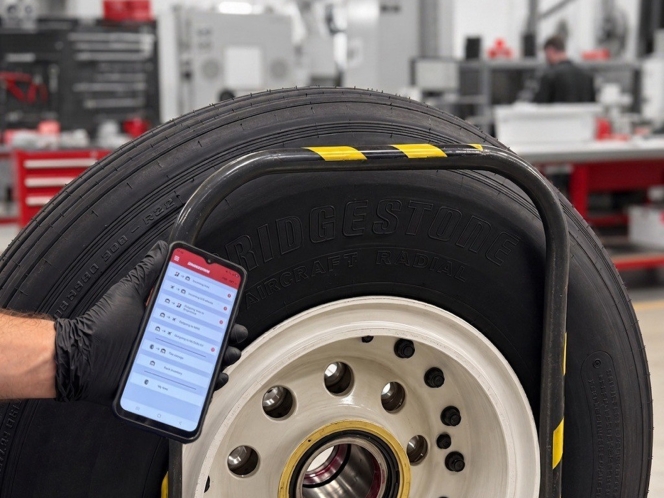
Bridgestone Aircraft Tire (Europe), a Bridgestone Corporation subsidiary, has announced the deployment of its ‘easytrack’ tyre management system at SR Technics Spain SAU, the tyre and wheel maintenance hub of global maintenance, repair & overhaul (MRO) provider SR Technics. The scalable digital platform is accessible on desktop and mobile devices.
Designed for airlines and MROs, ‘easytrack’ manages inbound and outbound tyre and wheel flows across single- or multi-site operations. It delivers real-time identification, tracking and documentation throughout each asset’s lifecycle. The project follows the solution’s first airline implementation in 2025, becoming its second customer rollout and first MRO application.
MRO providers handle large tyre and wheel volumes for multiple airlines, complicating operations. ‘easytrack’ simplifies asset management and improves traceability, accuracy, safety and productivity. At SR Technics Spain SAU, it digitalised paper-based processes, cutting processing time by 45 percent, reducing data-entry and identification errors and improving flow management across Palma de Mallorca and Madrid.

From left: David Sautois, ‘easytrack’ Product Manager, Bridgestone Aircraft Tire (Europe) S.A.; Antonio Colella, General Manager, SR Technics Spain SAU; Jean-Philippe Minet, Managing Director, Bridgestone Aircraft Tire (Europe) S.A.; Eugenie Baradzina, Commercial Director, SR Technics Spain SAU.
The results stem from a Bridgestone and SR Technics Spain SAU co-creation initiative built on long-standing partnership. ‘easytrack’ was adapted to support tyre and wheel combinations for the hub’s wheel and brake operations. Bridgestone’s expansion of airline and MRO solutions aligns with its E8 Commitment, emphasising efficiency and ecology.
Antonio Colella, General Manager, SR Technics Spain SAU, said, "The successful implementation of easytrack is a significant achievement for SR Technics Spain SAU and our teams in Mallorca and Madrid. From the very beginning, the collaboration with Bridgestone was built on trust, openness and a shared vision for innovation. Together, we have developed a solution that not only improves efficiency and traceability but also creates lasting value for our operations. We are proud to be the first MRO in the world to adopt this technology and look forward to continuing this journey with Bridgestone Corporation.”
Jean-Philippe Minet, Managing Director, Bridgestone Aircraft Tire Europe, said, “I’d like to thank SR Technics for their trust and another fruitful collaboration with Bridgestone. What the teams have jointly achieved is remarkable: co-creating through efficient teamwork and customising the Bridgestone easytrack application to digitise SR Technics tyre and wheel tracking operations. This is a brilliant example of how Bridgestone amplifies the value created at our partners.”




Comments (0)
ADD COMMENT