

NaugaShield BIO-TR 30: A New Bio-Based Cut & Chip Resin For The Most Demanding Applications
- By TT Bureau
- July 16, 2026
NaugaShield BIO-TR 30 is SI Group’s latest advancement in bio-based performance resins designed to significantly improve cut and chip
resistance in high-severity rubber applications. With approximately 75 percent bio-based content, this innovative material delivers on sustainability targets while exceeding the performance typically associated with petroleum-derived resins, making it a strong choice for applications such as OTR tyres in mining, construction and agriculture, mining conveyor belts, rubber tracks and mill linings.
Cut and chip resistance is a complex set of material behaviours, including static mechanical strength, dynamic response under deformation and ability to withstand sharp impacts and abrasive environments. In demanding applications such as mining or agriculture, materials
must tolerate repeated high-strain loading and resist the initiation and propagation of tears. NaugaShield™ BIOTR 30 was developed precisely to meet these conditions, demonstrating notably low dynamic heat buildup and excellent tear strength – characteristics closely tied to enhanced cut and chip resistance and long-term durability under cyclical loads.
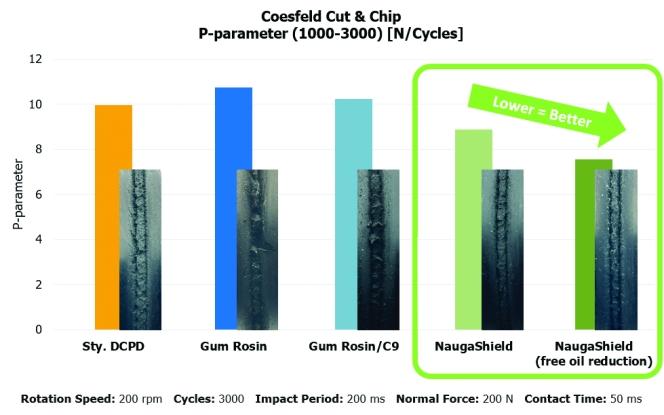
To evaluate its performance, NaugaShield BIO-TR 30 was benchmarked in an Off-road Rib Tread formulation against two widely used industry references: a gum rosin/ semi-aromatic C5/C9 resin combination and a styrenated DCPD resin. All materials were tested at an equal loading of 10 phr to provide a direct and unbiased comparison. Under these conditions, the bio-based resin consistently outperformed both alternatives, offering a stronger balance of reinforcing behaviour, improved tear propagation resistance and superior resistance to thermal degradation during dynamic flexing. Further improvements were achievable by reducing the amount of free extender oil in the compound, underscoring the resin’s adaptability in formulation design and its ability to unlock even greater performance when optimised.
These laboratory indicators were corroborated through extended Coesfeld Cut & Chip testing (see chart), in which compounds were subjected to up to 3,000 cycles at 200 rpm under a 200N applied force. Formulations containing NaugaShield BIO-TR 30 exhibited substantially lower mass loss and maintained tread surface integrity more effectively than the hydrocarbon and gum rosin-based-benchmarks. The performance advantage was even more pronounced in compounds adjusted for lower free oil content, confirming that the resin can be tailored to meet the durability requirements of the most challenging operating conditions.
The strong performance of NaugaShield BIO-TR 30 in OTR tread compounds can be readily transferred to other rubber goods that encounter similar wear mechanisms. Applications such as mining belts, agricultural and construction tracks or mill linings benefit from the resin’s ability to reinforce the rubber matrix, reduce crack growth under repeated impact and maintain structural cohesion under high-strain deformation. This versatility allows manufacturers to integrate a 75 percent bio-based resin that supports sustainability by reducing fossil-based content and helping end products last longer while maintaining – and often improving – operational performance across multiple product lines.
NaugaShield BIO-TR 30 is currently available in commercial quantities, enabling compounders and manufacturers to move directly from laboratory evaluation to pilot- and production-scale trials.
Kumho Petrochemical Group Shifts Focus To R&D and Speciality Materials
- By TT News
- September 25, 2026
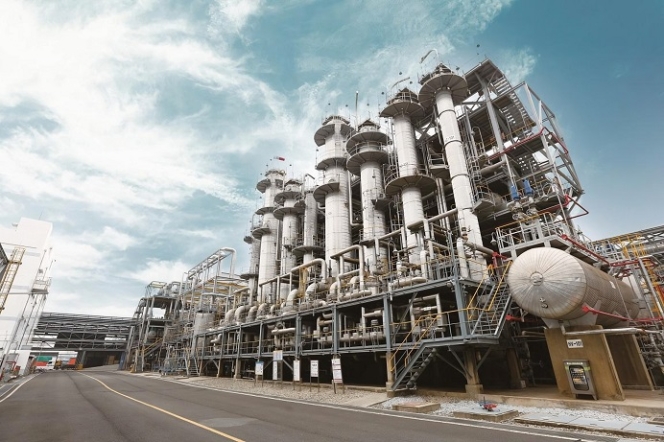
Kumho Petrochemical Group is steering its business towards research-driven, higher-value outputs as oversupply and soft demand continue to weigh on the worldwide petrochemical sector. The Seoul-based group outlined plans to boost spending on speciality chemicals, sustainable materials and novel production methods, a push intended to lift profits while building a foundation for future expansion.
Underlying the move is a deliberate evolution in the group's identity, from a bulk materials vendor to a provider of technology-backed solutions that address shifting customer requirements and stricter environmental rules. A central element of that effort involves widening the speciality lineup, exemplified by added capacity for solution styrene butadiene rubber, a synthetic rubber that enhances durability, rolling resistance and tread wear in high-performance electric vehicle tyres.
Environmental initiatives form another pillar. Facilities built by the company can trap approximately 76,000 metric tonnes of carbon dioxide each year, while separately developed technology turns recycled acrylonitrile butadiene styrene sourced from scrapped household appliances into automotive-grade interior components that satisfy performance standards and generate fewer emissions than conventional methods. The group has also joined forces with POSCO Future M and BEI on anode-free lithium-metal battery development.
Parallel technology-focused programmes are underway at affiliated units. Kumho P&B Chemicals is formulating water-based epoxy resins that curb volatile organic compound releases while incorporating more bio-based inputs to reduce carbon intensity. Kumho Mitsui Chemicals is advancing bio-based polyurethane systems and electric vehicle materials, alongside debottlenecking work to add 100,000 tonnes of annual methylene diphenyl diisocyanate capacity. Kumho Polychem, meanwhile, is targeting ethylene propylene diene monomer through low-temperature polymerisation paired with energy-efficiency improvements.
Birla Carbon Announces Asia-Wide Speciality Materials Price Hike Of Up To 15%
- By TT News
- September 22, 2026

Birla Carbon has confirmed a price increase of up to 15 percent for its Speciality Materials products across Asia, scheduled to take effect on 1 October 2026. The company pointed to significant and sustained rises in feedstock costs, driven partly by ongoing geopolitical instability and disruptions in global feedstock markets, as the reason behind the adjustment.
Although Birla Carbon pursued operational efficiencies, supply chain optimisation and disciplined cost management to soften the impact, the scale and persistence of the cost escalation left a price adjustment unavoidable. The company's sales teams will engage customers directly to explain the details and help them navigate the transition.
ACE Laboratories, Abdallah Consulting Launch VericarbSM To Standardise Recovered Carbon Black
- By TT News
- September 20, 2026
ACE Laboratories, an independent ISO/IEC 17025-accredited polymer testing laboratory, has partnered with Abdallah Consulting, LLC, a prominent tyre pyrolysis advisory firm, to introduce VericarbSM. This independent certification programme verifies that materials marketed as recovered carbon black (rCB) meet established criteria for rCB.
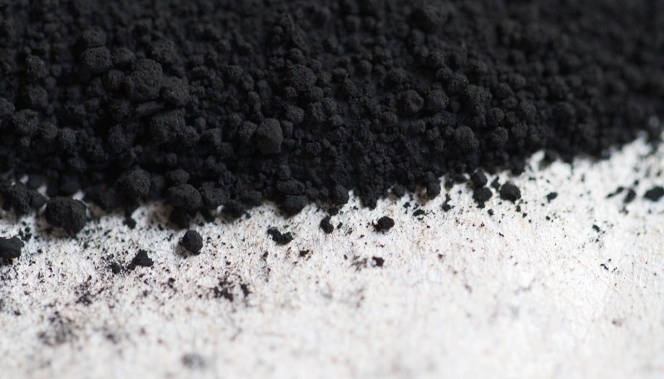
Recovered carbon black, derived from end-of-life tyres via pyrolysis, serves as a sustainable substitute for virgin carbon black in rubber and polymer applications. However, the emerging market has lacked the standardisation and independent verification that established supply chains provide. VericarbSM addresses this gap through independent material characterisation and rubber performance data, offering stakeholders a consistent basis for evaluating rCB products.
For producers, certification accelerates market entry and improves buyer approval rates. Consumers gain more capable suppliers and reduced evaluation time, while investors benefit from clearer volume sizing and fewer costly test failures. The programme is jointly administered by both organisations.
Erick Sharp, CEO, ACE Laboratories, said, “The rCB market has enormous potential, but growth has been held back by uncertainty about material quality and consistency. VericarbSM gives producers a way to prove their product and gives buyers the independent data they need to say yes.”
Dave Abdallah, Founder, Abdallah Consulting, said, “One key reason for the delayed growth of recovered carbon black is lack of product performance information in the customer’s language. ASTM standards are critical; in fact, most testing done in the process follows ASTM methods. But customers relate to a product better when its performance is shown in applications relevant to them. VericarbSM solves the language issue by showing verified rCB in terms of rubber performance while simultaneously adding credibility via third-party analysis and reporting.”
Zeon Establishes Kurashiki Subsidiary To Absorb Tohpe's Acrylic Rubber Business
- By TT News
- September 18, 2026
Zeon Corporation established Zeon Chemicals Kurashiki Co., Ltd. on 23 July 2026 to take over the acrylic rubber operations of fellow group firm Tohpe Corporation. The new entity, headquartered in Kurashiki City, Okayama Prefecture, is wholly owned by Zeon with paid-in capital of JPY 10 million and is led by representative Koji Minami.
On 21 August, Tohpe and the new subsidiary signed an absorption-type company split agreement, prompting Zeon to begin the procedures required under the Companies Act. Operations at the new company, focused on manufacturing and selling acrylic rubber and related activities, are scheduled to commence on 30 October 2026.
Acrylic rubber, known for its heat resistance, is used in automotive components including oil seals and hoses. The Zeon Group already maintains four production sites across Japan, United States and Thailand, forming a global supply network for the material.
The restructuring follows Zeon’s 11 May 2026 announcement that it would transfer Tohpe shares to NATOCO Co., Ltd. of Miyoshi City, Aichi Prefecture, as part of Tohpe’s paints business divestiture. Tohpe’s acrylic rubber operations, which complement Zeon’s Elastomers Business, will now be positioned as a key specialty rubber manufacturing site, with closer operational coordination intended to strengthen Group competitiveness and corporate value.

Comments (0)
ADD COMMENT