Trelleborg Tires Retains Crown As Brazil's Best Agriculture Tyre
- By TT News
- December 07, 2025
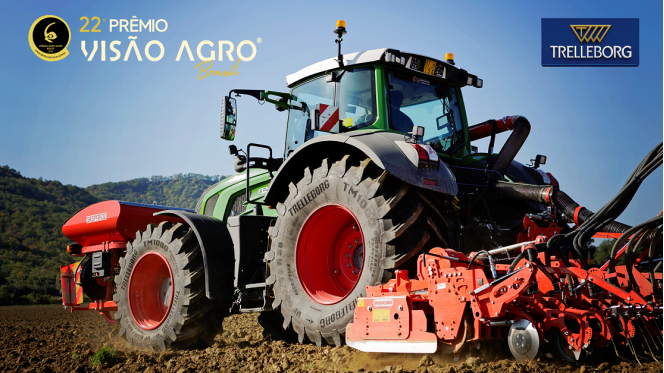
For the second consecutive year, Trelleborg Tires has earned the prestigious title of Best Agriculture Tyre at the 22nd Visão Agro Brazil Awards. This 2025 accolade, presented during a ceremony in Ribeirão Preto, highlights the company’s dedicated role in advancing Brazilian agribusiness through technological leadership and a commitment to sustainable practices. The award was received on behalf of the company by Fábio Metidieri, Agri Sales Director for Yokohama TWS Brasil.
Central to this achievement is Trelleborg’s ongoing innovation, particularly the expansion of its ProgressiveTraction technology within the TM tyre series. This engineering, featured in models from the row-crop TM600 to the high-horsepower TM1000, utilises a dual-edge lug design. The tread operates progressively on the soil to enhance traction, promote self-cleaning and minimise vibration. The resulting benefits include improved operational efficiency, increased tyre durability and superior soil protection, directly supporting farmers’ goals for greater productivity and environmental stewardship.
The company’s deep roots in Brazil, supported by a specialised local team, rigorous field testing and strong manufacturer partnerships, ensure its solutions are finely tuned to regional demands. This local infrastructure allows for responsive technical service and keeps product development closely connected to the practical challenges faced by the agricultural sector. The Visão Agro Brazil Awards, judged by a panel of industry executives and researchers, serve as a recognised benchmark for innovation and performance, making this recognition a significant testament to Trelleborg Tires’ impact on the country’s farming landscape.
Metidieri said, “Receiving this award at such a prestigious event once again reinforces our commitment to Brazilian agriculture. Our goal is to keep advancing in technology and field performance, ensuring that every Trelleborg tyre delivers real value – helping farmers operate more efficiently, sustainably and profitably. This award reflects the trust placed in our team and our products by professionals throughout the sector. It strengthens our commitment to delivering technologies that address local challenges and help shape the future of Brazilian farming.”
- Luc De Bruyne
- Department of Manufacturing and Innovation
- Eurofit
- ETRTO
- ISO
- ASTM
- JASO
- Michelin
- Continental
Why Tyre-Wheel Assembly Matters More Than You Think
- By Sharad Matade
- February 25, 2026
In an era of heavier vehicles, rising torque loads and ever-larger wheel diameters, the tyre-wheel assembly (TWA) has quietly become one of the most critical systems influencing vehicle safety, durability and perceived quality. Yet for most consumers, it remains entirely invisible. According to Luc De Bruyne, OEM tyre-wheel assembly R&D specialist in the Department of Manufacturing and Innovation at Eurofit, that invisibility is precisely why the industry underestimates its importance.
Based in Zaventem, Belgium, the company operates as a high-precision service supplier for tyre–wheel assembly, focused on passenger cars and light trucks in the European market. It runs a network of 16 factories, supported by around 900 employees, and delivers a full set of assembly and logistics services. With an annual capacity of roughly 20 million tyre–wheel assemblies, production is supplied to more than 25 OEM locations across Europe.
From an OEM perspective, De Bruyne argues that tyre-wheel assembly can no longer be treated as a simple fitment task. “Due to the increase of load and power transmission of the cars, a correct seating of the tyre bead is more sensitive. The increased bead tension can result in a damaged tyre during mounting, which isn’t visible at the outside. A damaged bead can result in leakages and low-pressure during driving, which is a high risk of a safety issue during high-speed driving. In other words, what appears externally acceptable may already be compromised internally,” he explains.
This growing complexity is not adequately addressed by existing standards. While ETRTO, ISO, ASTM and JASO regulate individual components, there is no global standard governing the assembled wheel. In practice, this means quality depends heavily on internal OEM processes. As De Bruyne notes, “A TWA assembler must mount the components together with no damages to the product and the lowest level of risk of vibration on the car.” To achieve this, Eurofit and its partners develop internal process references with machine suppliers, such as mountability and integrity tests used to qualify new wheels. When a non-OK status is detected, suppliers are informed, and if no solution is found, components may be replaced entirely.
The business is structured as a longstanding 50:50 joint venture between Michelin and Continental, established in 1996. This partnership combines the technological depth, quality standards and global experience of two of the world’s leading tyre manufacturers. The JV structure underpins strong process discipline, continuous improvement and long-term stability for OEM customers.
The technical challenge intensifies as wheel sizes increase and tyre profiles become lower. Larger diameters bring not only harsher ride characteristics but also tighter tolerances across mounting, uniformity and balancing. De Bruyne outlines a suite of measures now required for high-performance wheels: checking rim run-out and match points to filter supplier deviations; guiding the tyre bead diagonally to reduce mounting forces; matching components to lower total uniformity (TU) levels; optimising bead seat geometry; measuring complete wheel run-out to achieve what he calls the ‘perfect circle’ and correcting balance through final audit controls linked to vehicle sensitivity. The payoff is clear – less vibration of a wheel results in a longer lifetime of the tyres and suspension system of the car.
The contrast between OEM-assembled wheels and typical aftermarket replacements remains stark. In Europe, De Bruyne identifies two aftermarket models. The first involves high-volume industrial assembly of wheel kits – often winter packages – using processes similar to OEM plants. “We recommend to order wheels from such entity to receive an upper grade quality level compared with the garage machine assemblers,” he says. The second model is the small local tyre shop, where limitations are far more pronounced. These workshops often use grade 2 or 3 tyres rather than the grade 1 tyres supplied to OEMs, apply grease-based lubricants forbidden in Tier 1 environments, rely on manual mounting without force control, inflate tyres without proper bead seat techniques and balance wheels on single machines without controlling clamping-device influence. “The manual mounting approach can result in a higher risk of vibration/sound level of the wheels to the car/driver/passenger,” De Bruyne warns. For OEMs, the objective is clear: the first test drive of a new car must feel fundamentally different from that of a used one.
Electrification has further raised the stakes. Higher torque loads and quieter powertrains mean that any wheel-induced vibration is far more noticeable. “Observation of increase of torque load on cars results in increase of tyre bead tension,” De Bruyne explains, along with higher surface roughness requirements on rim bead edges. Assembly processes now demand stricter control of mounting forces and higher-energy inflation using inflator bells. After inflation, micro bead correction is required to ensure full contact and maximise friction. Lubrication, meanwhile, must leave no residual grease, as this could allow bead slip under extreme acceleration or braking.

Eurofit’s position as an industrial service provider rather than a component manufacturer reflects broader shifts in vehicle production. A generation ago, car manufacturers assembled most parts themselves. “Due to the increase of complexity and need of assembling volume and faster cycle time of cars, a lot of key-assembling activities are outsourced,” De Bruyne says. This has freed space within vehicle plants, increased model variants and created demand for specialist know-how. Tier 1 component suppliers now deliver globally to wheel assembly plants located close to OEMs, enabling just-in-time supply with greater flexibility.
Logistics has evolved accordingly. Classic JIT lines are increasingly supplemented – or replaced – by batch production, sequencing centres and high-bay warehouses. De Bruyne describes specialised processes that keep wheels sequenced all the way to the OEM, including racks and trailers with walking-floor systems for direct unloading. Over the past 20 years, the explosion in variants has driven major upgrades in logistics software and product traceability. Such systems require constant monitoring and rapid deviation management to avoid production stoppages at the customer.
Despite all this, wheel assembly remains largely invisible to consumers – at least for now. De Bruyne believes this may change as EVs become dominant. With fewer vibration sources from engines and transmissions, wheel-induced disturbances move ‘on the horizon’, particularly as XL tyres and extreme sizes – up to 25 inches – enter production. Some manufacturers, he notes, are already upgrading assembly specifications in response to negative customer feedback on ride performance.
Replicating OEM-level quality outside factory environments remains difficult. OEM assemblers must meet manufacturer-specific specifications that are neither public nor economically viable for most aftermarket operations. While some garage-machine suppliers now offer optional TU, run-out and matching functions, De Bruyne is blunt: accuracy, repeatability and production speed remain poor, and costs are high. Where large aftermarket organisations adopt industrial processes for volume reasons, conditions may resemble OEMs, but ‘the difference is the respect of process limits’, which are typically broader and not tied to a single vehicle programme.
Balancing tolerances illustrate the point. OEM plants may work to residual imbalances as low as two grammes, while many workshops accept eight to 15 grammes. Whether a driver notices depends on vehicle sensitivity, but the physics are unforgiving. “Imbalance vibrations can increase very fast when the speed is going up due to the exponential behaviour,” De Bruyne notes. Lower residual imbalance always reduces TU vibration risk.
Automation is transforming the assembly line, yet human expertise remains central. Practical assembler knowledge is increasingly embedded into software, statistical process controls, cameras, sensors and AI systems. “The key-knowledge is the teacher of such equipment and less the production operator on the line,” De Bruyne observes, underscoring a shift from manual skill to process intelligence.

Convincing OEM decision-makers to invest in this hidden discipline relies on data. Carmakers increasingly use market feedback tools, such as J.D. Power studies, tracking performance from delivery through the first year of ownership. This feedback drives Tier 1 suppliers to adjust processes in pursuit of customer satisfaction. Internal rejections between OEMs and wheel assemblers can also trigger upgrades, particularly when Tier 2 suppliers across global plants struggle with consistency. “Over the last 30 years, numerous additional optional processes have been introduced in the wheel assembly industry. While tyre shops may be aware of these processes, the high cost of the required equipment has often made it difficult to turn them into a viable business model,” De Bruyne concludes.
For an industry obsessed with powertrains, software and styling, tyre-wheel assembly may remain out of sight – but, as De Bruyne makes clear, it is increasingly central to how a vehicle feels, performs, and ultimately, how a brand is judged.
- Nokian Tyres
- Nokian Tyres Romania Factory
- LEED Gold Certification
- US Green Building Council
- Sustainability
Nokian Tyres’ Romania Factory Becomes World’s First LEED Gold-Certified Tyre Factory
- By TT News
- February 24, 2026
Nokian Tyres has achieved a significant global milestone as its new Romanian production facility becomes the first tyre factory in the world to be awarded LEED v4 Gold certification by the U.S. Green Building Council. This prestigious designation recognises the building's incorporation of extensive sustainable features, such as high energy efficiency, an advanced water management system and the use of on-site solar panels.
The LEED (Leadership in Energy and Environmental Design) framework is the foremost global rating system for sustainable construction. Certified buildings are distinguished by their reduced energy and water consumption, lower carbon emissions, minimised landfill waste and the creation of healthier indoor spaces for occupants. This accolade adds to a history of environmental leadership for Nokian Tyres; its US facility was previously the world's first tyre factory to receive LEED v4 Silver certification, and its on-site solar panels fully power the Gold-certified administration building there.
Having commenced tyre deliveries in March 2025, the Romanian plant is also notable as the world’s first full-scale tyre factory to operate with zero CO2 emissions from its direct operations. Furthermore, the company’s broader commitment to sustainability was acknowledged in 2025 when it was named one of the World’s Most Sustainable Companies by TIME Magazine.
Teppo Huovila, Vice President – Quality and Sustainability, Nokian Tyres, said, “Sustainability is not only about the products we create; it is also about the spaces where we create them. Earning the LEED certification reflects our commitment to reducing the environmental footprint of our operations while providing healthier, safer and more energy‑efficient workplaces for our employees.”
BKT Charts New Growth Trajectory With Entry Into India's Consumer Tyre Market
- By TT News
- February 24, 2026
Balkrishna Industries Limited (BKT Tires), already a dominant force in the Off-Highway Tyre (OHT) sector globally, has announced its strategic foray into India’s consumer tyre market. This significant expansion introduces the company’s On-Highway portfolio, marking a pivotal shift in its business trajectory. The initial product lineup is purpose-built for two-wheelers, encompassing both scooters and motorcycles, as well as Medium and Heavy Commercial Vehicles (M&HCV). This move underscores BKT’s long-term commitment to establishing a strong presence in India’s rapidly expanding consumer and replacement tyre segments. Accompanying the product launch is a new national brand campaign, ‘Elevate Your Drive’, fronted by brand ambassador Ranveer Singh, which heralds the beginning of the company’s journey as a consumer-facing brand.
To provide clarity for its evolving corporate structure, BKT has introduced a new brand architecture under its existing identity, ‘BKT – Growing Together’. This framework establishes two distinct verticals: BKT Tyres, which will encompass the company’s complete range from Off-Highway to the new On-Highway categories, and BKT Carbon, dedicated to its carbon black and industrial materials business. This dual-pillar approach reflects BKT’s transformation into a more integrated mobility enterprise.


The company’s entry into the consumer space is led by two new two-wheeler tyre lines, both manufactured in India. The BKT ZENOVA is engineered specifically for urban commuting, prioritising rider comfort, smooth handling and reliable grip. Complementing this is the BKT THYROS, designed for riders who encounter mixed terrain, offering enhanced control and confidence on both on-road and off-road surfaces. Developed with core consumer needs like comfort, safety and mileage in mind, the range has undergone rigorous validation. This includes design verification, durability trials and performance testing for braking and handling at the government’s NATRAX facility, ensuring they meet IATF 16949 standards and hold mandatory BIS certifications.
BKT’s expansion into the commercial on-road segment will follow with the introduction of its Medium & Heavy Commercial Vehicle Radial (MHCVR) tyres, slated for launch in the first quarter of FY2026-27. The initial offering will include the BKT m.Loadxpert and BKT Milexpert RG, tyres developed for demanding applications like cement transport and regional cargo logistics. Engineered for high stability and robust casing strength, each tyre undergoes over 138 in-process quality checks and more than 20 design verification tests in NABL-accredited labs. By meeting all BIS standards, the range emphasises reliability, long service life and retreadability, bringing industrial-grade validation to the commercial road sector.


The go-to-market strategy involves a phased rollout through BKT’s nationwide distributor and dealer network, beginning with key high-demand markets. Reinforcing its consumer-first approach, the company will support the new portfolio with an advanced digital platform designed for efficient service response and transparent complaint tracking. This initiative aims to set new standards in customer engagement and service responsiveness within the Indian mobility sector.
Underpinning this strategic expansion is a substantial investment commitment of INR 35 billion (approximately USD 400 million). These funds are earmarked for expanding manufacturing capacity, advancing research and development, supporting vertical integration through the BKT Carbon business and widening the distribution network. This investment is central to the company’s Vision 2030, which targets a consolidated revenue of approximately INR 230 billion by FY30. This future revenue mix is projected to comprise about 70 percent from its core Off-Highway tyre business, 20 percent from the newly entered On-Highway categories and 10 percent from third-party carbon black sales.
Arvind Poddar, Chairman & Managing Director, BKT, said, “Our entry into the on-highway segment is a natural extension of BKT’s purpose – to support India’s evolving mobility needs with products engineered for real world conditions. We are building on decades of manufacturing discipline to offer tyres that deliver safety, reliability and value. Guided by BKT – Growing Together, we aim to be a dependable partner for consumers, distributors and dealers.”
Rajiv Poddar, Joint Managing Director, BKT, said, “BKT’s foray into the on-highway tyre segment is a strategic milestone under our Vision 2030 – an India-led initiative to scale responsibly and expand our mobility footprint. Our approach balances ambition with discipline, where we aim to grow while protecting profitability and maintaining our engineering excellence. With a defined revenue roadmap of INR 23,000 crore (INR 230 billion) by 2030 – a 2.2x increase from FY25 levels, this measured growth, is built on clarity, capability and long-term commitment.”
Satish Sharma, Senior President and Director – Business Development and Strategy, BKT, said, “As we step into a new phase of growth, our focus remains unwavering on delivering durability, mileage, comfort and advanced performance across 2-Wheeler, Truck Bus Radial, Passenger and Light Truck categories, backed by deep customer insights and a commitment to product leadership. We are proud to pioneer industry first initiatives – whether it is pure distribution play ensuring wide reach with zero channel conflict, our ‘Journey Assistance Program’ for riders, or transformative programmes like ‘Save the Casing’ and market leading end user loyalty platforms. Our goal is clear – to achieve a five percent market share by FY30 through a disciplined, India-led strategy based on product leadership, distribution strength and consumer trust.”
Hankook Tyre UK Appoints Ho Seok Chea As New Managing Director
- By TT News
- February 23, 2026
Hankook Tyre UK has entered a new phase of its development with the appointment of Ho Seok Chea as its Managing Director, effective from the start of 2026. Based at the company's Daventry facility, he steps into the role equipped with significant international expertise and a robust foundation in sales and marketing.
Chea brings a deep understanding of the global tyre landscape to the UK operation, having dedicated his career to the Hankook organisation since 2005. His professional journey began within the original equipment division at the company's South Korean headquarters, where he cultivated a comprehensive grasp of the industry's commercial and technical intricacies. This initial experience laid the groundwork for a career marked by analytical rigour and technical insight.
His subsequent postings across various international markets have further enriched his perspective. By holding key positions at Hankook’s European hub, in United States and most recently in the Netherlands, he has gained first-hand exposure to the nuances of different regional markets. This diverse career path has endowed him with a truly global outlook, which he will now leverage to guide the company's strategy and growth within the United Kingdom.
Jongho Park, President and COO, Hankook Tire Europe, said, “Mr Chea brings extensive experience from his previous leadership roles at Hankook across Europe, North America and the Netherlands, along with a comprehensive understanding of the tyre industry and the unique characteristics for each market. His strategic expertise in sales and marketing will support the continued development and strengthening of our brand in the United Kingdom. We have full confidence in his leadership and are pleased to announce his appointment as Managing Director for the UK.”
Chea said, “I truly believe there is great potential ahead of us. With the dedication of the UK team and the strength of Hankook’s product portfolio, I am confident we can build on our successes and further expand our presence as a premium tyre manufacturer in the UK market. Together, we will continue to deliver innovation, quality and exceptional service to our customers. Through my previous roles, I have learned that sustainable growth comes from strong collaboration, open communication and a team built on trust and mutual support. I am excited to commence my new role in the UK and look forward to working with a talented team to achieve even greater success.”

Comments (0)
ADD COMMENT